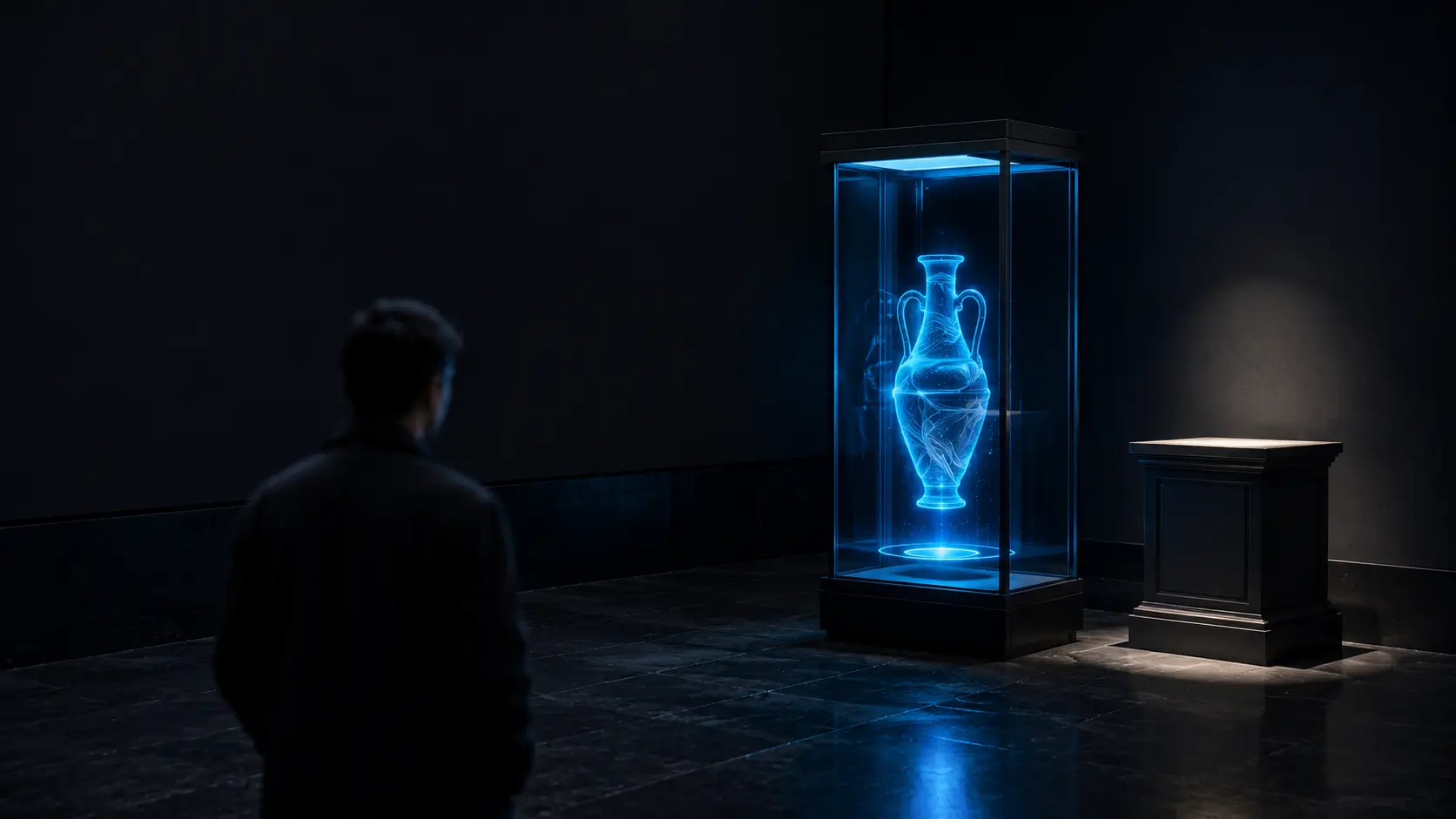
Science: How does holography work?
To understand why this technology is fascinating, we have to go back to physics. Unlike a conventional screen that only displays color pixels, holography captures the phase of the light.
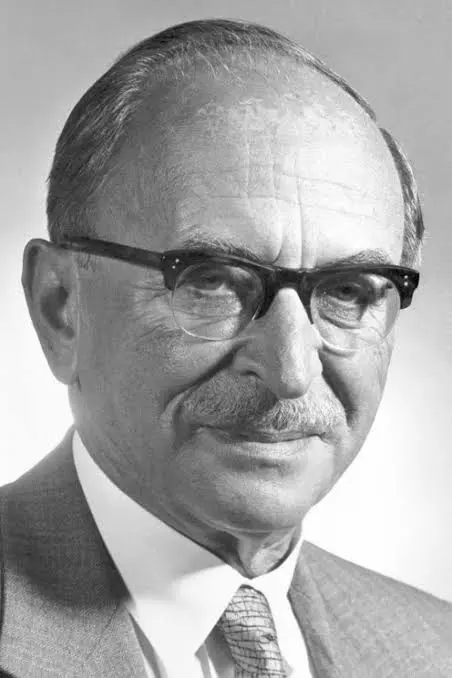
The inventor: Dennis Gabor (1948)
It all starts with the Hungarian physicist Dennis Gabor, who theorized the concept in 1948 (which won him the Nobel Prize in Physics in 1971). The scientific principle is based on Interference. To create a pure hologram, you divide a laser beam into two:
- The first ray hits the object.
- The second (reference radius) goes directly onto the sensitive plate.
- Their encounter creates a microscopic 3D “footprint”.
It is the historical method. But for modern business and communication, technology has evolved into brighter and more practical solutions.
The 2 dominant technologies today
Be careful not to mix everything up. On the current market, two techniques are competing. Google makes a good distinction between optical illusion and volumetric display.
Illusion through Reflection (“Pepper's Ghost”)
This is the technique used for concerts (Tupac, Dalida) or political meetings.
- Operation: A 2D image is projected onto a transparent film tilted at 45° on stage.
- The limit: It's just a reflection. You need total darkness and a good position in front of you for the illusion to work. It is very restrictive for a store.
.webp)
Volumetric Display (Holographic Propellers/POV)
It is modern technology, the one used by Holovisio. It does not affect the reflection, but the physiology of the eye.
- Operation (POV): Blades equipped with LEDs rotate at very high speed. The movement is so fast that the helix becomes invisible (Retinal Persistence). Only the light is left.
- The result: The image is generated directly in a vacuum, in front of the camera.
- Why it's better: It is extremely bright (visible in the window in the sun) and the 3D effect is striking because there is no window between you and the image.
Do you want to get concrete? Find out how our Holographic propellers use this POV technology to transform your windows.

Why use a hologram in 2026?
Beyond science, it is a powerful marketing tool. Neuroscience explains to us why:
- Breaking the Pattern: Our brain ignores TV screens (advertising blindness). The hologram, by its floating and new aspect, forces the brain to stop.
- Memorization: Information presented in volume is retained 4 to 5 times better than a flat image.
- Virality: It is the most shared medium on social networks by customers themselves (“Wow effect”).
The future is already here
The hologram went from Dennis Gabor's lab to your window. If you want to capture the attention of your customers with the most efficient technology of the moment, our experts are there to guide you.
Request a demo of our solutions
.webp)
FAQ: The most frequently asked questions about the hologram
What does hologram mean?
The word comes from the Greek Holos (“in full”) and Graphein (“write”). It literally means “message in full.” Unlike a photo that only captures one face (2D), a hologram contains all the information about the volume (3D) of the object, allowing it to be seen from different angles.
How is a hologram made?
Historically, a hologram is created by dividing a laser beam in two: one part illuminates the object and the other serves as a reference. Their encounter creates a 3D luminous imprint. Today, we also use holographic propellers (like at Holovisio) who rotate LED strips at high speed to recreate this 3D image by retinal persistence.
What is the difference between 3D and Hologram?
3D in cinema (stereoscopy) requires glasses to trick the brain. The hologram is visible to the naked eye (autostereoscopy) by everyone at the same time.
Can you touch a hologram?
No, because a hologram is composed of light (photons), which has no physical mass. You can put your hand through it. However, the image floats in front of the support (like our propellers), which gives a feeling of proximity much stronger than an image locked behind glass.
When was the hologram invented?
The principle was discovered in 1948 by the Hungarian physicist Dennis Gabor (which earned him the Nobel Prize in Physics in 1971). However, it was not until the invention of the laser in 1960 to produce the first truly visible holograms.
Are holograms real today?
Yes, but not always as in Star Wars. Holograms “without any support” (which float in the middle of the void without an emitter) do not yet exist. On the other hand, volumetric display technologies (LED propellers) and optical illusions (Phantom of Pepper) are very real and used daily in commerce and events.
Boost your ROI with holograms
Your goals, our solution, your results.