By Pierre Chabot, Holovisio
Holograms in education are 3D displays, such as HoloBox cases, holographic fans or mixed reality headsets, used to show a whole class an object, a process or a person that cannot be brought into the room. Research shows real benefits for spatial subjects like anatomy, but also clear limits: costs, content creation and mixed evidence on learning. This guide sets out where holograms help, what studies actually show, what they cost and when a screen or a VR headset does the job better.
What a hologram changes in a classroom
A hologram changes one thing above all: spatial understanding, shared by the whole group. Structures that flatten on a slide, a heart valve, a gear train inside a housing, a molecule's geometry, keep their depth when they float in 3D, rotate, open into layers and reassemble at the pace of the explanation.
The social side matters as much. A VR headset teaches one learner at a time; a hologram on a display is a shared object. A class and a teacher look at the same heart, point at the same valve and ask questions out loud. The teacher stays in charge, pausing and rotating the model, with the hologram as an instrument rather than the lesson itself.
It is also repeatable. A demonstration that used to be rare becomes a regular lesson, run the same way for every cohort from the same file. And a display with no headset means no hygiene rotation between students and full visibility, for the teacher, of where the class is looking.
Where holograms are used in education and training
Five settings account for most uses today.
- Medical and health education. Anatomy at life size, physiological processes in motion, procedures step by step. At the University of Central Florida, medical and physical therapy students observe life-size virtual patients displayed in large hologram boxes, which show subtle signs such as quivering hands, as reported by Inside Higher Ed on February 23, 2024.
- Engineering and vocational schools. Machines in cutaway, assemblies exploding into parts, processes animated end to end.
- Schools and science outreach. Cells, the solar system or historical reconstructions shown at large scale to a whole class.
- Remote lectures. A teacher or guest speaker beamed into a hologram box from another campus or country, an approach several universities are testing, according to the same Inside Higher Ed article.
- Corporate academies. Onboarding, safety and product training, with the same expert and the same 3D model in every training room.
What research actually shows
Research supports holograms for spatial learning, but the evidence is uneven and often concerns other technologies sold under the same name. Three publications are worth reading before you invest.
A randomised trial in anatomy. A study published in Scientific Reports on April 9, 2020 randomly assigned 52 second-year medical students to text only, 3D models on a 2D screen, or mixed reality with holograms shown in a headset. The mixed reality group did worse on naming questions right after the session, but retained both naming and spatial information better for at least a month. The authors note the small sample and threats to internal validity.
A large literature review. A review published in Multimodal Technologies and Interaction (2026, volume 10, article 118) synthesised 119 publications on holographic technologies in education. Its key warning: most studies labelled holographic actually use augmented or mixed reality headsets, or pseudo-holograms such as pyramids and LED fans, and results from one technology cannot be transferred to another. It reports, for example, a study with pupils aged 10 to 12 where pyramid projections increased motivation and enjoyment, with no significant difference in knowledge compared with videos.
The same review on barriers. It lists the cost of purchase and maintenance, the difficulty of creating content, sensitivity to ambient light and the lack of clear teaching models as the main obstacles. It also stresses that higher engagement reported by students does not prove better learning unless it is measured objectively.
Our reading: holograms are worth it for content that is spatial by nature and hard to show otherwise. They are not a general upgrade for every lesson.
Hologram, VR headset or screen: which one for which lesson?
Choose by the type of lesson, not by the technology. The literature review cited above describes holography as better suited to shared visualisation and discussion, and VR to simulation and procedural training, with the two used as complements.
| Lesson type | Best fit | Why |
|---|---|---|
| A spatial object discussed by the whole class | Hologram on a display (HoloBox, fan) | Shared view, no equipment for students |
| A procedure practised one learner at a time | VR headset | Full immersion, individual practice |
| Interaction with a 3D model in the real room | Mixed reality headset | Model placed in the learner's space |
| Text, diagrams, data, labels | Screen or projector | Cheaper, better for reading detail |
| A remote teacher or guest speaker | Hologram box with live feed | Life-size presence in the room |
VR has its own evidence. In a study on soft skills training, PwC found that its VR learners completed training four times faster than in the classroom. That is a VR result, for one type of training: it says nothing directly about holograms, and it should not be presented as if it did.

What it costs a school or a training centre
At Holovisio, a turnkey rental starts at around €2,000 excluding VAT, and buying a professional holographic fan costs €2,000 to €10,000 excluding VAT. Content comes on top and often matters most.
| Holovisio option | Budget, excl. VAT |
|---|---|
| Turnkey project: device, 3D content and installation | From around €2,000 |
| Rental of a holographic fan | €300 to €500 per day |
| Purchase of a professional fan | €2,000 to €10,000 |
| Rental of a HoloBox | €1,500 to €5,000 per event |
| Studio capture of a person | €3,000 to €10,000 |
For context, Inside Higher Ed reported that a desk-size 21.5-inch hologram screen from one vendor was listed at $6,900, and that some person-size hologram machines reportedly cost about $60,000. Prices vary widely by format and by vendor.
Two paths cover most cases. Hologram rental suits pilots, open days and single-semester programmes. A hologram purchase makes sense once a device is used every teaching day. The lasting asset is the 3D content, built with faculty by our 3D studio: a heart, a gearbox or a reconstruction can serve every cohort that studies it.
How to run a pilot that convinces a committee
Start small, measure objectively, then decide. Pick one course with spatial content. Rent a device for one term. Compare a cohort taught with the hologram and a cohort taught without it, using the same test, not only a satisfaction survey. Then write the deployment case with your own data.
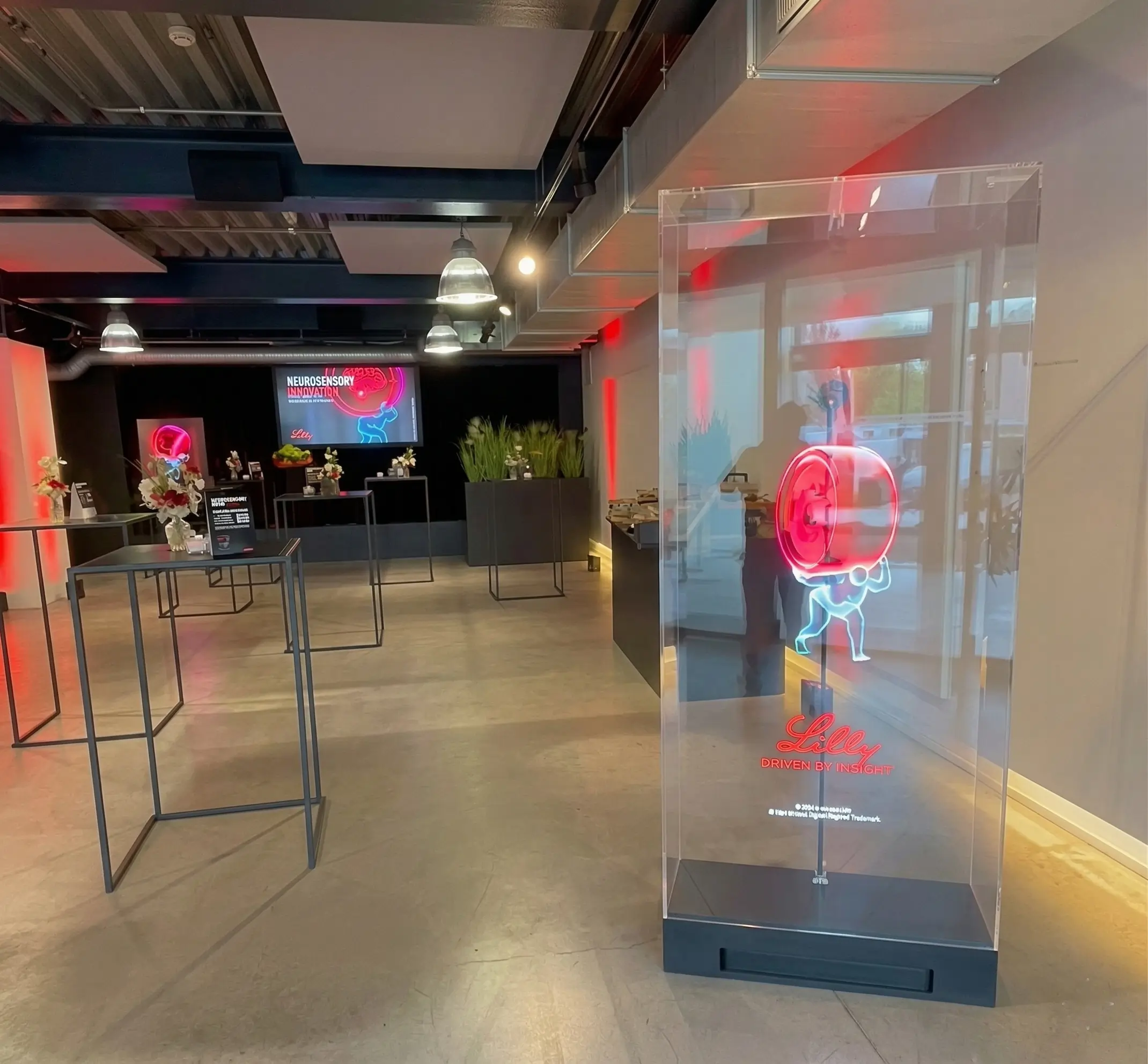
The device choice usually comes down to two formats. A HoloBox is a closed, glazed display that shows a person or a model up to life size and protects the hardware. A holographic fan is compact and cheaper, but must be kept out of reach. For a remote speaker, see our human hologram formats.
Plan the people side too. The 2026 literature review cited above lists teacher training and ongoing technical support among the conditions for adoption. In practice, name one teacher who owns the device, train them before the term starts, and agree who updates the content and who to call if the display fails before a lesson.
Our position
Holograms are a good tool for showing the whole class what cannot enter the room, especially in anatomy, engineering and science. They are not proof of better learning on their own, and the research says so. Choose them for spatial content, measure the result against a control group, and budget the content as seriously as the device. When the lesson is about reading or individual practice, a screen or a VR headset does the job better.
Holovisio is a holographic communication agency based in Orsay, France. We design turnkey holographic experiences for brands. We start from your objective to choose, among all holographic technologies, the most suitable device: holographic fan, HoloBox, projection, pyramid, transparent screen, among others. Our studio then creates the 3D content, and we handle delivery, installation and follow-up, for rental or purchase, for your trade shows, shop windows and events.
Planning a pilot? Let's talk about your project. For the basics of the technology, read our guide what is a hologram.
Frequently asked questions about holograms in education
Do holograms improve learning?
Sometimes, for spatial content. A randomised trial in anatomy found better retention after a month with mixed reality holograms, but worse immediate results on naming. A 2026 literature review warns that evidence is uneven and that engagement reported by students does not prove better learning.
What is the difference between a hologram and VR in education?
A hologram on a display is seen by the whole class without equipment, which suits shared explanation and discussion. A VR headset immerses one learner at a time in a virtual environment, which suits individual simulation and procedural practice. The two are complementary rather than competing.
How much does a hologram cost for a school?
At Holovisio, a turnkey rental starts at around €2,000 excluding VAT, a holographic fan rents for €300 to €500 per day and costs €2,000 to €10,000 to buy. A HoloBox rents for €1,500 to €5,000 per event. 3D content is budgeted separately.
Which subjects benefit most from holograms?
Subjects where shape and space matter: anatomy and medicine, engineering, chemistry, physics and some history reconstructions. For text-heavy subjects, data or detailed labels, a screen or a projector remains clearer and cheaper, according to the limits listed in recent research.
Can a teacher appear as a hologram in another classroom?
Yes. A teacher or guest speaker can be filmed and broadcast live into a hologram box in another room, campus or country. Several universities are testing this, including for co-teaching between campuses, and the speaker appears at life size in front of the class.
Can holograms be used for corporate training?
Yes. Corporate academies use them for onboarding, safety and product training, with the same 3D model or the same recorded expert in every training room. As in schools, they work best for content that is spatial or hard to show, combined with hands-on practice.
Who creates the 3D content for educational holograms?
Content is usually created by a specialised 3D studio, working with teachers to make sure the models are accurate. Research identifies content creation as one of the main obstacles for schools, so it should be planned and budgeted from the start of any project.
Pierre Chabot, Holovisio, the company behind hologramme.co.
Boost your ROI with holograms
Your goals, our solution, your results.