Between notifications, Emails and commercials, theconsumer attention Is ceaselessly Solicited. In this flow of information, the advertising at the point of sale is strategic to capture their attention, mark them, offer them a memorable experience. However, not all actions in stores are created equal: the choice between Traditional POS vs dynamic POS So is a stake decisive for marks and Retailers. Paper posters, kakemonos, stop-rays, digital screens, digital screens, animated content, interactive devices... Today, the question is no longer whether to do POS advertising, but What POS really generates value. Dynamic POS vs traditional POS: which offers the best return on investment in the short, medium and long term? We explain to you.
What is POS?
POS is all advertising devices used directly at the point of sale to influence the act of purchase. Its main objective is to influence buying behavior directly in stores. Advertising at the point of sale comes at a key moment, when the consumer is physically confronted with the offer. Unlike media advertising, POS acts in a context of immediate decision-making. Its effectiveness is based on visibility, understanding the message and the ability to trigger action. It is precisely on these points that the comparison between traditional and dynamic POS makes perfect sense.
What are the different forms of traditional POS?
The classic POS that we all know includes all the static physical supports used in stores:
- paper posters;
- rigid boards;
- stop-rays;
- kakemonos;
- cardboard or plastic displays.
It is historically rooted in retail strategies for a simple reason: it is easy to produce and deploy.
The advantages of traditional POS
Traditional POS seduces by its simplicity and its controlled unit cost. It requires no technical infrastructure, is not dependent on a connection, and can be installed quickly. For local, very specific operations or extremely simple messages, it sometimes remains relevant. In certain contexts (small businesses, very targeted promotions), it can still be adapted, but does it still have a lot of effect on the consumer?
The limits in terms of results
The main obstacle to traditional POS lies in its lack of measurable performance. Its message is fixed, non-evolving, and quickly drowned in a visually saturated environment. Once installed, it does not allow adjustment or optimization. Above all, it does not offer any concrete data on its real impact: it is impossible to know if it has been seen, understood or if it has influenced purchasing behavior. In a logic of return on investment, this lack of visibility becomes a major handicap.
The digitalization of the point of sale seems to be a response to these limits. According to LSA, the digital transformation of retail has become a strategic lever for capturing attention, enriching the customer experience and improving commercial performance. This evolution highlights why static solutions are quickly outdated and why dynamic POS is becoming essential.
Dynamic POS: a performance-oriented approach
What is dynamic POS?
Dynamic POS refers to all digital devices used at the point of sale to distribute scalable and measurable content. Unlike traditional POS, it makes it possible to broadcast evolving, contextualized and measurable messages.
Why does digital POS capture more attention?
Movement naturally attracts the eye. Animated, video or interactive content offers an important cognitive advantage by breaking the monotony of the customer journey. Dynamic POS makes it possible to explain a product in an educational way, to stage an offer, to adapt the message according to the time of day or the profile of the public, and to create a memorable and immersive experience.
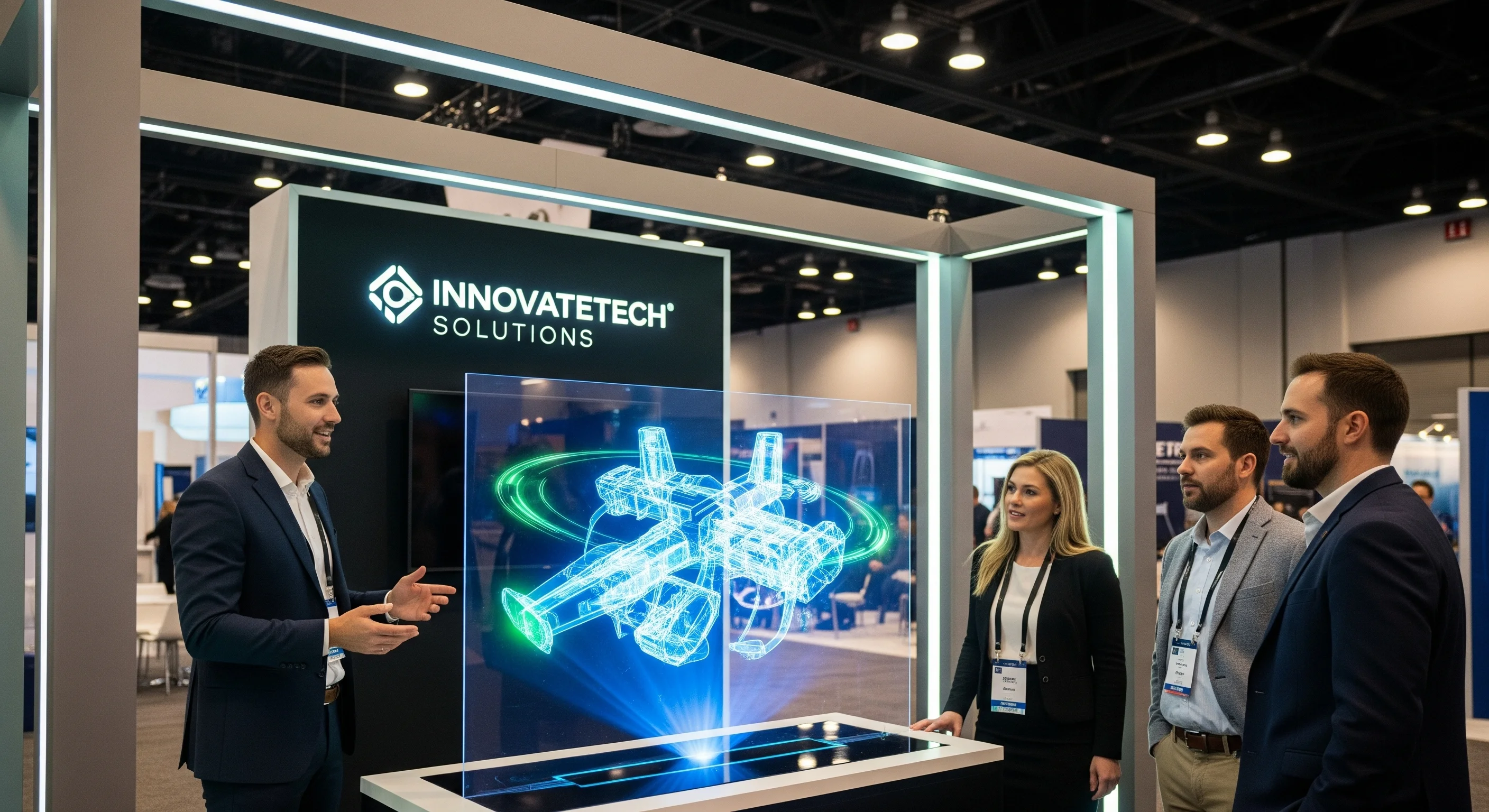
Holography: when POS becomes an immersive experience
Holographic solutions take impact and innovation to the next level. Holivisio develops devices capable of transforming retail spaces into real experiential media such as:
- LThe holographic propeller : it attracts the eye and highlights a product from all angles thanks to an immersive 3D effect;
- The Holographic pyramid : it is ideal for presenting a complete range or animated content in all directions.
- TheHolobox (or holographic booth): cabin equipped with a high definition screen, it gives the impression that a person or a product is physically present, offering a unique experience for the consumer.
- the Studio Holivisio : platform to easily create, manage and distribute all holographic content, at the point of sale or in telepresence.
These Holiviso devices combine visual impact, interactivity and measurability. They represent a real asset in maximizing the ROI of a dynamic POS.
Dynamic PLV vs traditional POS: ROI analysis
Initial cost vs total cost over 24 months
Traditional POS seems cheaper to buy, but this reading is misleading. A basic Holivisio device represents an investment of around €2,200, to which is added the creation of 3D content, generally between €600 and €900. At first glance, this cost may seem high compared to paper media. However, over a projection of 24 months, or around eight campaigns, the gap narrows considerably.
Comparable ROI, significantly better performance
Digital content is reusable, adaptable and does not require reprinting. Where traditional POS involves recurring costs for each campaign, dynamic POS makes it possible to smooth the investment over time. Over a period of 24 months, the overall cost is gradually balanced with that of traditional POS. On the other hand, the performances observed are not comparable. Indeed, Holivisio devices offer a higher downtime rate, a more sustainable commitment and the possibility of collecting usable data.
With an equivalent budget, the company thus has a tool that is more flexible, more measurable and capable of evolving without changing support. Especially since the equipment can be offered by lease, an option that Holivisio makes available to its French customers to optimize budget management.
Impact on sales
Digital POS acts at several levels: it makes the offer more attractive, interactive and intuitive, promotes the increase in the average basket and positively influences additional sales.
→ Important point: a recent study shows that 70% of consumers feel more engaged with digital POS than static media, and that this type of display can increase in-store conversions by up to 33%.
Traditional POS, which is more discreet, struggles to generate this cumulative effect.
Performance measurement
This is where the difference is most significant. Dynamic POS makes it possible to analyze interactions, compare the performance of messages, and adjust the strategy in real time.
Traditional POS, on the other hand, remains blind to its real effectiveness.
In which cases does traditional POS remain relevant?
Despite its limitations, traditional POS is not obsolete. It remains relevant for very specific operations, in poorly digitized environments, when the message is simple and unique, and in addition to dynamic POS. The challenge is therefore not always to choose one or the other, but sometimes to combine them intelligently.
Dynamic POS and customer experience: an image challenge
Beyond numbers, dynamic POS plays a decisive role in brand perception. It conveys a differentiating image, better captures attention, as noted by 84% of consumers, and is distinguished by its originality.
In a context where many brands are competing, digital POS therefore has a strong impact. As pointed out deloitte In a detailed report, technologies that improve the store experience, personalization and operational efficiency are among the main areas of investment for retailers to remain competitive in a market undergoing profound transformation.
As retail is constantly evolving, investing in point-of-sale advertising capable of adapting and performing over time, in particular thanks to innovative holographic solutions such as those from Holovisio, is no longer a luxury, but a strategic choice.
FAQ — dynamic POS vs traditional POS: what is the best option?
Is dynamic POS profitable for all types of stores?
Yes, dynamic POS is profitable for the majority of points of sale as long as the messages change regularly. It is particularly effective in stores offering multiple promotions, launches, or product rotations, as it allows content to be adapted without reprinting.
Do you need a lot of content to make dynamic POS profitable?
No, a few well-designed contents are enough to make dynamic POS profitable. The main thing is to produce strategic messages, which are regularly updated, rather than multiplying creations.
What indicators can be used to assess the ROI of a dynamic POS?
The ROI of a dynamic POS is measured via the stop rate, the exposure time, the evolution of sales, the average basket and the conversion rate. This data allows campaigns to be adjusted in real time.
Can a dynamic POS be developed without changing hardware?
Yes, a dynamic POS allows content to be modified remotely without replacing physical media. This flexibility reduces costs and extends the life of the device.
Is dynamic POS likely to tire customers?
No, if it is used appropriately. A well-thought-out dynamic POS remains contextualized, fluid and integrated into the customer journey, without over-solicitation.
What holographic devices can complement a dynamic POS?
Holographic devices such as the propeller, the pyramid or the Holobox reinforce the visual impact of a dynamic POS. They make it possible to create immersive experiences, increase attention and enhance the innovative image of the brand.
Sources: