What is a hologram? Definition, operation and uses
Full Guide • 8 min read • Updated on April 16, 2026
Written by Pierre CHABOT Of the team Holovisio, French leader in holographic projection since 2020.
One Hologram Is a Three-dimensional image Projected into Space, Visible to the Naked Eye Without Glasses or Helmets. Scientifically, it is created by the interference of Laser Beams Recording the Volume of an Object. In events, it refers to 3D Optical Illusions generated by LED propellers, pyramids or holoboxes.
Definition of a Hologram
A hologram is a three-dimensional image obtained by recording the interference between two coherent light beams, generally coming from a laser. It recreates the volume, depth, and angles of a real object, without glasses or headphones. By extension, the term now refers to 3D projections visible to the naked eye (LED Helix, Holographic Pyramid, Pepper Ghost, Holobox).
In short
- Inventor: Dennis Gabor, 1948 (Nobel Prize in Physics 1971)
- 5 modern technologies: Holographic propeller, pyramid, holobox, holobox, scenic projection, laser hologram
- Main uses in 2026: retail, event, museum, real estate, real estate, medical, security
- Indicative budget: from 2,500€ (short rental) to 100,000€ (installation stage)
What exactly is a hologram?
A Hologram is a Three-dimensional image Which gives the illusion that an object is floating in space, visible from different angles and observable with the naked eye. Unlike traditional photography that only records light intensity, a hologram captures Both amplitude and phase Light, which allows it to faithfully reproduce the spatial structure of an object.
Etymology: Where does the word “hologram” come from?
The term comes from ancient Greek: Holos (λrosa) means “whole, complete” and Gramma (gamaremuμα) means “letter, writing.” So literally, a hologram is a “Write in full”, as opposed to photography, which only records part of the light information (the intensity). The word appeared in French in the 1970s, In the Wake of the Work of Dennis Gabor.
Scientific Hologram vs “Mainstream” Hologram
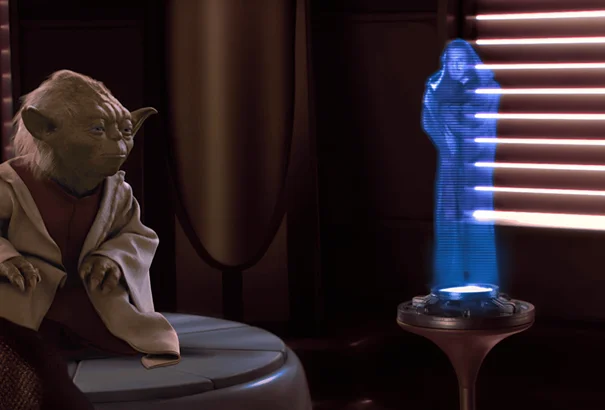
In popular culture, the word “hologram” refers to any floating 3D projection Star Wars, Blade Runner gold Iron Man. These free images in the air, visible at 360° and totally realistic, do not yet exist. Physics forbids it: all light needs a support to be visible.
What the industry now calls a “hologram” in events or retail corresponds to Holographic Illusions created by various media: rapidly rotating LED propellers, windows tilted at 45° (Pepper's ghost), transparent canvases, volumetric screens. The rendering is impressive, but scientifically, they are optical illusions and not holograms in the strict sense.
This distinction is important: a hologram Lato Sensu (commercial use) is fully operational and measurable in terms of marketing impact. A Hologram Strictly sensu (laser interference on photosensitive media) remains confined to laboratories, security (bank notes, passports) and a few artistic installations.
How does a hologram work? The Physical Principle
The functioning of a hologram is based on the phenomenon ofLight Interference. A laser beam is separated in two:
- The reference beam It feels directly onto a photosensitive plate.
- The Object Beam Lights up the object to be holographed and is reflected on this same plate.
When the Two Waves Meet, They Create a Interference Figure microscopic, unique to each object, recorded on the plate. Once this plate is illuminated again by an identical beam, the three-dimensional image of the object is reconstituted in space.
Why a laser?
The laser is essential because it produces light Monochromatic (only one wavelength) and Coherent (all waves are in phase). Without these two properties, interference would be garbled and no 3D information could be encoded. For this reason, holography was only able to take off after the invention of the laser in 1960.
And for “modern” holograms?
The holograms used in events and retail are not based on laser interference, but on other optical principles:
- Retinal persistence for holographic propellers (LEDs rotate so fast that the eye recreates a stable image in the air)
- 45° Reflection For the Pyramid and the Ghost of Pepper
- Rear projection on a transparent surface For Stage Projection and Holoboxes
Each technology creates its own illusion, adapted to a specific use. We detail all of this below in the comparison table.
.webp)
Who Invented the Hologram? Full chronology
The history of the hologram spans more than a century, between visionary fiction and major scientific discoveries.
Initially, Dennis Gabor sought to improve the resolution of electron microscopes. His Idea to Record The Full Wave of Light Rather than its intensity alone was going to open up a technological field that he would never have imagined.
What are the different types of holograms?
It Exists Today 5 Major Families of holographic technologies, each with its strengths, constraints and budget.
The Holographic Propeller: The Star of POS
The holographic helix diffuses an image thanks to rapidly rotating LED bars. The human eye, unable to keep up with this speed, sees a stable image floating in the air. It is the most technology Accessible and the most visible in retail : compact, easy to install, compatible with video content and perfect for drive-to-store.
You can even combine several propellers to create a Holographic Wall Giant of several meters, ideal for trade shows and large-scale events.
The Holographic Pyramid: a 360° vision
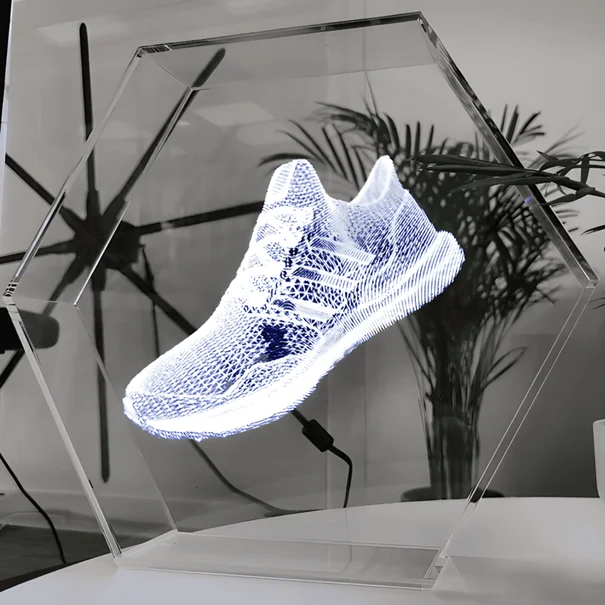
Direct yesterday to Pepper's Ghost (optical illusion invented in 1862), the holographic pyramid uses a window tilted at 45° to reflect a video broadcast under or above. The Image Seems to Float in the Center of the Pyramid and Can Be Observed On 270° or 360°, which makes it the preferred solution for presenting a product (bottle, sneaker, model car) in a window or in store.
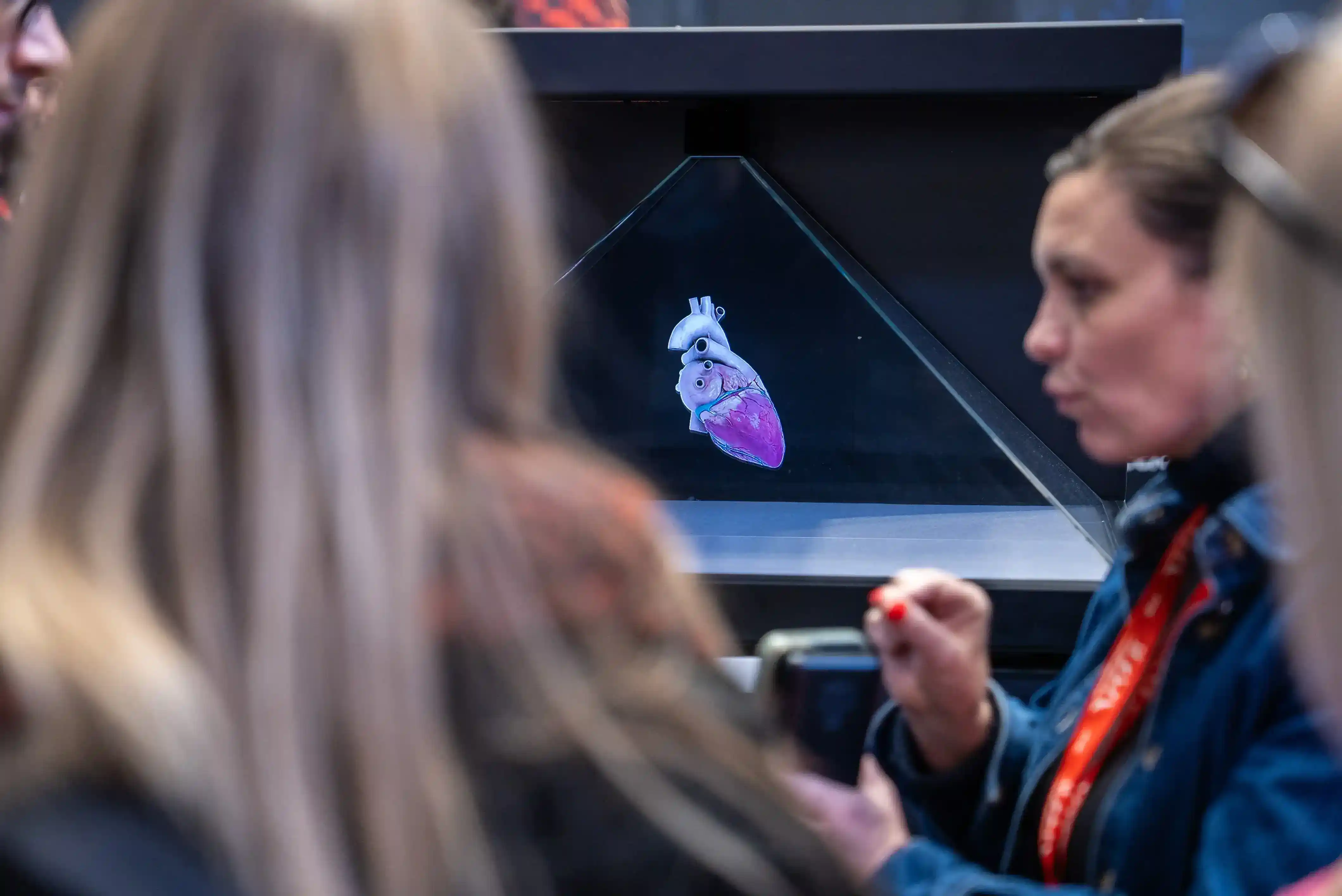
The Holobox: The Life-Size Human Hologram
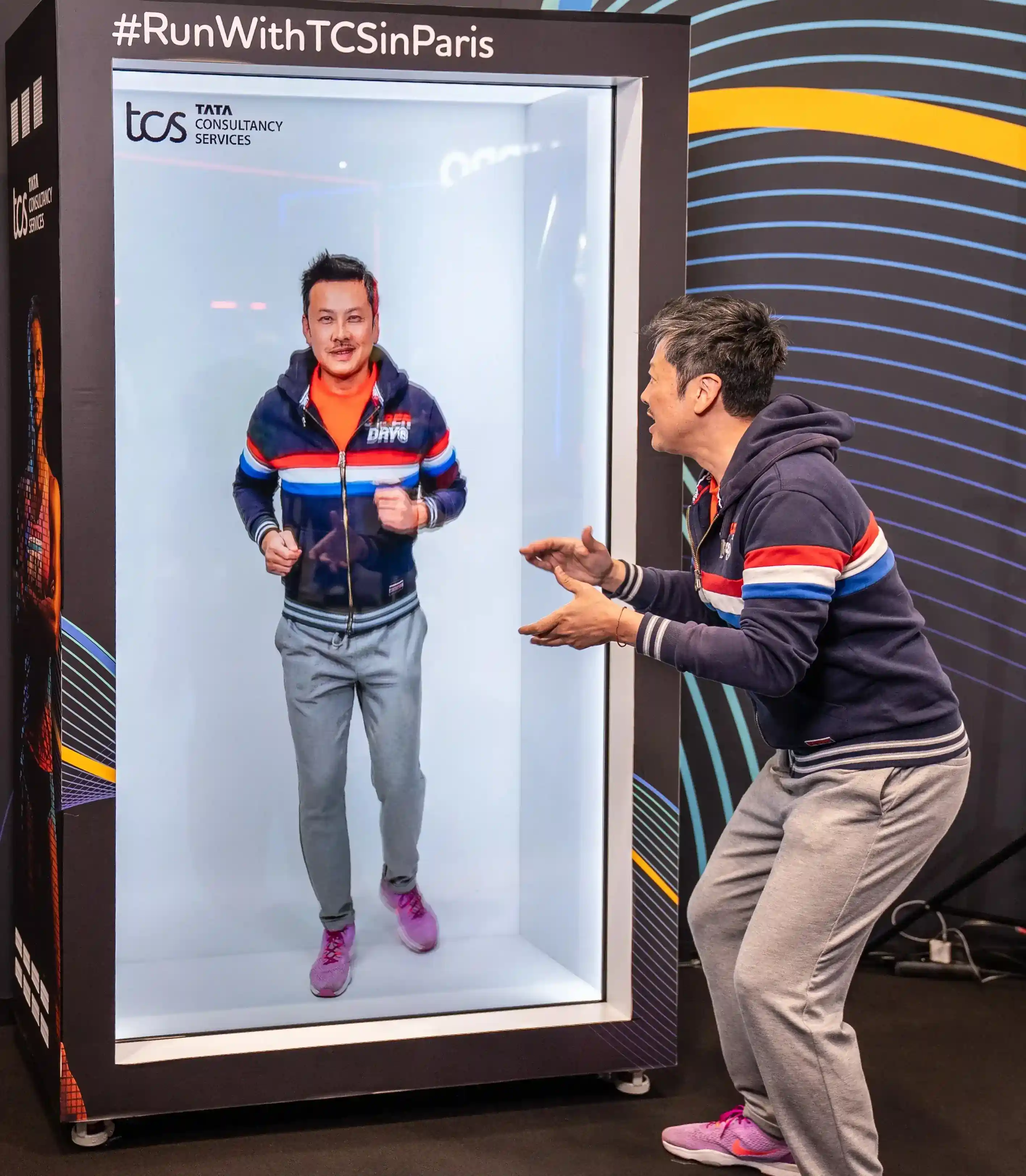
The Holobox is a Glass Cabin In which a speaker, avatar, or product appears in 4K, at full size. It is particularly popular for conferences, product launches, telepresence, and high-end event booths. It is also the technology that comes closest to rendering Star Wars In the commercial imaginary.
Stage projection: for big stages
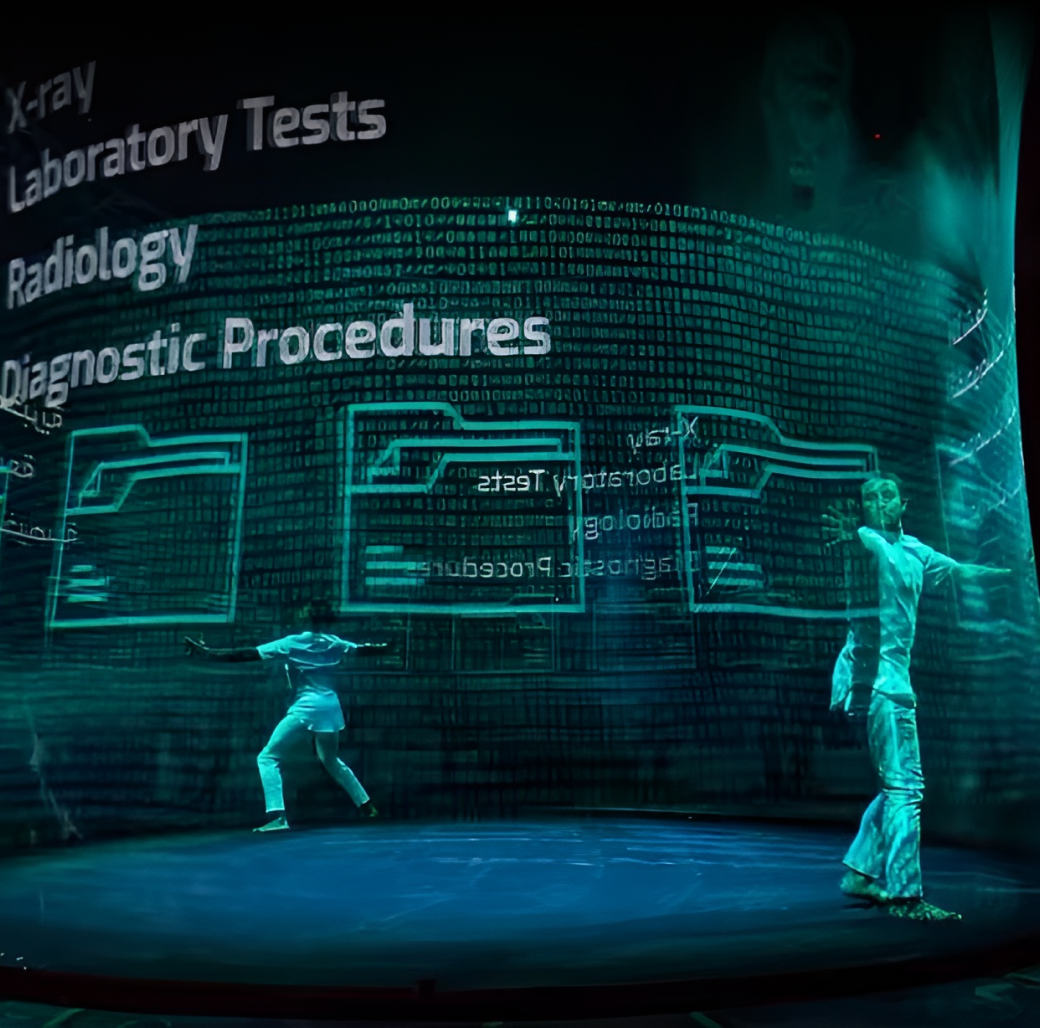
When the stage lasts several meters (concert, meeting, opera), we use a Ultra-Powerful Video Projector coupled with a transparent canvas (tulle, holographic film). It is this technique that made it possible to have Tupac, Michael Jackson, or more recently ABBA “resurrect” on stage. It requires a sharp technical set-up but creates an incomparable scenographic impact.
The Laser Hologram: Pure Scientific Technology
Finally, the hologram in the strict scientific sense, recorded on a photosensitive plate via laser interference, remains used in niche fields: Authentication and Anti-Counterfeiting (optical embossing on bills, passports, bank cards), Holographic Data Storage And 3D medical imaging.
Hologram vs virtual reality vs augmented reality: what's the difference?
These three technologies are often confused. Here are their fundamental differences:
In practice, The Hologram is the only one of these three technologies to offer a collective experience without equipment. That's what makes it such a powerful communication and marketing tool: you don't need to equip your visitors, they just need to pass by to experience the effect.
What is the purpose of a hologram? Use cases in 2026
Long Confined to Science Fiction, Holography is Now Emerging as a A lever for communication and differentiation in many sectors.
Retail and point of sale advertising (POS)
It is the most spectacular use. Holographic Propellers and 3D Windows Installed in Stores or on a Stand Catch the Eye By far, increase the memory rate of a product and digitize the customer experience without glasses or headphones. They transform an innocent passage into a memorable moment and generate a Passive Traffic (drive-to-store) measurable. See our retail case study.
Events and Trade Shows
We have a living room, 80% of visitors pass by a stand without stopping. A hologram constantly changes this equation: it creates a visual breaking point that draws audiences from afar, triggers conversation, and extends the time spent on the stand. It's one of the best ROI in B2B lead generation right now.
Museums, Heritage and Culture
Museums are adopting holography to Reconstructing missing pieces, bringing digital works to life or allowing contactless interaction. It is a solution that is both educational, secure and highly scenographic, used by the Louvre, the Museum of Man or even the Cité des Sciences.
Real Estate and Architecture
Promoters use holographic showcases to present their projects in the form of Animated 3D mockups, visible from all angles. On a living room like the SIMI, this makes it possible to implement a real estate program that still only exists on plan.
Medical and 3D imaging
Surgeons are now using holographic projections to Visualize organs in relief or complex transaction plan. The accuracy offered greatly improved that of conventional 2D scanners, which reduces operational risks.
Security and Authentication
The most widespread use on a daily basis, often invisible: Security Holograms (optical embossing) protect banknotes, passports, bank cards and pharmaceutical packaging against counterfeiting, thanks to optical properties that are impossible to photocopy.
How much does a hologram cost?
The price of a hologram varies according to Four Criteria : the technology chosen, the size of the device, the duration (rental or purchase), and the 3D content to be produced.
At Holovisio, we offer turnkey solutions including hardware, 3D content, installation, and technical support. Each project is subject to a prior audit to size the most relevant solution. Request a personalized quote.
How do you make a hologram yourself?
There are two very different approaches depending on the objective.
The DIY mini-hologram with smartphone (5 minutes)
For a home demonstration, you can make a small holographic pyramid out of a CD case or transparent sheet :
- Cut 4 identical trapezoids (1 cm x 3.5 cm x 6 cm)
- Assemble Them Into an Inverted Pyramid with Duct Tape
- Place the pyramid in the center of your smartphone screen
- Start a video in “pyramid hologram” format (many available on YouTube)
- The Image Seems to Be Floating in the Center of the Pyramid
This is impressive in demonstration, but very limited: small image, requires darkness and low light.
The Creation of a Professional Hologram
For event or retail use, the approach is very different:
- Define the objective (POS, exhibition, conference, museum...)
- Choosing Technology adapted (helix, pyramid, holobox, projection)
- Produce 3D content (modeling, animation, optimization for support)
- Install and install The device (lighting, height, view distance)
- Measuring the impact (traffic, engagement, leads)
Our team of Holovisio 3D designers supports brands throughout this process, from idea to deployment.
The Future of the Hologram: Trends 2026-2030
Holography is experiencing an increasing acceleration, driven by four converging dynamics.
1. Miniaturization and cost reduction
LED, optical, and processor components are getting more efficient and cheaper every year. Result: entry-level holographic propellers at less than €2,500, accessible to SMEs, independent businesses and event agencies.
2. Convergence with 3D generative AI
Creating holographic content required several days of 3D modeling yesterday. Today, generative AI tools make it possible to produce 4K animated avatars or photorealistic 3D products in a few hours. AI democratizes access to content, and therefore to technology.
3. Holographic Telepresence
Solutions like Google Project Starline Or Portl already makes it possible to teleport an interlocutor in the form of a hologram to a cabin at the other end of the world. By 2028, holographic video conferencing will be a serious alternative to business travel.
4. Convergence with Mixed Reality
With the Arrival of Helmets Like Apple Vision Pro And the screens Light Field (Looking Glass, Leia Inc.), the border between hologram, AR and VR is being erased. We Are Now Talking About “spatial computing” : a spatial 3D visual experience, accessible by all channels simultaneously.
The Hologram Is No Longer a Futuristic Gadget: It is a New Immersive Media in the process of establishing itself in communication, commerce and culture.
Hologram FAQs
What is a hologram?
A hologram is a three-dimensional image obtained by recording the interference between two coherent light beams (laser). Unlike a conventional photo, it records both the amplitude and the phase of light, which makes it possible to faithfully reproduce the 3D structure of an object, visible to the naked eye.
Who Invented the Hologram?
The Hologram Was Invented In 1948 by Dennis Gabor, a Hungarian physicist who was then working on improving electron microscopy. He received the Nobel Prize in Physics in 1971 for this discovery. The invention of the laser in 1960 then made it possible to make holograms clear and usable.
How does a hologram work technically?
The principle is based on Light Interference. A laser beam is separated into two: a reference beam sent directly to a photosensitive plate, and an object beam that is reflected on the object before reaching the plate. The encounter of the two waves creates a microscopic imprint which, when illuminated again, restores the 3D image of the object.
Do you need glasses to see a hologram?
No This is precisely what distinguishes the hologram from virtual reality or 3D cinema. A hologram is projected into physical space and visible directly to the naked eye, by several people simultaneously, without any equipment.
What is the difference between a hologram and virtual reality?
The Hologram Projects a 3D Image In the real environment, without equipment, visible by several people at the same time. Virtual reality, on the other hand, isolates the user in a world 100% digital via headphones. The hologram brings the virtual into the real; VR takes the user into the virtual.
Is the Tupac or Mélenchon hologram a “real” hologram?
No, scientist. These famous apparitions use a 19th-century optical illusion technique called Pepper's Ghost : a 2D image projected onto a transparent film tilted at 45°. The General Public Talks About Holograms for Convenience, But Specialists Talk About Holographic projection.
How much does a hologram cost for a business?
A Professional Hologram Costs Between €2,500 (short-term rental of a holographic propeller) And More Than €100,000 for a complete stage installation. The ranges vary depending on the technology, size, duration, and the 3D content to be produced.
What is the purpose of a hologram?
In 2026, holograms are used mainly for POS and retail (window, stand, shop), The event (trade show, conference, product launch), The museums, Real Estate (3D models), The medical (surgical 3D imaging) and the Security (tickets, passports).
Can you make a hologram at home?
Yes, for a fun demonstration: all you have to do is make a small transparent pyramid placed on the screen of a smartphone and broadcast a video in hologram format. The result is limited (small image, not very bright) but very educational. For professional use, it is necessary to use a dedicated technology (propeller, holobox, projection).
How do you recognize a hologram?
A hologram can be recognized by its depth effect and how the perspective of the image changes depending on the angle of view. Unlike a simple 2D projection, it gives the impression that the object is actually floating in the air or moving in volume.
Will the hologram replace video conferencing?
In the long run, probably yes for some high-end uses. Solutions like Google Project Starline or telepresence holoboxes already make it possible to teleport an interlocutor at real size, in 4K, with direct visual contact. By 2028-2030, holographic video conferencing will be a serious alternative to business travel for strategic meetings.
Conclusion: the hologram, a medium in its own right
The hologram left the field of science fiction to become a true immersive media, at the service of communication, commerce, culture and medicine. Whether it's a holographic propeller in a window, a holobox in a conference, or a stage projection for a major event, it offers something that few technologies can claim: capture collective attention, without equipment, with a strong and measurable emotional effect.
In a world saturated with flat images and ephemeral content, the hologram reintroduces dimension, literally. He doesn't just inform, he does To feel. And it is precisely this ability to transform a message into an experience that makes it one of the most powerful communication levers of the decade.
Are you considering integrating holography into your retail, event or corporate strategy? Let's talk about your project, our teams cover paris, lyons, geneva, luxemburg and Dubai.
Boost your ROI with holograms
Your goals, our solution, your results.