

By Pierre Chabot, Holovisio
A hologram is a three-dimensional image recorded by the interference of two beams of coherent light, which rebuilds the depth of an object and can be seen with the naked eye from several angles. In a shop window, on a trade show stand or on stage, the same word describes optical illusions such as LED fans, pyramids, HoloBox cases and projection on film, and this guide explains how each one works, what it costs and when it is not worth your budget.
What exactly is a hologram?
A hologram records all of the light information coming from an object, not only its intensity as a photograph does. Encyclopaedia Britannica defines holography as a method of recording or reproducing a three-dimensional image by means of an interference pattern produced with a laser beam.
The word comes from the Greek holos, "whole", and gramma, "writing". A hologram is literally a complete record of light: it keeps both the amplitude and the phase of the light waves, which is what allows depth to be reconstructed. Move your head in front of a true hologram and the perspective shifts, something no flat image does, however realistic.
Holovisio is a holographic communication agency based in Orsay, France. We design turnkey holographic experiences for brands. We start from your objective to choose, among all holographic technologies, the most suitable device: holographic fan, HoloBox, projection, pyramid, transparent screen, among others. Our studio then creates the 3D content, and we handle delivery, installation and follow-up, for rental or purchase, for your trade shows, shop windows and events. We sell these devices: that is exactly why this guide also tells you when they are useless.
Scientific hologram vs commercial hologram: what is the difference?
Almost everything sold as a hologram in marketing is an optical illusion, not a hologram in the physical sense. That is not a flaw: it is what makes the technology bright, animated and usable outside a laboratory.
The floating image visible from every side in open air, the one from Star Wars or Iron Man, does not exist. Light needs a medium to reach the eye: a plate, a pane of glass, spinning LEDs, a transparent film.
| Hologram in the strict sense | Hologram in the commercial sense | |
|---|---|---|
| Principle | Interference of coherent light recorded on a photosensitive medium | Persistence of vision, reflection on tilted glass, projection on a transparent surface |
| Image | Static, usually small | Animated video, from countertop size to several meters |
| Uses | Banknotes, passports, bank cards, research, imaging | Shop windows, trade show stands, congresses, concerts, museums |
| Editable content | No | Yes, like a video file |
For a marketing director, the right question is therefore not "is it a real hologram?" but "which illusion serves my objective, in my venue, at my viewing distance?". If you are preparing a trade show, a window or a congress, we will tell you which format fits and what it costs: ask for a detailed quote.
Can you touch a hologram?
No: a hologram is made of light, so your hand goes straight through it. Light offers no resistance, whether it comes from a laser-recorded plate, a reflection on glass or a spinning LED fan. Some research prototypes add a feeling of touch with ultrasound or air jets, but no commercial display you can rent today does that.
On a holographic fan, never bring your hand close, because the blades spin very fast. That is why fans sit under a cover or out of reach on a stand. If you want visitors to interact, the interaction goes through a tablet, a touch screen or a motion sensor placed next to the image.
How does a hologram work?
A scientific hologram relies on light interference. A laser beam is split in two:
- the reference beam travels straight to a photosensitive plate;
- the object beam lights the object, which sends it back to the same plate;
- where the two waves meet, they record a microscopic interference pattern unique to that object;
- lit later by an identical beam, the plate reconstructs the image in relief, in space.
Why does it take a laser?
Because interference requires light that is monochromatic, a single wavelength, and coherent, with waves in phase. Dennis Gabor carried out the first holography experiments in 1948, according to his biography published by the Nobel Foundation, while trying to improve the electron microscope. Optical holography only really succeeded after the invention of the laser. Gabor received the 1971 Nobel Prize in Physics "for his invention and development of the holographic method".
And the holograms used at events?
- Persistence of vision for the holographic fan: LED bars spin so fast that the eye no longer sees the blades, only the image, which seems to float in empty space.
- Reflection on tilted glass for the pyramid and Pepper's Ghost, an old stage illusion.
- Projection on a transparent surface for the HoloBox and stage projection.
Two key dates
| Year | Milestone | Source |
|---|---|---|
| 1948 | Dennis Gabor carries out the first holography experiments, then called wavefront reconstruction | Nobel Foundation |
| 1971 | Dennis Gabor receives the Nobel Prize in Physics "for his invention and development of the holographic method" | Nobel Foundation |

What are the different types of holograms?
Four technologies serve brand communication; the fifth, the laser hologram, stays in security and research. Each one answers a constraint of venue, viewing distance and ambient light.
| Technology | Principle | Ambient light | Typical use | Indicative rental, excl. VAT |
|---|---|---|---|---|
| Holographic fan | Spinning LEDs | Handles a shop window in daytime | Window, POS, trade show | €300 to €500 per day |
| Holographic pyramid | Reflection on tilted faces | Needs controlled lighting | Showroom, museum, counter | On quote |
| HoloBox | Closed case, 4K image | Good, the cabin shields the image | Conference, premium stand | €1,500 to €5,000 per event |
| Holographic projection | Projection on transparent film | Dark room required | Concert, keynote, rally | €15,000 to €80,000 and more |
| Laser hologram | Interference on a photosensitive medium | Not applicable | Security, research | Outside the event market |
The holographic fan, the most common format in retail
Compact, it sits in a window, on a counter or high on a stand, and plays 3D videos prepared for it. It stays readable in a shop window in daytime, which no pyramid can do. Several synchronized fans form a holographic wall several meters wide. The technical detail is in our article on how holographic fans work.

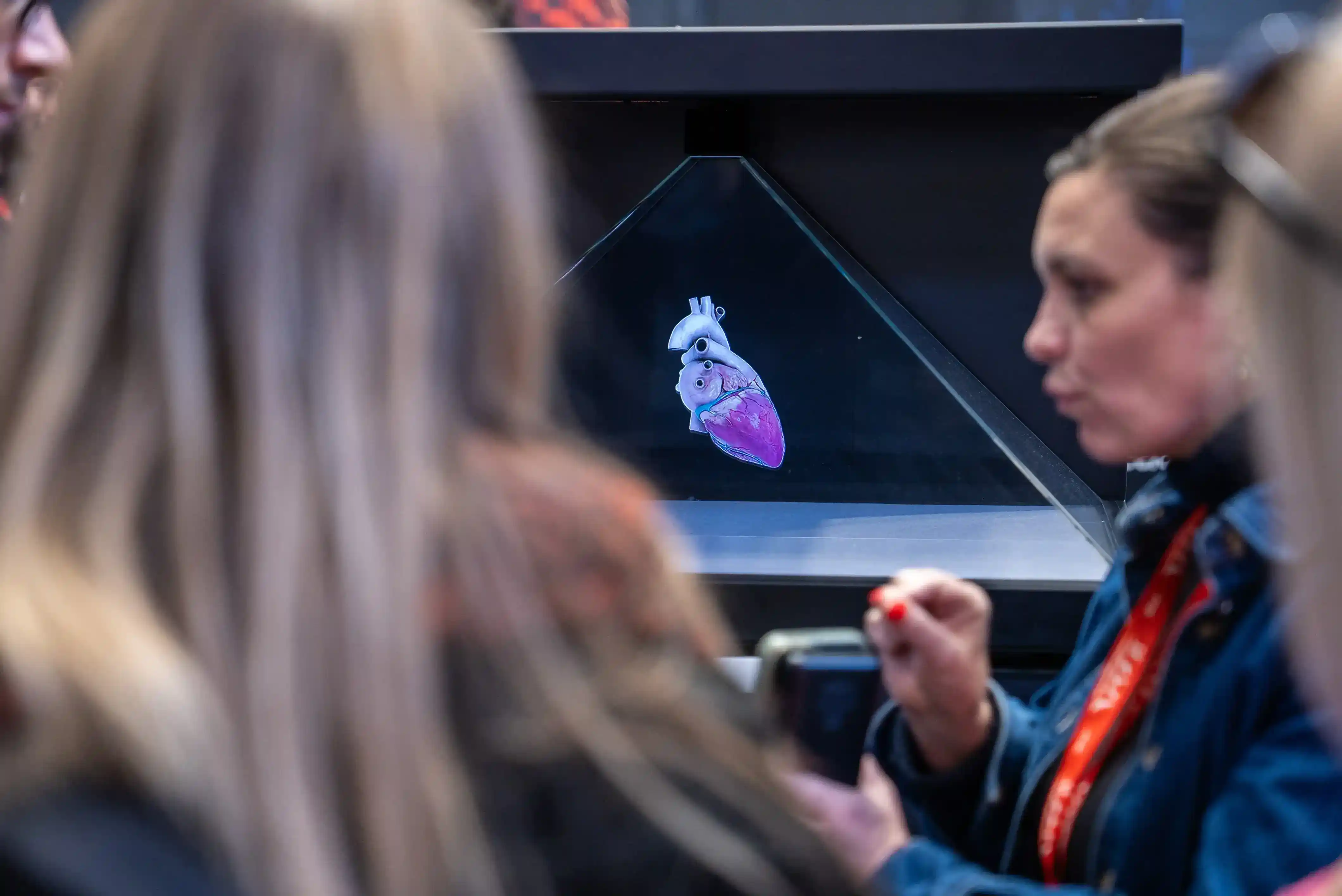
The holographic pyramid, for an object seen from every angle
A video played above or below the pyramid reflects on its tilted faces: the image seems to float in the center and can be viewed over 270° or 360°. It is the right choice for a bottle, a shoe or a scale model placed in the middle of a room, provided the lighting is under control.
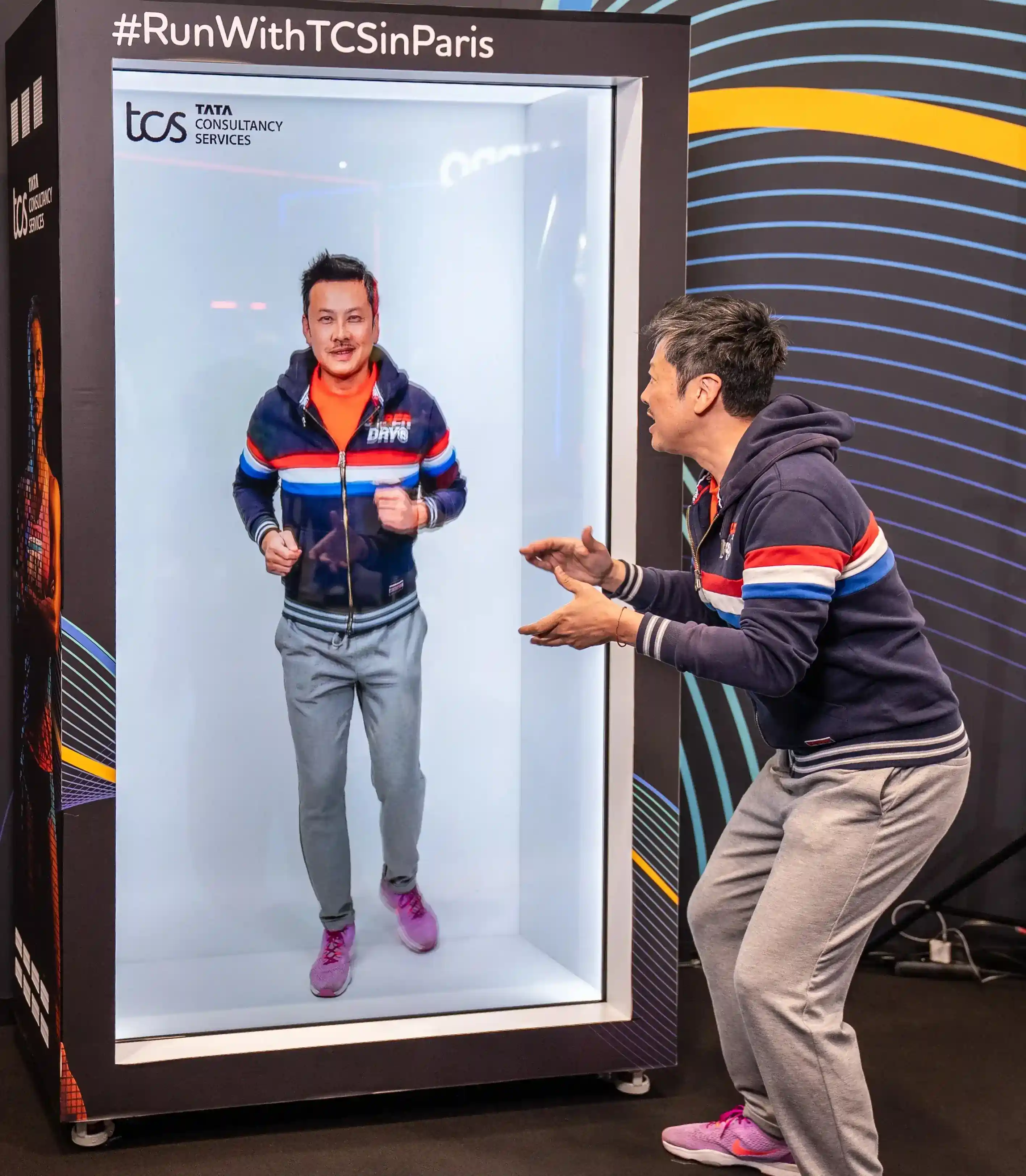
The HoloBox, for a person or a product at full scale
A glazed cabin in which a speaker, an avatar or a product appears in 4K, from countertop size to life size. It serves conferences, launches and telepresence. The human formats are covered further down.
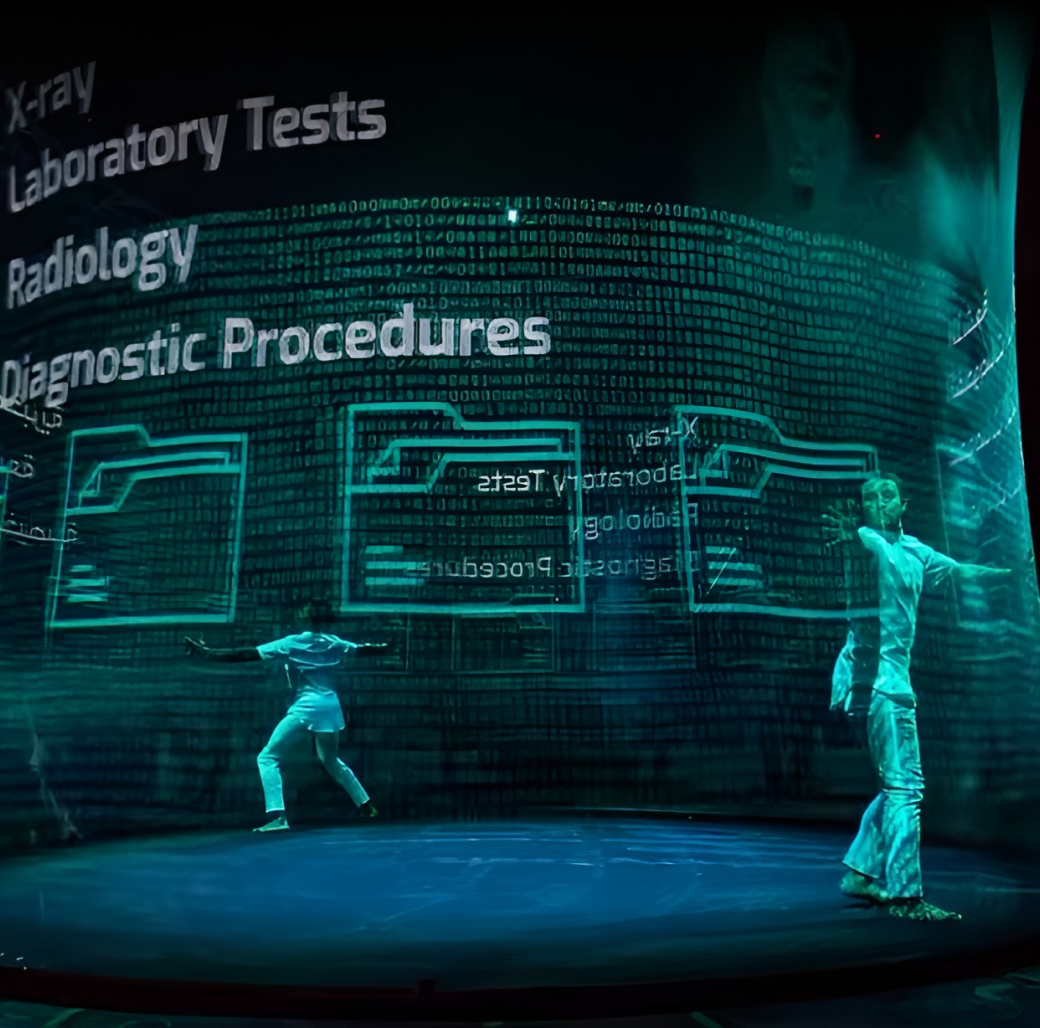
Stage projection, for large rooms
A very powerful video projector and a transparent film stretched across the stage: the technique behind Tupac at Coachella and a Jean-Luc Mélenchon rally. It requires a dark room, an audience seated in front, and a heavy technical setup.
What is a hologram of a person?
A hologram of a person is a video of a real speaker, filmed in a studio on a neutral background, then played so that the person seems physically present. At Holovisio, it is shown in a HoloBox, a glazed cabin where the speaker appears at real scale, or on stage with projection on a transparent film.
The speaker can be pre-recorded for a loop on a stand, or broadcast live for a remote keynote. The quality depends on the shoot: lighting, black background, framing of the whole body. Our human hologram page details the formats.
Hologram, virtual reality or augmented reality: which one?
The hologram is the only one of the three that offers a shared experience with no equipment. Your visitors have nothing to wear and nothing to download: they only have to walk past.
| Criterion | Hologram | Virtual reality | Augmented reality |
|---|---|---|---|
| Audience equipment | None | Headset | Smartphone or glasses |
| Environment | Real, with an added image | Fully virtual | Real, with a digital layer |
| Viewers | Many at the same time | One | One per device |
| Typical uses | Trade show, retail, stage | Training, simulation | Virtual try-on, maintenance |
The trade-off is real: a hologram does not take the visitor into another world, it shows. For immersive one-to-one training, a headset will do better. The full comparison is in augmented reality vs holograms.
What are holograms used for in business?
A hologram is used to win a stop: a passer-by who slows down in front of a window, a visitor who steps onto a stand, a delegate who remembers a brand. The research points that way, with one important nuance. An eye-tracking study published in Applied Sciences on December 27, 2025 measured 870 seconds of cumulative fixation on animated posters against 462 on static ones, across 60 participants. But the Journal of Retailing study presented by the University of Bath on October 12, 2022 shows that the most spectacular projection, noticed by 31 percent of shoppers against 26 percent, did not sell more than the simple version.
"A hologram wins the first glance almost every time. The real work starts after that: getting the message across in two seconds." Pierre Chabot, Holovisio
These are the uses we deploy most often, each with a real project:
- Store networks. For Or en Cash, we installed a 65 cm Full HD fan in a custom stand in stores across France. Every unit is connected and content changes remotely from one central point (Or en Cash case).
- Car showroom. In a Mercedes-Benz dealership, a HoloBox paired with a tablet generated 70 percent more engagement than a standard vehicle presentation and 10 minutes of interaction on average. This is a figure reported by the dealership, with no published control group (Mercedes-Benz case).
- Trade show. At IT Partners 2026, ASUS Business had to present the ExpertBook Ultra, a laptop not yet on sale: a human hologram drew people in from the aisle, and a 30 cm holographic case above the product opened the sales conversation.
- Medical congress. For Lilly in Brussels, a holographic totem at reception and fans on either side of the plenary stage.
- A product that cannot travel. At the 2026 Paris International Agricultural Show, health restrictions banned the movement of cattle: we recreated Biguine, the Brahman breeder's cow, on a wall of nine 65 cm fans.
- Culture and institutions. For the Moroccan Pavilion at the 2025 Venice Architecture Biennale, a double-sided wall animated by 24 holographic fans.
Outside marketing, the hologram in the strict sense protects banknotes, passports and bank cards against counterfeiting, and serves scientific imaging.
How much does a hologram cost?
At Holovisio, a turnkey project starts at around €2,000 excluding VAT, hardware, 3D content and installation included, and a full stage appearance ranges from €15,000 to €80,000 and more. The line-by-line breakdown, with the full grid, is in our guide to how much a hologram costs.
| Service | 2026 range, excl. VAT |
|---|---|
| Rental of a single holographic fan | €300 to €500 per day |
| Rental of a HoloBox | €1,500 to €5,000 per event |
| Rental of a holographic wall | €3,000 to €12,000 depending on the number of fans |
| Purchase of a holographic fan | €2,000 to €10,000 depending on model and services |
| Studio capture of a person | €3,000 to €10,000 of production |
| Full stage appearance (keynote, concert) | €15,000 to €80,000 and more |
The four mistakes we see on hologram projects
Choosing the technology before the objective. A HoloBox impresses at a conference and gets lost in a narrow shop window. Start from the venue, the viewing distance and the message, then pick the format.
Forgetting ambient light. A pyramid loses most of its contrast in a brightly lit hall. Device brightness and placement are checked before you sign, not on install day.
Recycling an existing video. A hologram is watched on a black background, in volume: a flat commercial, cropped, renders badly. Content is designed for the medium, which is the job of our 3D studio.
Measuring nothing. Passers-by, stop time, contacts generated: without a metric set at the start, you cannot defend the budget the following year. Baseline one week before installation, then compare like for like.
Holovisio, the company behind hologramme.co
Holovisio was founded in Orsay by Pierre Chabot and Isaac Sikorski. The team brings together several holographic technologies, a 3D creation studio and technicians who install and run every device, for hologram rental or purchase. Mercedes-Benz, Stryker, Lilly, ASUS and TCS are among the references in our portfolio.
Our position
The word hologram is technically wrong in almost every commercial use, and we own that: it is the word your customers use. What matters is that a device stops the eye where a flat screen no longer does, then delivers a short message. Our advice does not change from one project to the next: budget the content as seriously as the hardware, rent before you buy, and set a metric before installation.
Have a trade show, a window or a congress coming up? We help you choose the format and price the content: let's talk about your project.
Frequently asked questions about holograms
What does the word hologram mean?
The word comes from the Greek holos, "whole", and gramma, "writing": a hologram is a complete record of light. In the strict sense, it means a relief image recorded with a laser. In everyday language, it also covers animated optical illusions used by brands.
What is the principle of a hologram?
A laser beam is split in two: one part lights the object, the other goes straight to a photosensitive plate. Where they meet, they record an interference pattern. Lit later by an identical beam, the plate rebuilds the image in relief, visible from several angles.
Who invented the hologram?
Physicist Dennis Gabor carried out the first holography experiments in 1948 while trying to improve the electron microscope. He received the 1971 Nobel Prize in Physics. Optical holography only really took off after the invention of the laser made sharp images possible.
Do you need glasses to see a hologram?
No. A hologram is seen with the naked eye, by several people at once. That is the main difference with virtual reality, which requires a headset, and with 3D cinema, which needs glasses to trick the brain.
Were the Tupac and Mélenchon holograms real holograms?
Not in the scientific sense. Both relied on Pepper's Ghost, an old stage illusion: a projected image reflects on a transparent film tilted in front of the audience. Professionals call it holographic projection, and that is the honest term for this kind of show.
Is a hologram visible in daylight?
It depends on the technology. A holographic fan stays readable in a shop window in daytime, out of direct sun. A pyramid or a projection on film needs a darker setting. The location should always be checked before you buy or rent.
Can you make a hologram yourself?
Yes, for a demonstration: four transparent trapezoids assembled into an inverted pyramid, placed on a smartphone playing a suitable video. The image stays small and needs dim light. For professional use, you need a dedicated device and content designed for it.
Can you change the content of a hologram?
Yes. Commercial holograms play video files that you replace as you would on a screen. On a connected fleet, like the Or en Cash store network, updates are pushed remotely from one central point, on the same day for every location.
Pierre Chabot, Holovisio, the company behind hologramme.co.
Boost your ROI with holograms
Your goals, our solution, your results.


Let's discuss your project