
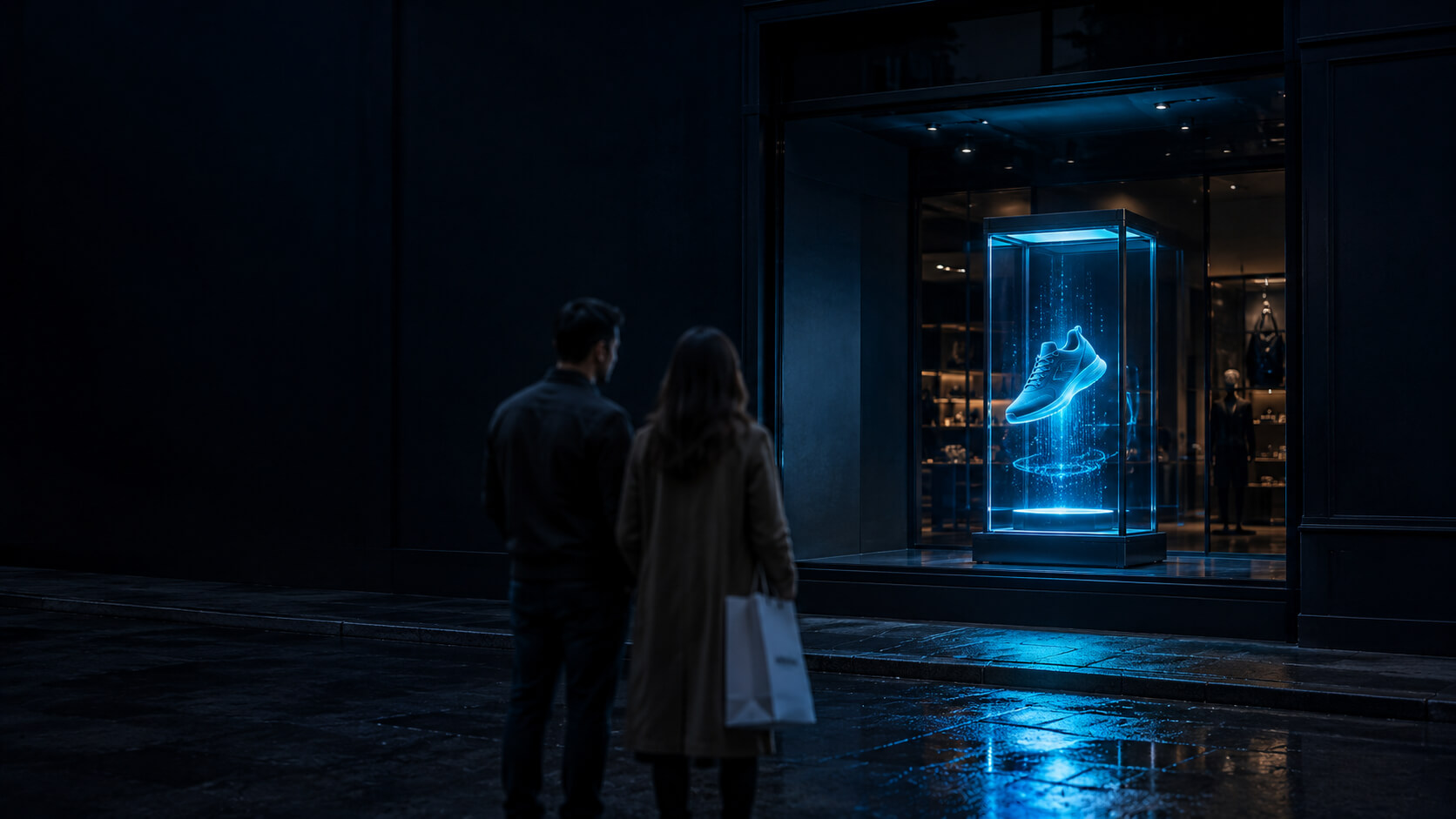
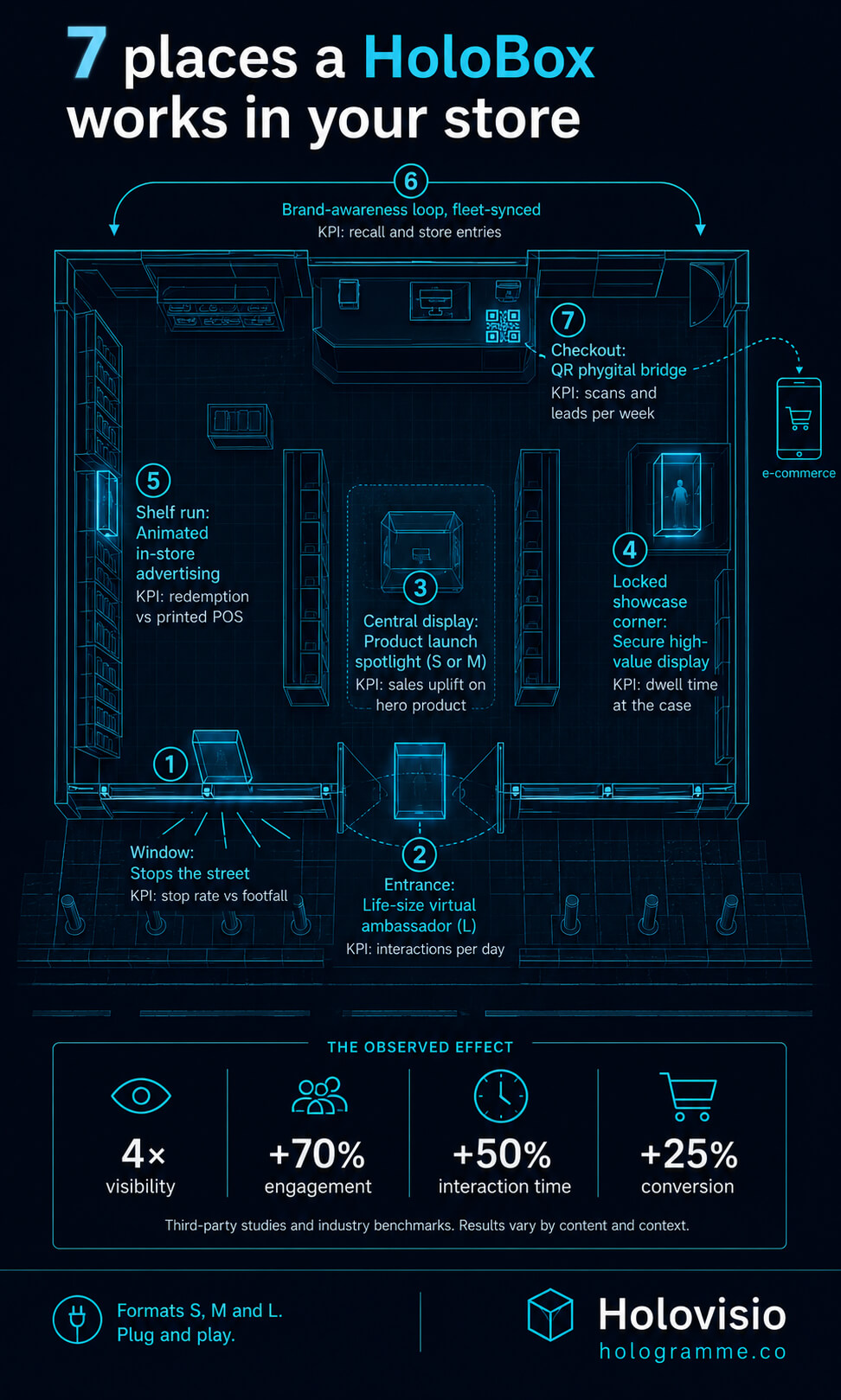
Retailers use the HoloBox seven main ways: stopping street traffic at the window, spotlighting product launches, securing high-value items behind glass, running brand-awareness campaigns, animating in-store advertising, hosting a life-size virtual ambassador, and bridging the display to e-commerce with lead capture. Three formats — S, M and L — cover everything from a counter to a flagship entrance.
Or en Cash did not put holographic displays into its French storefronts for the novelty. It did it because a window that moves stops more of the street than a window that doesn’t — and in retail, the stop is where everything starts.
So if you are searching “HoloBox for retail”, you have probably already seen the effect somewhere. This guide is the device-specific answer from Holovisio, the company behind hologramme.co, 500+ clients in 20+ countries, with holographic hardware running in working stores, not just on trade-show reels.
One scope note before the list: our overview of holograms in the retail industry covers the sector-wide picture. This article stays on a single device — the HoloBox — and the seven ways brands actually deploy it in-store.
Why the HoloBox fits retail better than any other holographic format?
The HoloBox by Holovisio is a glazed holographic display case: a high-resolution screen, an optical reflection system and a glass or plexiglass enclosure that projects 4K content readable in full daylight. That enclosure is the retail argument: the hologram lives safely inside the merchandising, not on top of it.
It runs plug & play on a standard outlet, comes in three formats from counter-top to life-size, and the content swaps per campaign in minutes. If you are sizing a location, our HoloBox space and installation guide gives the planning numbers format by format.
The 7 retail use cases, from the window to the checkout
1 · The window that stops the street
The M format sits directly in the vitrine and turns the storefront into moving media, readable even in bright daylight. That is the play behind the Or en Cash deployment: working windows across France, animated where every competing storefront stays still.
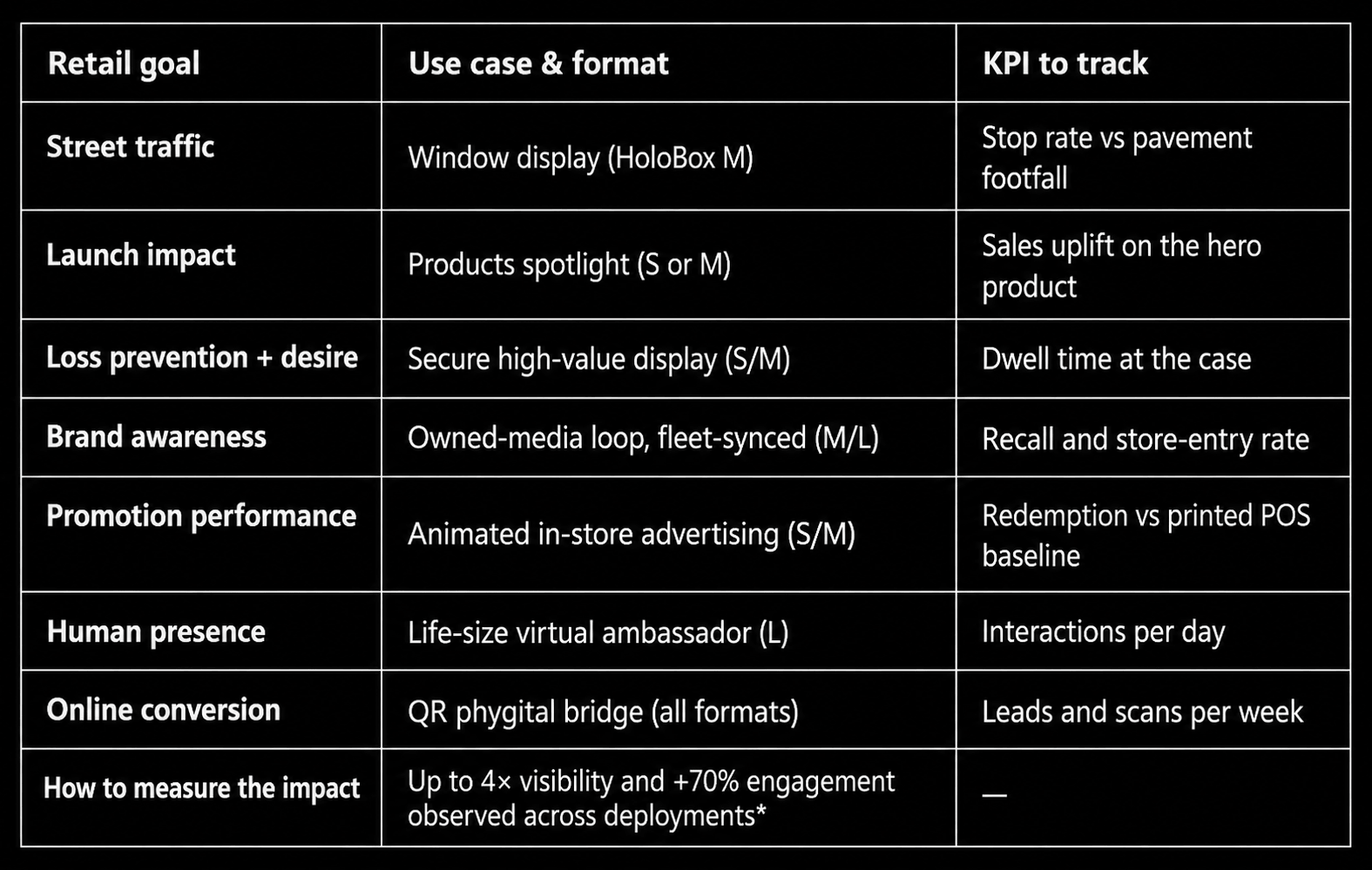
Track it through stop rate against pavement footfall — the first metric any window activation lives or dies by.
2 · Product launches and new collections
A launch needs a stage, and a floating 3D render of the new product is a stage that fits on one square metre. The Respire activation in Paris made the case in beauty retail: one hero product, holographically centre-stage, and the rest of the store arranged around the halo.
Limited series and seasonal drops recycle the same enclosure with new content — the hardware amortises, the campaign stays fresh.
3 · Secure display of high-value products
Jewellery, tech, rare bottles, collector pieces: the glazed case lets shoppers inspect a high-value item in animated 3D without the item leaving the safe. Several Holovisio clients deploy it precisely to exhibit products without risk of theft or handling damage.
The physical product can sit in the same case or stay in the back — the hologram does the touching.
4 · Brand-awareness campaigns
Between launches, the HoloBox becomes owned media: brand codes, mascots and campaign films running as an in-store loop, synchronised across every location of a fleet. It is the difference between a store that sells and a store that broadcasts.
For franchise networks, one content production covers the entire estate — central campaign, local impact.
5 · In-store advertising and promotions
Where printed point-of-sale material fades into the shelf, an animated holographic promotion does not. Retailers use the HoloBox to cycle offers, cross-sell near high-traffic fixtures and replace paper POS with a medium shoppers actually look at.
Content updates are file swaps, not print runs — the promo calendar moves at digital speed.
6 · The life-size virtual ambassador
The L format displays a human at real scale, pre-recorded or live-streamed: a founder welcoming customers, a beauty advisor demonstrating a ritual, a brand ambassador greeting the flagship. The presence effect is the point — people talk back to it.
It also solves the coverage problem: one filmed expert, present in every store at once.
7 · The phygital bridge to e-commerce
A QR code on the enclosure links the moment of attention to a landing page, a product sheet or a loyalty signup. The display captures the eyes; the bridge captures the lead — and finally gives the window a conversion number.
It is the shortest route from “that stopped me” to a measurable customer.
What the numbers say
Across third-party studies and industry benchmarks, the orders of magnitude repeat from one retail deployment to the next:
• Up to 4× the visibility of a standard display
• +70% engagement on the activation
• +50% interaction time with the featured product
• +25% conversion uplift on the highlighted offer
Treat them as directional: content quality drives the spread. The market context points the same way: digital signage and kiosks are the largest product segment of the holographic display market, at 34.45% in 2025, with luxury retailers among the adopters driving it, according to Mordor Intelligence.
From one window to a whole fleet
The typical path starts with a single rented unit in one store: a controlled test with a stop-rate baseline. Once the window wins, the rollout scales: the Or en Cash pattern went from pilot to a national retail deployment, and the 3D content produced for store one runs unchanged in store forty.
Hologram rental with Holovisio covers delivery, installation, training and pickup, which keeps the pilot phase light; purchase takes over when the format becomes permanent furniture.
Frequently asked questions
Is a HoloBox effective for retail brand awareness?
Yes: used as an owned-media loop, it broadcasts brand codes, mascots and campaign films inside the store, synchronised across a fleet. Recall and store-entry rate are the metrics to watch, and one content production covers every location.
How do retailers use a HoloBox for advertising?
As animated point-of-sale: cycling promotions near high-traffic fixtures, cross-selling beside the shelf, and replacing printed POS with a medium shoppers actually notice. Updates are file swaps, so the promo calendar moves at digital speed.
Which HoloBox format works best in a shop window?
The M format - sized for the vitrine, readable in daylight, and small enough to live inside the merchandising. The counter-top S covers tight corners; the life-size L belongs at flagship entrances and open floors.
Can a HoloBox show a real person in-store?
Yes. The L format displays a life-size human hologram, pre-recorded or live-streamed - a virtual ambassador, advisor or founder present in every store at once. It is one of the most-used retail configurations.
How do I measure the ROI of an in-store HoloBox?
Pick the KPI that matches the use case: stop rate for windows, dwell time for secure displays, interactions per day for ambassadors, scans and leads for the phygital bridge. Baseline a week before installation, then compare like for like.
For the sector-wide view, read our overview of holograms in the retail industry; for inspiration at the top end, the eight luxury-brand examples show what the format looks like at full polish. And the complete guide to holograms maps every device family to its use case.
Holovisio, the company behind hologramme.co, designs, produces and operates holographic displays (fans, HoloBox, pyramids, walls, projections) for companies - from Mercedes-Benz to Stryker. Rental or purchase, 3D content included. → Request a quote.
By the Holovisio team — hologramme.co
Boost your ROI with holograms
Your goals, our solution, your results.


