
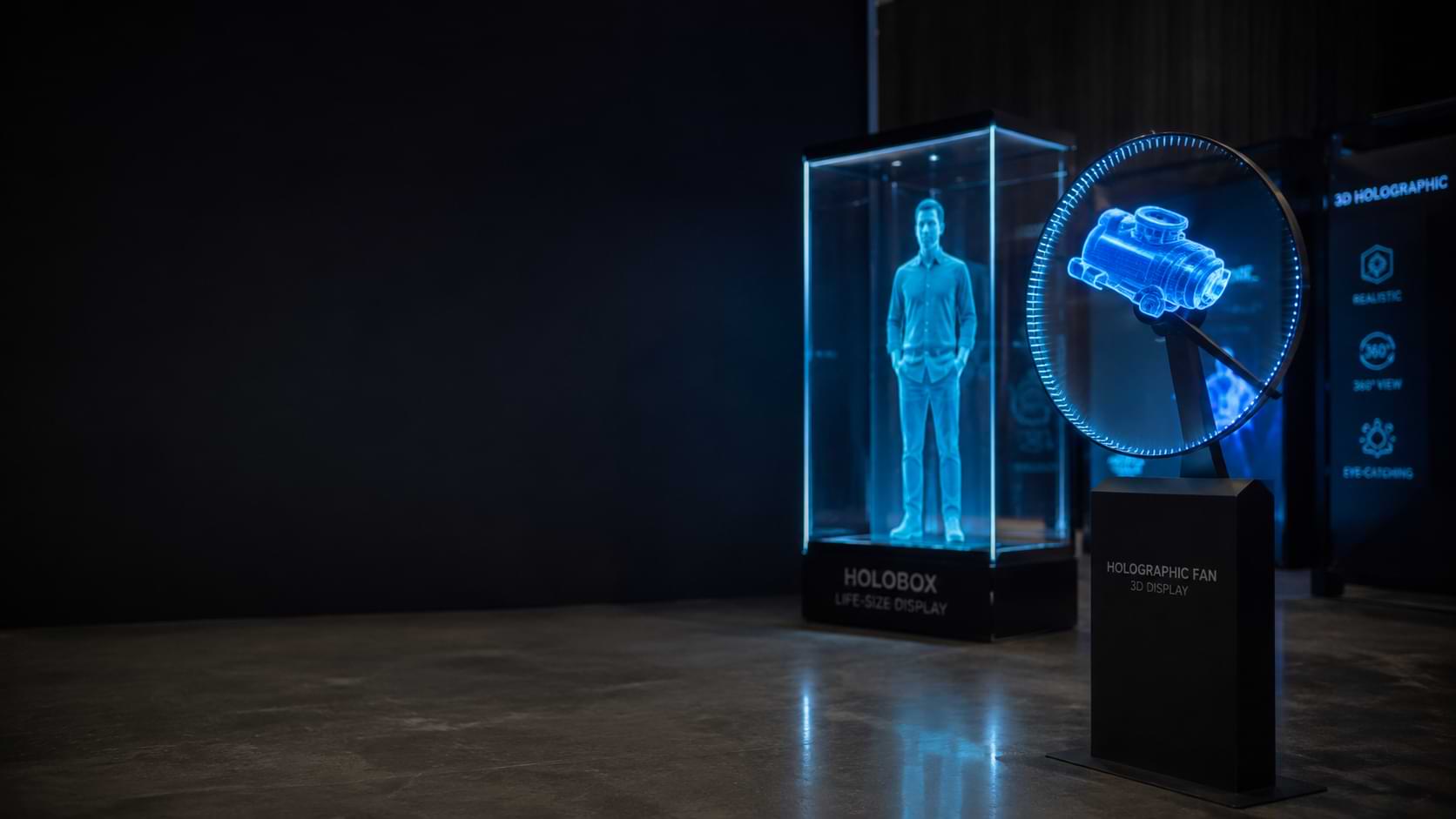
Renting a holographic fan costs €300–500 per day. A HoloBox runs €1,500–5,000 per event, a holographic wall €3,000–12,000, and buying a professional device costs €1,500–15,000 excluding VAT. Complete turnkey projects (hardware, 3D content and installation included) start at €2,000, with a quote returned within 48 hours.
When ASUS unveiled its ExpertBook Ultra at IT Partners 2026 in Paris, the crowd around the booth was not gathering for a poster. It was gathering for a hologram.
Behind every project like that sits the same first question: what does this actually cost? The honest answer is “it depends”, but “it depends” is not a budget.
So whether you searched “hologram cost”, “holobox price” or “how much to rent a hologram for a trade show”, this page answers with numbers. Holovisio, the company behind hologramme.co, has delivered holographic projects for 500+ clients in 20+ countries, from Mercedes-Benz to Stryker: these are the 2026 brackets we quote every week.
One piece of context before the grid: this is no longer a niche purchase. The holographic display market is worth $5.14 billion in 2026 and is heading toward $11.66 billion by 2031 according to Mordor Intelligence — and entry prices have never been more accessible.
What actually decides the price of a hologram?
Two projects using the exact same device can end up five budgets apart. The gap almost never comes from the hardware alone.
Five variables shape your final quote:
• The device. A compact holographic fan and a three-metre holographic wall do not play in the same league.
• Rental duration. One day, a full trade show or a whole season — daily rates fall as the duration rises.
• The 3D content. Adapting an existing 3D file costs little; producing a photorealistic animation from scratch is the single biggest budget variable.
• Logistics and installation. Venue access, rigging and power constraints all move the number.
• Operation. An autonomous loop is one price; a show-called experience with a technician on site is another.
Once you can read a quote through these five lines, every offer becomes comparable. Now for the figures themselves.
How much does each holographic device cost in 2026?
These are the brackets Holovisio applies across its catalogue — the same figures you will find on our transactional pages, with no inflated “blog numbers”.
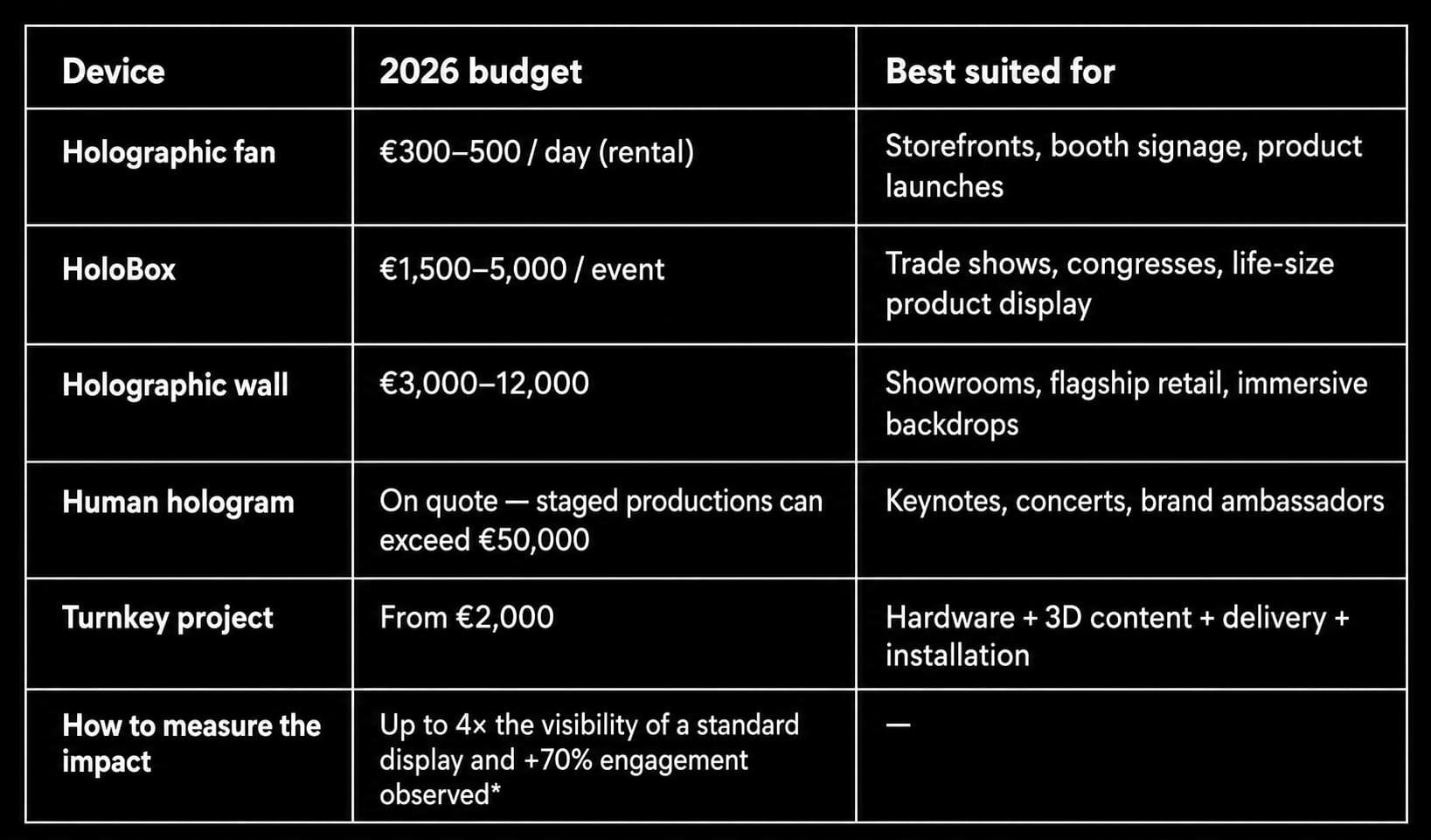
Three reading rules apply. All amounts are excluding VAT; a “per event” rental typically covers one to three days of operation, with transport and installation included in turnkey formulas; and rates become degressive as soon as several events are contracted in advance.
Three ways to read this grid:
• The holographic fan is the entry ticket: at €300–500 per day, it can pay for itself in a single busy trade-show aisle.
• The HoloBox covers the €1,500–5,000 per event range and remains the reference for life-size display in bright environments.
• The holographic wall is the large-format option: €3,000–12,000 buys an immersion that a flat screen of the same size simply cannot match.
For an all-inclusive figure, a turnkey project starts at €2,000: device, adapted 3D content, delivery, installation and launch. Full conditions sit on the hologram rental page by Holovisio, with a quote returned within 48 hours.
Should you rent or buy your hologram?
The deciding factor is frequency of use. For one or two events a year, rental wins on flexibility and zero capital outlay; from three to four uses a year - or any permanent installation - purchase becomes the rational choice.
Buying a professional device costs €1,500–15,000 excluding VAT depending on model, size and included services - the bracket published on our own purchase page. A well-maintained unit then works for 4 to 8 years, which changes the arithmetic completely for a showroom or a storefront.
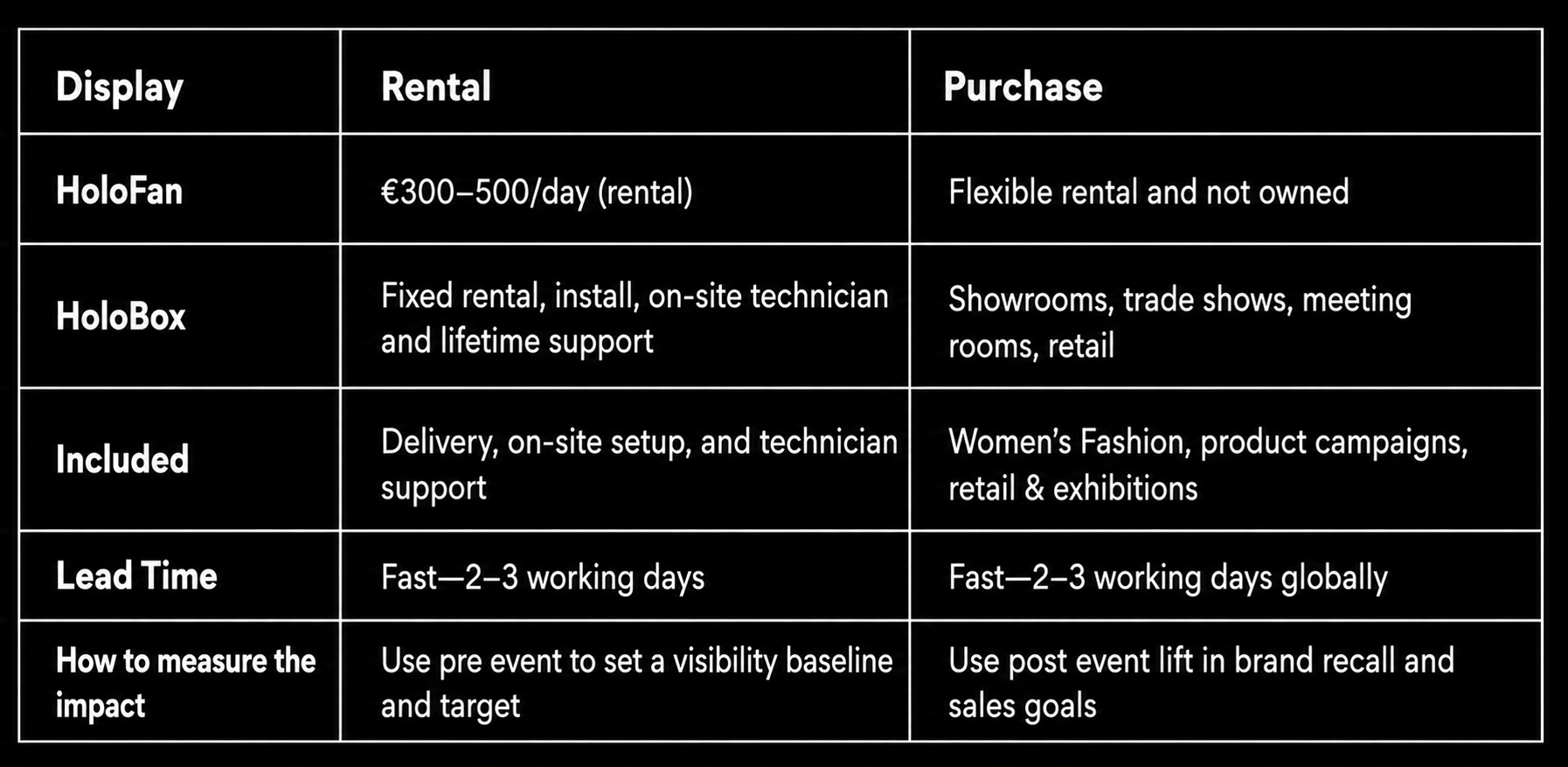
Many clients follow the same path: rent once to test the effect, then move to purchasing a holographic display once the format has proved itself. The 3D content produced for the rental is reusable, which accelerates the payback of the purchase.
What hidden costs should you budget for?
Most surprises come from three lines that rarely appear in a first quote. None of them is a trap as long as they are priced from day one.
• 3D content creation. The visible star of the project. Adapting an existing 3D model is inexpensive; a bespoke product animation typically runs €1,500–5,000, and a complex photorealistic scene €5,000–20,000. The Studio by Holovisio handles both and the files remain yours for every future campaign.
• Logistics and installation. Small devices install in under two hours; a large event configuration can take up to two days on site, in France and internationally. Venue constraints (access, power, rigging) are validated before the quote, not after.
• Operation and insurance. An autonomous loop runs itself. A show-called or interactive experience adds technician time, worth it when the hologram is the centrepiece of the stand.
What return can you expect on this budget?
A hologram is not a screen upgrade; it changes the way people behave around your stand or storefront. Across third-party studies and industry benchmarks, the observed orders of magnitude are consistent:
• Up to 4× the visibility of standard displays
• +70% engagement on the activation
• +50% interaction time with the featured product
• +25% conversion uplift on the highlighted offer
Treat these as directional, not contractual: context and content quality drive the spread. But they explain projects like the Mercedes-Benz Black Box Experience, where the technology disappears and only the attention remains.
For a full picture of which device produces which effect, our complete guide to holograms maps every format to its use case.
Frequently asked questions
How much does it cost to rent a hologram for one day?
A holographic fan rents for €300–500 per day, content adaptation included in turnkey formulas. Larger devices are priced per event: €1,500–5,000 for a HoloBox, €3,000–12,000 for a holographic wall.
How much does a HoloBox cost?
Count €1,500–5,000 per event in rental, depending on duration, content and logistics. For a permanent installation, purchase is quoted case by case within the €1,500–15,000 excl. VAT professional bracket with a quote returned within 48 hours.
Is it cheaper to rent or to buy a hologram?
Below three uses a year, rental is almost always cheaper and more flexible. From three to four uses a year, or for any permanent showroom or storefront installation, purchase amortises quickly, especially since the 3D content is reusable across campaigns.
How much does 3D holographic content cost?
Adapting existing 3D assets costs little. A bespoke product animation typically runs €1,500–5,000; a complex photorealistic scene, €5,000–20,000. The files remain yours and can be reused on every device and at every event.
What does a turnkey hologram project include?
From €2,000: the device, the adapted 3D content, delivery, installation by a technician and launch support, with a quote returned within 48 hours, in France and internationally.
Holovisio, the company behind hologramme.co, designs, produces and operates holographic displays (fans, HoloBox, pyramids, walls, projections) for companies, from Mercedes-Benz to Stryker. Rental or purchase, 3D content included. → Request a quote.
By the Holovisio team — hologramme.co
Boost your ROI with holograms
Your goals, our solution, your results.


