Phygital Retail: definition, examples and technologies to transform your point of sale
The Retailing Live a Profound Transformation. On the one hand, e-commerce continues to grow. On the other hand, the physical store is resistant. It can even be said that it is being reinvented. Between the Two, a Strategy is Needed: The Phygital Retail. But what exactly is behind this term? What technologies allow it to be deployed? And How are Holograms Imposed As one of the most powerful tools in this retail revolution? Here is a comprehensive article to answer any questions you may have.
Phygital retail: definition
Phygital retail refers to the integration of digital technologies into the physical shopping experience and vice versa, the fact of reproducing the advantages of the store in online channels. The objective: to erase the border between the two worlds to create a smooth, personalized and memorable shopping journey.
In concrete terms, a phygital customer is one who:
- Consult online reviews from your smartphone Within the department of a store;
- order online and pick up in store (click & collect);
- Scan a QR code on a product to access a video demonstration;
- Interacts with a hologram in the window before entering the store.
60% of Generation Z visit e-commerce sites while they are in store (Fevad, 2023). This behavior perfectly illustrates the challenge of phygital: if the store does not respond instantly to the customer's questions, it will look for the answer, and potentially the purchase, elsewhere.
Phygital retail is no longer an option, it's an expectation.
💡 To go further on the general definition of phygital, check out our full article: Phygital, everything you need to know about this new customer strategy
Why does retail need phygital?
Large retailers and specialized retailers are facing double pressure:
On the digital side: Amazon and e-commerce pure players capture a growing share of purchases thanks to convenience, competitive prices and algorithmic personalization.
On the physical side: consumers have not abandoned the store, they are looking for something else. Contact with the product, human advice, sensory experience, and immediate gratification remain irreplaceable benefits.
Phygital retail is the answer to this tension: keeping customers in store by offering them the best of digital technology, and converting online visitors into physical buyers.
The benefits are measurable:
- Increase in point of sale traffic thanks to digital experiences that create curiosity and desire;
- increased conversion rate: a customer who interacts with a phygital device is more engaged, and therefore closer to the purchase;
- Higher average basket thanks to personalized recommendations in real time;
- Collecting behavioral data in stores to refine marketing strategies
The essential phygital technologies in retail
Interactive Terminals and Digital Kiosks
Touch screens allow customers to navigate through an entire catalog (well beyond what the store can physically store), check stock availability in real time, compare products and place an order for home delivery or in-store pickup.
Retailers such as Undiz in Toulouse or Timberland in New York were pioneers in their deployment, with tangible results on the average basket and customer satisfaction.
Augmented Reality and Connected Mirrors
Augmented reality (AR) superimposes digital content on the real world. In retail, it allows customers to virtually try on a piece of clothing, to visualize a piece of furniture in their home or to test a makeup shade without manipulating the physical product.
Sephora has deployed its Virtual Artist application, which allows you to try hundreds of beauty products via smartphone. IKEA did the same with its 3D visualization application, allowing you to virtually place a sofa in your living room before buying it.
QR codes and NFC tags
Simple and inexpensive, QR codes are the first step towards phygital retail. Placed on product labels, showcases or media communication, they refer to detailed sheets, demonstration videos, customer reviews or personalized offers.
NFC (Near Field Communication) tags go further: a simple tap on the smartphone is enough to trigger an interaction without even opening the camera.
Mobile applications and in-store geolocation
The mobile application is the conductor of the phygital experience. It allows the customer to prepare for their visit (shopping list, product availability), to geolocate themselves in the store to find an item, to receive personalized offers according to their position and to access their loyalty program in real time.
In particular, Nike has taken this concept very far with its concept store in Melrose, Los Angeles: the store's stock is updated. Every week based on online shopping data from local customers. The result: a store that is constantly in line with the desires of its community.
Holograms: The Maximum Visual Impact at the Point of Sale
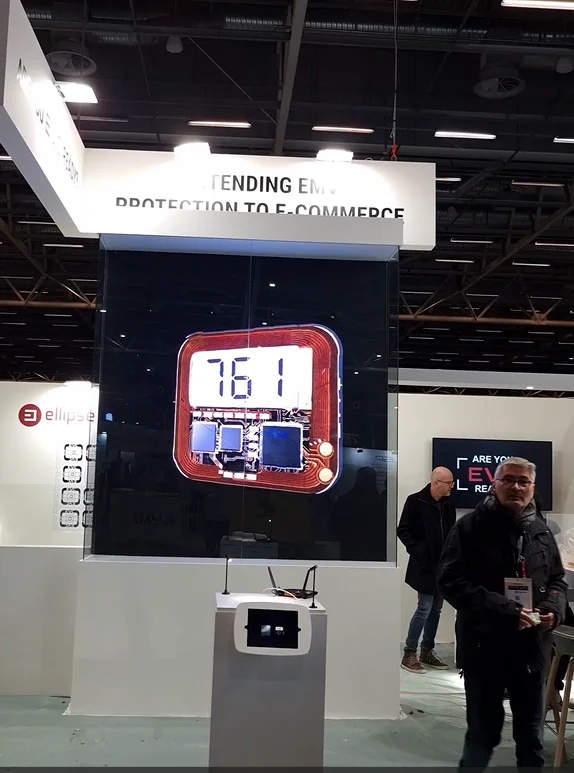
Among all phygital technologies, holograms occupy a singular place. Where a touch terminal informs and encourages, a hologram captures attention, provokes emotion and engrave a memory.
Holographic fans (or holographic LED propellers) project 3D visuals that seem to be floating in the air, visible to the naked eye without any special equipment. Positioned in the window, at the entrance to a sales area or on a display, they generate a stopping rate much higher than any traditional medium.
Retail use cases are numerous:
- product promotion: 3D presentation of a product, animation of its technical characteristics, 360° rotation;
- promotional animation: dynamic display of an offer, a countdown or a brand message;
- brand experience: holographic storytelling that immerses the customer into the world of the product before even touching it;
- Spectacular Window: The Hologram Seen from the Street creates immediate curiosity and attracts traffic to the point of sale.
Les Holobox, human-sized holographic booths, for their part, open up new possibilities for premium retail: a virtual brand ambassador available at all times, able to present products, answer frequently asked questions and guide the customer in their choice.
👉 Discover holographic solutions for retail — Holovisio
Examples of successful phygital retail
Nike: The Store Driven by Data
The Nike concept store in Melrose, Los Angeles, is the most successful example of large-scale phygital retail. The store does not have a fixed stock: the products on display are selected every week based on the online purchase data of customers in the neighborhood. Customers can reserve items via the app, try them on in store, and leave with or have them delivered. The physical experience is entirely enhanced by digital data.
Sephora: Enhanced Beauty
Sephora has made augmented reality a central lever in its phygital experience. The Virtual Artist application allows you to try hundreds of shades of lipstick or eye shadows in real time via the smartphone camera. In stores, Color IQ terminals analyze skin tone to recommend suitable products. The result: fewer returns, more confidence in the purchase, and significantly strengthened customer engagement.
Warby Parker: From Digital to Physical
The Warby Parker eyewear brand was born online. She then opened physical stores not to replace her site, but to complete the experience: real try on after virtual selection, consulting team available, integrated ophthalmology service. In a decade, Warby Parker opened more than 200 stores in the United States, capitalizing on the complementarity of the two channels.
Lululemon: Virtual Reality Immersion
In its flagship stores, Lululemon offers virtual reality experiences that allow customers to try on sportswear in various simulated environments such as a snowy mountain or a Parisian yoga room. The aim: to create an emotional connection with the product before buying.
How to deploy a phygital retail strategy?
Step 1: Identify the friction points in the customer journey
Before investing in technology, map your current customer journey. Where does the customer give up? Where is he looking for information and can't find it? Where Does His Attention Get Lost? It's these sticking points that phygital needs to resolve, not technology for its own sake.
Step 2: choose the technologies adapted to your challenges
Not all phygital devices have the same goals:
Step 3: Test on a pilot point of sale
Deploy your phygital strategy on a single store before generalizing it. Measure the impact on key KPIs (traffic, conversion, average basket, NPS) and adjust content and experience before large-scale deployment.
Step 4: Train Field Teams
Phygital increases teams, it does not replace them. A well-trained salesperson can rely on a holographic device to open the conversation, present a product in a new way, and convert a pass-by into a customer. Without training, the best tool goes unused.
Step 5: Measure and Optimize Continuously
The KPIs to follow to manage your phygital retail strategy:
- stopping rate in front of devices (holograms, terminals);
- engagement rate (interactions, QR code scans);
- point of sale conversion rate;
- average basket and frequency of visits;
- NPS Before and After Deployment
Phygital retail is not a passing trend. It's the new normal in physical retail. Consumers no longer have patience for stores that have not yet reached this milestone. They expect fluidity, personalization, and experience.
Among the available technologies, holograms stand out as the most powerful lever for brands that want to make an impression: spectacular, flexible, deployable in the window as well as in the sales area, they transform a passage into an engagement and a look into a memory.
Do you want to integrate holograms into your phygital strategy? Holovisio experts support you from 3D content design to on-site deployment.
👉 Discuss your project with a Holovisio expert
FAQ — Phygital retail
What is phygital retail in summary?
Phygital retail is the fusion of physical in-store experiences and digital tools to create a more fluid, personalized and engaging shopping journey. It connects to technologies such as interactive terminals, augmented reality, QR codes, mobile applications and holograms.
Is phygital retail only for big retailers?
No While the most spectacular examples come from Nike, Sephora or IKEA, phygital technologies are accessible to smaller structures. A holographic fan in the window, a QR code on a product label or a touch terminal at the entrance of a store are devices that adapt to varied budgets.
What is the ROI of phygital retail?
The ROI depends on the devices and the objectives. Holographic devices, for example, are mainly measured on the stopping rate, the engagement rate, and brand awareness. Interactive terminals are measured by the rate of use and the impact on the average basket. In all cases, the experience must be managed by KPIs defined naturally.
Are Holograms Really Effective at the Point of Sale?
Yes, and for a simple reason: in an environment saturated with screens and displays, the hologram creates an effect of surprise that conventional media can no longer reproduce. A 3D visual that seems to float in the air captures attention where a poster or flat screen goes unnoticed. Retailers that deploy them are systematically seeing an increase in incoming traffic and time spent in stores.
What is the difference between phygital retail and omnichannel?
Omnichannel connects channels (online, mobile, store) so that they work together in a coherent way. Phygital retail goes further: it merges physical and digital within the same moment of experience, often thanks to immersive technologies. All phygital are omnichannel, but not all omnichannels are phygital.
Boost your ROI with holograms
Your goals, our solution, your results.