
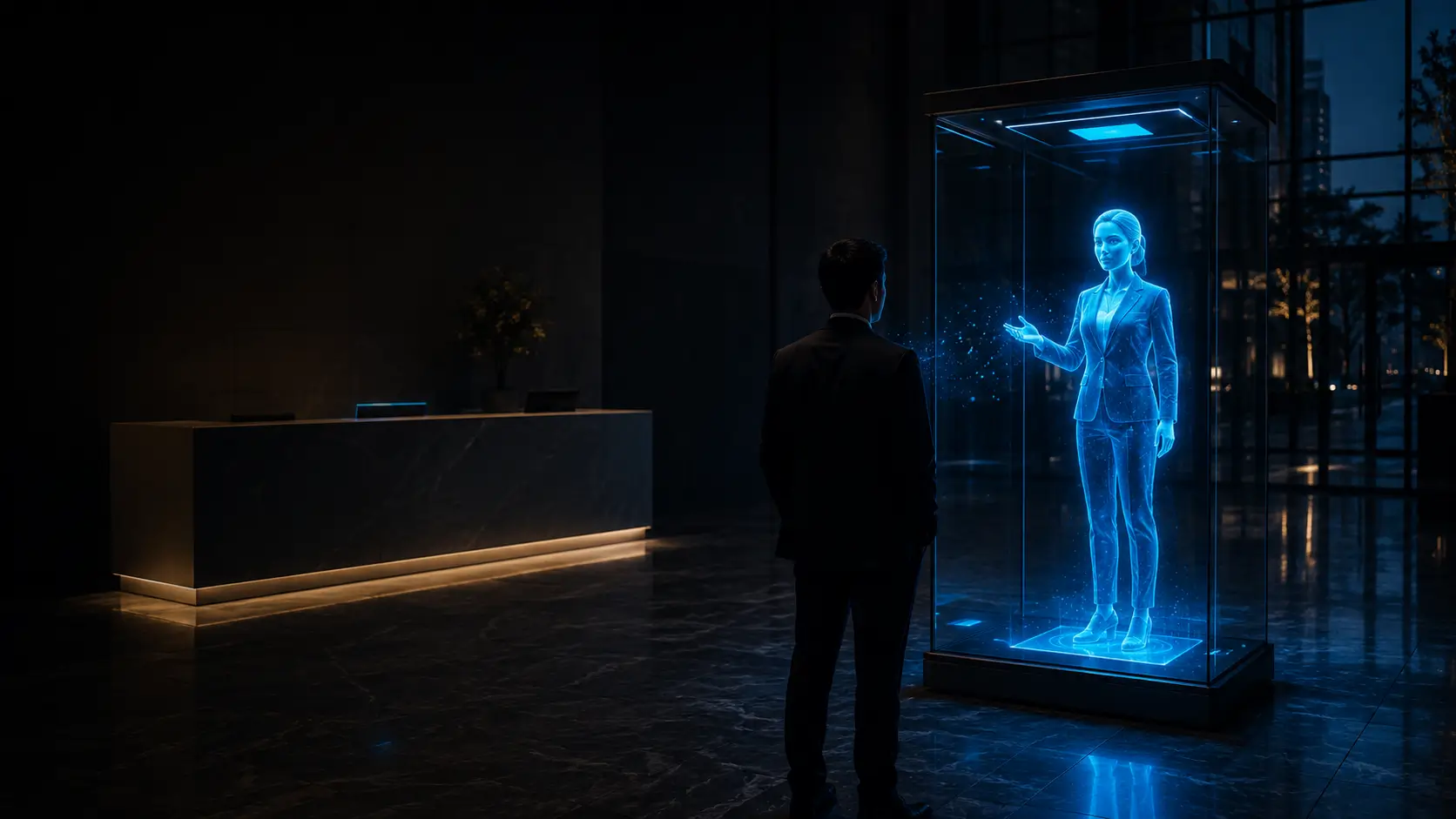
An AI hologram pairs a conversational AI avatar with a life-size holographic display: it greets, answers and guides in multiple languages, hands the exchange to a human when it turns commercial, and never leaves its post. Brands deploy it as concierge, retail advisor, booth host, brand persona and always-available expert.
For decades, the promise was a screen that talks. What arrived in 2026 is stranger and more useful: a presence that converses, life-size, in the middle of the room, with no glass between it and the visitor.
This guide covers the brand side of that arrival: the five deployments that work, the hardware that carries them, and how to design the conversation. Holovisio, the company behind hologramme.co, builds both halves, the holographic device and the content that inhabits it, and the AI hologram page carries the formats and booking.
A scope note: our AI avatar article explains the concept and the software layer. This one assumes the concept and answers the operator's question: what do brands actually do with it, and on what.
The adoption context is already mainstream: even the exhibition industry's own barometer reports 91 percent of companies using AI, according to UFI's July 2026 Global Exhibition Barometer. The differentiator has moved from using AI to giving it a body.
What exactly is an AI hologram?
Three layers make one experience. The avatar layer: a generated or captured human likeness with a voice, driven by conversational AI briefed on your products, tone and boundaries. The display layer: a holographic device that renders it life-size and free-floating, so it reads as presence rather than as another screen. The handoff layer: the design decision about where the AI stops and a human continues. The measure of the whole stack is conversational composure: the pause before it answers is where the uncanny valley lives now.
The honest boundary matters as much as the capability. An AI hologram converses inside its brief: it answers, orients, qualifies and entertains, and it escalates. It is not a staff replacement; it is coverage. One avatar absorbing forty small questions an hour is not replacing anyone, it is returning that hour to the humans for the conversations that need them.
Why 2026 is the year is a story of three curves crossing: avatar realism cleared the believability bar, conversational latency dropped under the threshold where dialogue feels like dialogue, and the holographic hardware matured into daylight-capable, life-size, plug and play. Any one alone was a demo; the three together are a deployment.
The five brand deployments that work
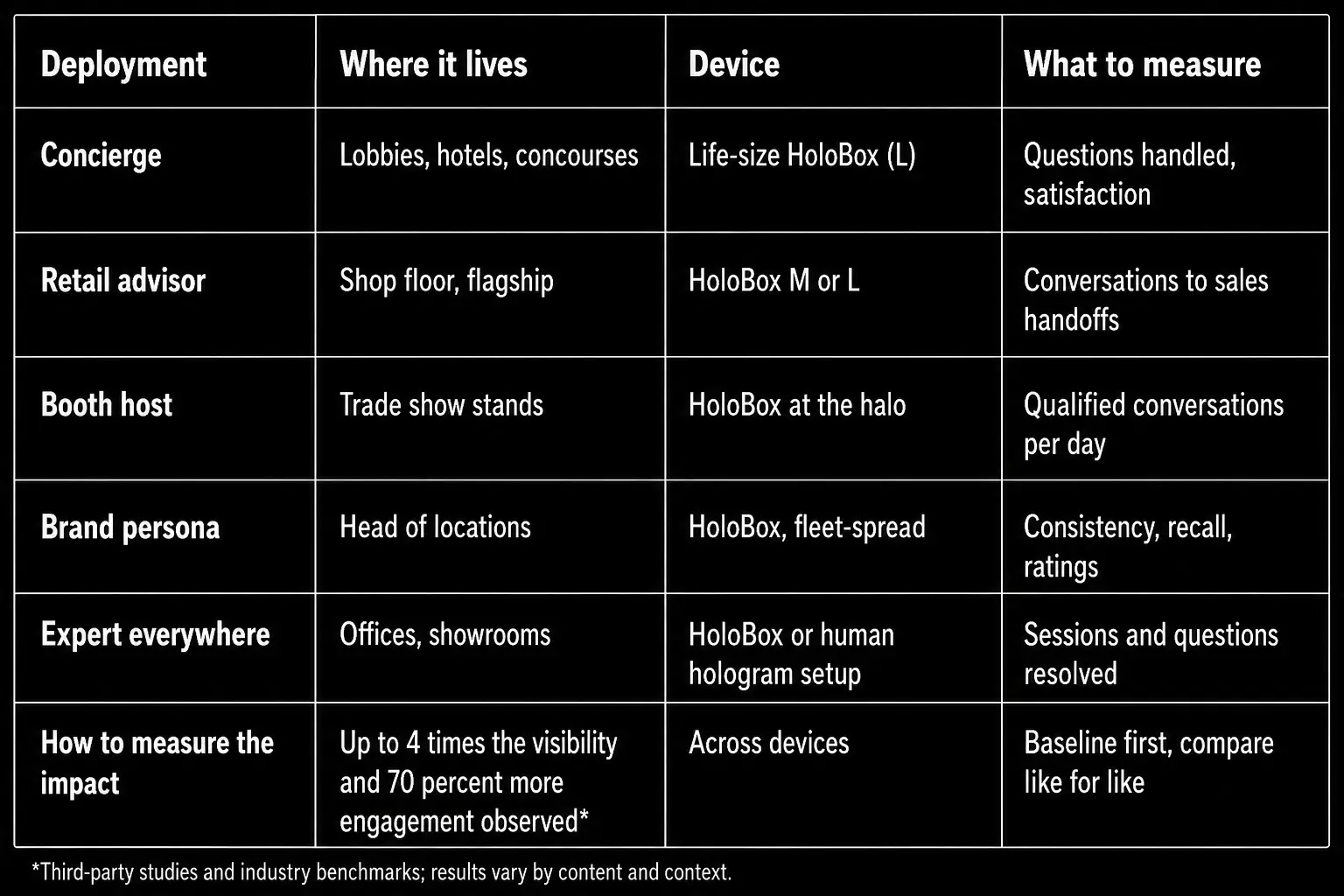
• 1 · The concierge. In a lobby, a hotel entrance or a mall concourse, the AI hologram greets, orients and answers the hundred small questions that otherwise queue at a desk, in the visitor's language, at any hour. It is the deployment behind the AI hologram portal searches rising through 2026, with the Gulf's lobbies and concourses leading the pattern.
• 2 · The retail advisor. On the shop floor, the avatar answers product questions, compares options and points to the shelf, then hands warm intent to a human seller. It extends the logic our AI in stores article traced: the front line of retail AI is moving past the touchscreen.
• 3 · The booth host. On a trade show stand, the AI hologram works the halo: it engages the visitors the display stops, qualifies interest with three good questions, and routes the right conversations to the team. The device earns the stop; the avatar earns the badge scan.
• 4 · The brand persona. A consistent character, founder likeness or invented ambassador, present identically in every location of a fleet: one persona production, one voice, one standard of welcome, updated everywhere as a file. The strongest ones get named, and the name becomes part of the brand's furniture.
• 5 · The expert everywhere. For training, internal comms and technical support, a filmed or generated expert answers on demand in every office and showroom at once, which turns scarce expertise into infrastructure.
The hardware that carries it
Presence is a hardware property before it is a software one, and the carrier matters. The HoloBox renders interactive 4K holograms at up to life size inside a glazed enclosure that reads in daylight, which makes it the default body for an AI avatar in lobbies, stores and stands. The human hologram configurations extend the same idea to staging scale. Fans and walls broadcast; the conversation formats are the enclosed, life-size ones, which is why the deployments above concentrate there.
Three content tiers run on the same devices, and most brands climb them in order: pre-recorded loops for welcome and storytelling, live-streamed humans for events and remote expertise, and AI-interactive avatars for conversation at scale. The hardware does not change between tiers, which protects the investment as the ambition grows, and keeps the pilot honest: prove the venue with a loop before paying for the conversation.
Designing the conversation
The avatar is briefed like a new hire, and the brief is where projects succeed or stall. Six decisions do most of the work:
• Scope. What it answers, and the graceful sentence it uses for everything else. A narrow, excellent scope beats an ambitious, hedging one.
• Tone and persona. Scripted like a character, tested out loud: the voice, the pace, the humor budget, the greeting for a returning visitor.
• Languages. Content is files, so language versions rotate on schedule; multilingual pairs are standard for international venues.
• Escalation. The handoff to a human is designed, named and rehearsed: who receives it, on what signal, with what context passed along.
• Guardrails. What it must never claim, promise or collect, written down before launch, and reviewed like any public-facing asset.
• Likeness and rights. If the avatar borrows a real face or voice, consent, usage scope and duration are contracted before production, not after, and renewal dates live in the same file as the content.
Persona, likeness and 3D production run through the Studio by Holovisio, and the resulting assets remain yours: the avatar that hosts your booth in spring can greet your flagship in autumn without being rebuilt.
Getting started
The pragmatic path is a pilot: one venue, one scope, one measured month. Hologram rental with Holovisio covers the device end turnkey, from delivery to pickup, with turnkey packages starting at 2,000 euros excluding VAT and quotes returned within 48 hours; the avatar brief travels with you to every deployment after.
Measure the pilot like a channel, not a gadget: conversations held, questions resolved, handoffs delivered, and the one number that decides expansion, whether the humans behind it received better conversations than before. Expect an editorial rhythm too: the brief that launched the pilot will be rewritten twice in the first month, and that is the system working.
For the concept and the software layer, read our AI avatar guide; for the wider device families, the complete guide to holograms maps them all. The body is ready; the question is what you want it to say.
Holovisio, the company behind hologramme.co, designs, produces and operates holographic displays (fans, HoloBox, pyramids, walls, projections) for companies, from Mercedes-Benz to Stryker. Rental or purchase, 3D content included. Request a quote.
By the Holovisio team · hologramme.co
Boost your ROI with holograms
Your goals, our solution, your results.


