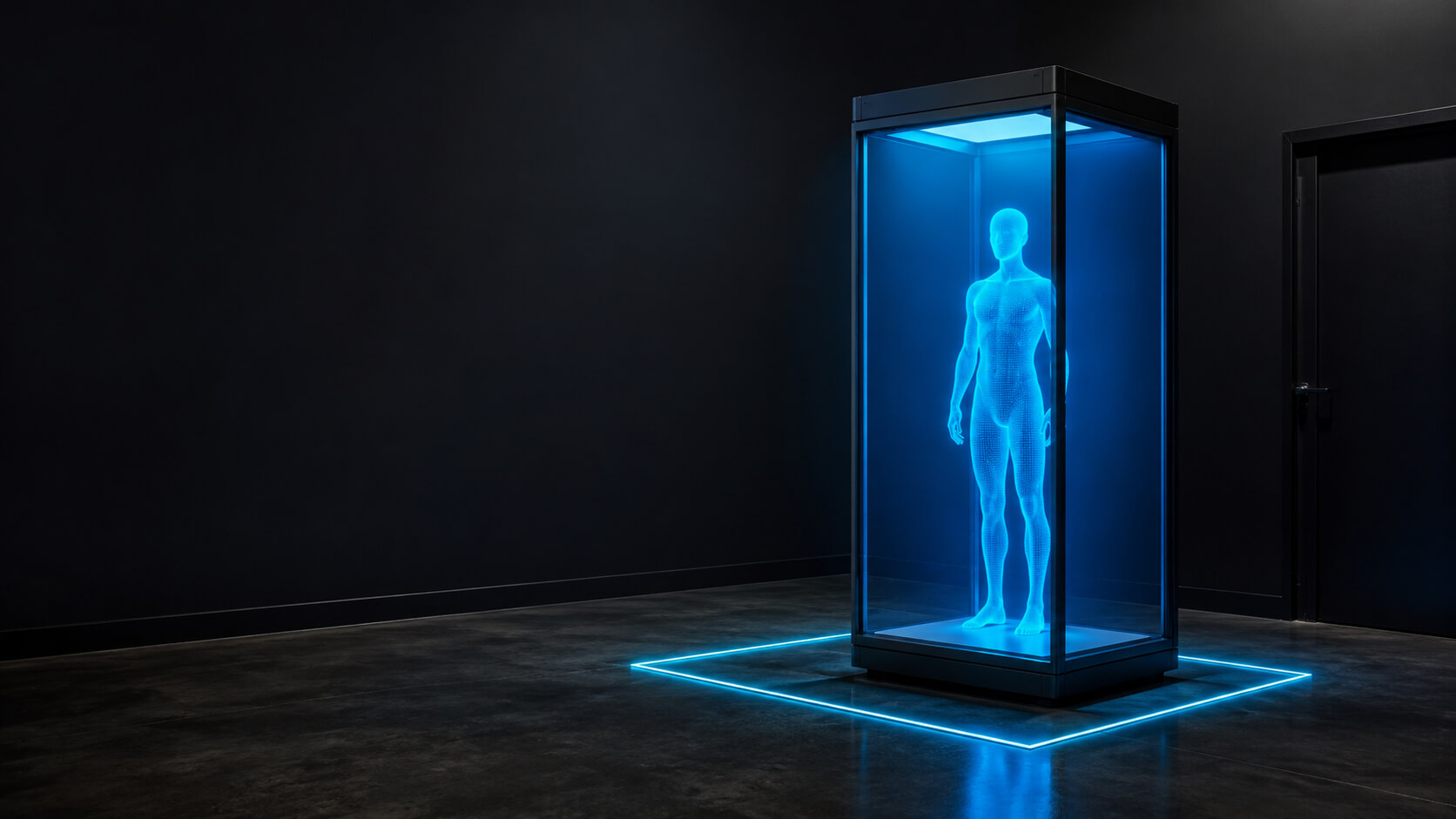
Less than most exhibitors expect. A compact HoloBox S or M sits on a counter or in a shop window, with enclosures starting around 30 cm wide. The life-size HoloBox L needs roughly one square metre of floor space, a standard power outlet and clear door access - and installs in under two hours.
When Holovisio deployed holographic displays across Or en Cash storefronts in France, the constraint was never the technology. It was the square metre: retail windows are measured in centimetres, and every one of them is fought over.
So if you have typed “space needed for HoloBox installation”, you are asking the right question at the right moment. It is the first thing Holovisio, the company behind hologramme.co, validates on every project - before the content, and before the budget.
Here are the planning numbers, format by format, plus the checks that decide whether install day takes two hours or two days.
How much floor space does each HoloBox format need?
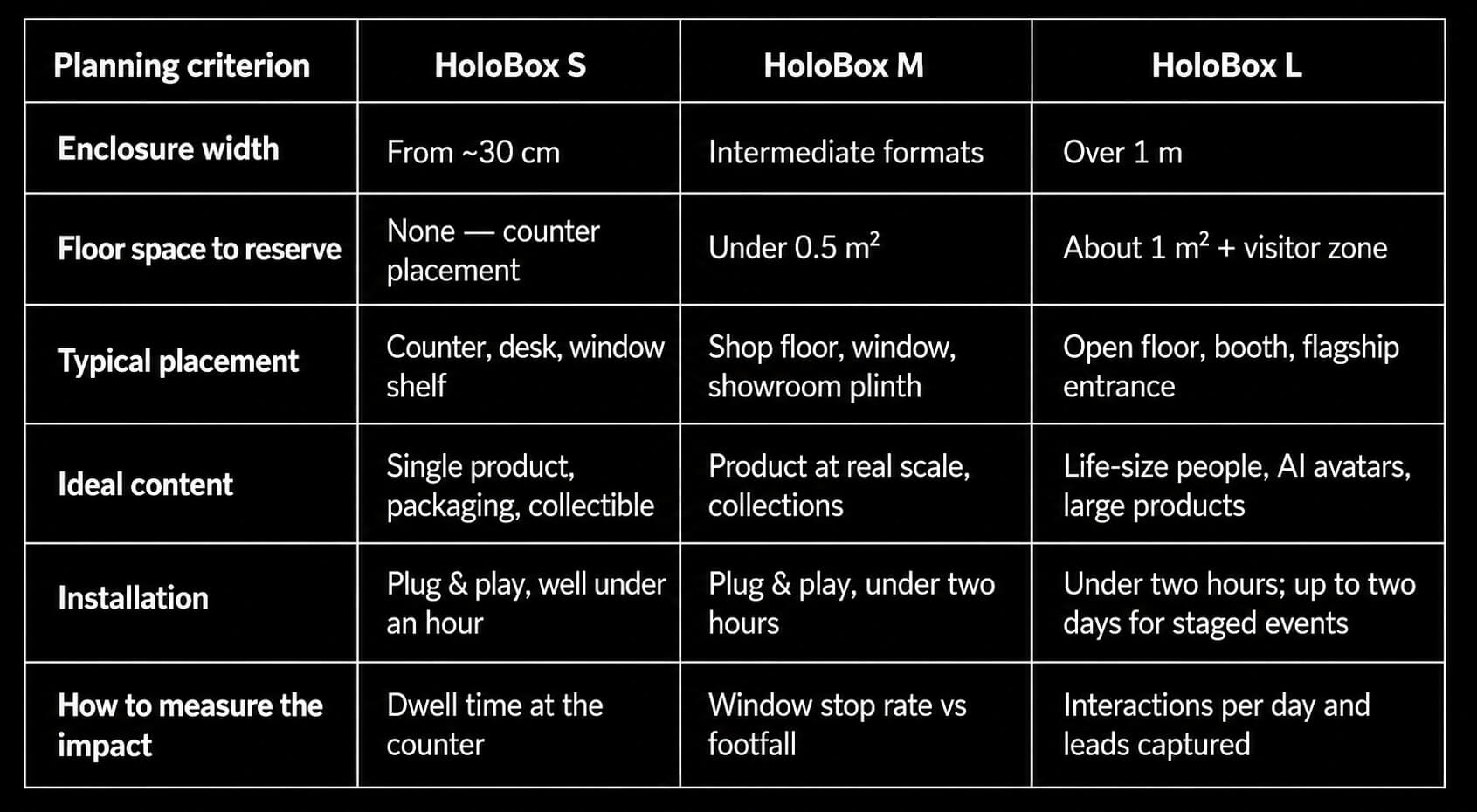
The HoloBox exists in three formats - S, M and L - with enclosures running from about 30 cm to over one metre wide. Each format answers a different space equation.
• HoloBox S - the counter format. Compact and lightweight, built for portability: it sits on a counter, a reception desk or a window shelf. It claims no floor space at all — ideal for travelling events and genuinely tight retail corners.
• HoloBox M - the window format. Sized for the shop floor or the window itself, on a plinth or directly in the display. Plan well under half a square metre and it disappears into the merchandising.
• HoloBox L - the life-size format. Designed for human-scale holograms, AI avatars and large products. Budget about one square metre of floor footprint, plus the visitor zone in front — more on that below.
One planning rule ties the three together: the hologram needs the glass face clear. Whatever the format, nothing should sit between the enclosure and the eyes it is meant to catch.
Will it fit through the door? Access, transport and ceiling height
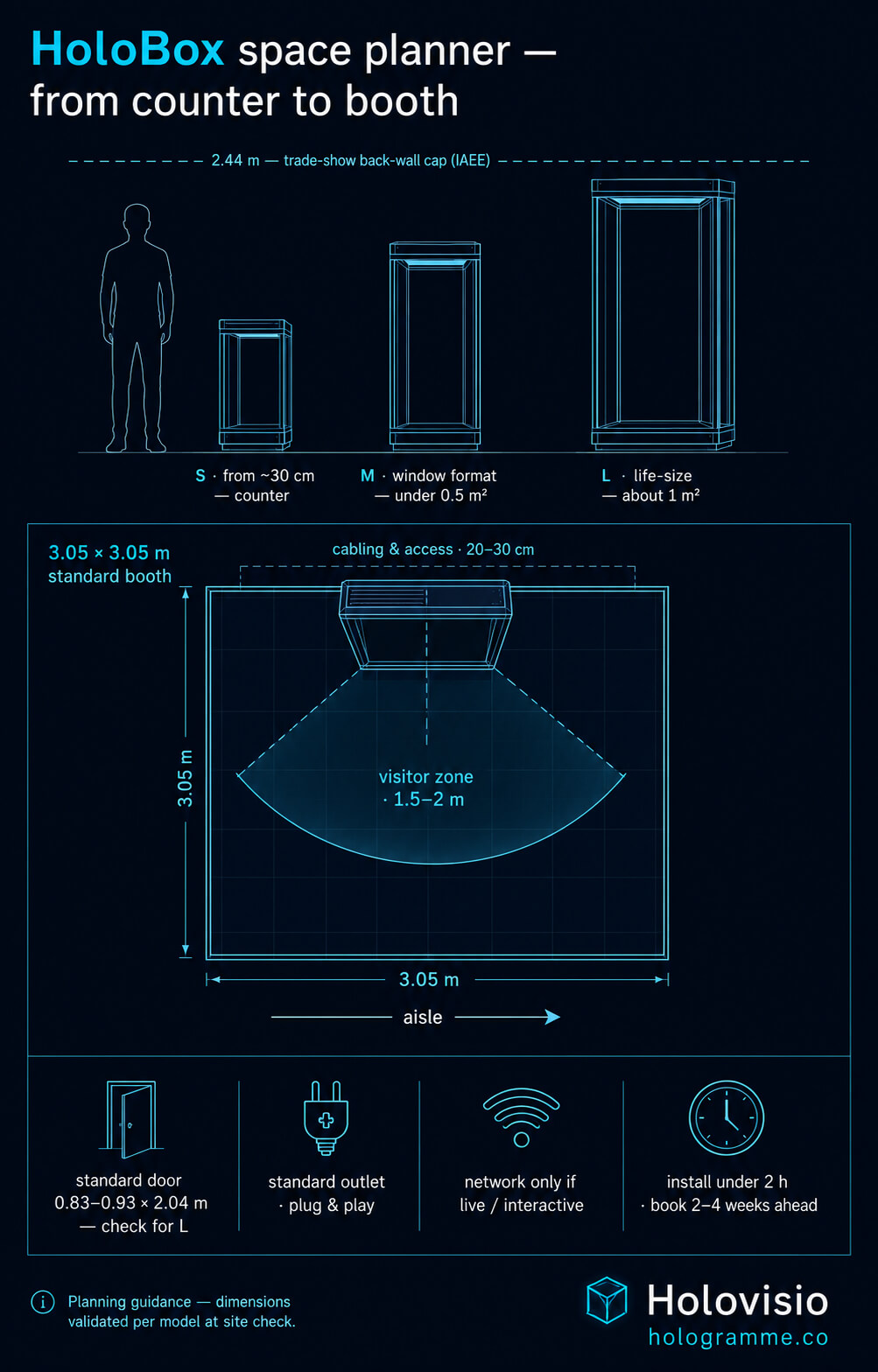
The check that saves install day is not the final position - it is the path to it. Standard European doorways run roughly 0.83–0.93 m wide and about 2.04 m high: the S and M pass without a thought, while the L calls for a quick look at door heights, corridors and lift dimensions.
Ceiling height is rarely the blocker indoors. A life-size display stands taller than a person, and standard 2.4–2.5 m ceilings accommodate it comfortably; only mezzanines, stage risers and low retail soffits justify a measurement before delivery.
Trade shows are stricter - and the format is built for it. The IAEE guidelines that most organisers follow define the standard linear booth at 3.05 × 3.05 m with a back-wall height cap of 2.44 m: the HoloBox L is designed to live under exactly that kind of constraint, with floor to spare for visitors.
As for the floor itself: a solid, flat surface is all a standard configuration requires. Units ship with their stand and protective plexiglass, and clients regularly describe assembly as quick and tool-free. Holovisio validates the full access path during the site check, so surprises stay off the delivery truck.
What about power, light and the surrounding environment?
The electrical answer is short: a standard mains outlet. The HoloBox runs plug & play - no three-phase supply, no dedicated cooling in normal indoor conditions.
• Light. The high-brightness screen keeps the hologram readable in daylight - which is what makes the window placement work. Avoid aiming the glass face into direct low sun, which flattens contrast on any display.
• Connectivity. Pre-recorded content runs standalone. Interactive experiences and live-streamed human holograms need a network connection — plan an ethernet drop or reliable Wi-Fi at the final position.
• Cabling. Reserve a discreet 20–30 cm behind or beside the enclosure for the power run and maintenance access, especially in closed window displays.
How much space do visitors need in front of it?
This is the zone nobody plans - and the one that produces the results. Keep 1.5 to 2 metres clear in front of the glass: that is where people stop, watch and interact.
On a booth, place the unit on the back-wall line, angled toward the aisle, so the people it stops gather on your stand instead of blocking traffic - a layout that also keeps you inside most organisers’ line-of-sight rules. In a window, the visitor zone is the pavement - free by definition.
Third-party benchmarks put the gain at up to +50% interaction time with the featured product (figures vary by device, content and context) - and that interaction happens entirely in the metre and a half in front of the enclosure. The Or en Cash retail deployment made the point in the field: working storefronts, real merchandising constraints, and the space question answered at scale across France.
How long does a HoloBox installation take?
Under two hours for standard configurations; up to two days for large staged events. Holovisio operates turnkey in France and internationally: delivery to your address, installation by the team, quick user training, and pickup at the end of the service.
Book two to four weeks ahead - that window covers logistics, the technical validation of the venue and any 3D content adaptation. For a first project, hologram rental with Holovisio is the low-commitment way to test the format in your exact space before considering purchase.
For the optics behind the glass, our article on how the HoloBox works explains the reflection system; for the wider family of devices, the complete guide to holograms maps every format to its use case.
Frequently asked questions
How much space is needed for a HoloBox installation?
A HoloBox S or M needs a counter, shelf or window position; enclosures start around 30 cm wide. The life-size HoloBox L needs about one square metre of floor space, a 1.5–2 m visitor zone in front, and a standard power outlet.
Can a HoloBox fit in a shop window?
Yes, the M format is designed for exactly that, and the screen stays readable in daylight. The Or en Cash deployment ran holographic displays in working retail storefronts across France, merchandising constraints included.
Does a HoloBox need special power or cooling?
No. It runs plug & play on a standard mains outlet, with no dedicated cooling required in normal indoor conditions. Only interactive or live-streamed content adds a requirement: a network connection at the final position.
Can a HoloBox fit on a small trade-show booth?
Yes. A standard 3.05 × 3.05 m linear booth hosts a HoloBox L on the back-wall line with room for visitors, and the 2.44 m back-wall height cap used by most organisers is not a blocker. The S and M formats leave the floor entirely free.
Who handles delivery and installation?
Holovisio does, end to end: delivery, on-site installation by a technician, user training and pickup — in under two hours for standard setups, in France and internationally. Book two to four weeks ahead.
Holovisio, the company behind hologramme.co, designs, produces and operates holographic displays (fans, HoloBox, pyramids, walls, projections) for companies - from Mercedes-Benz to Stryker. Rental or purchase, 3D content included. → Request a quote.
By the Holovisio team — hologramme.co
Boost your ROI with holograms
Your goals, our solution, your results.