
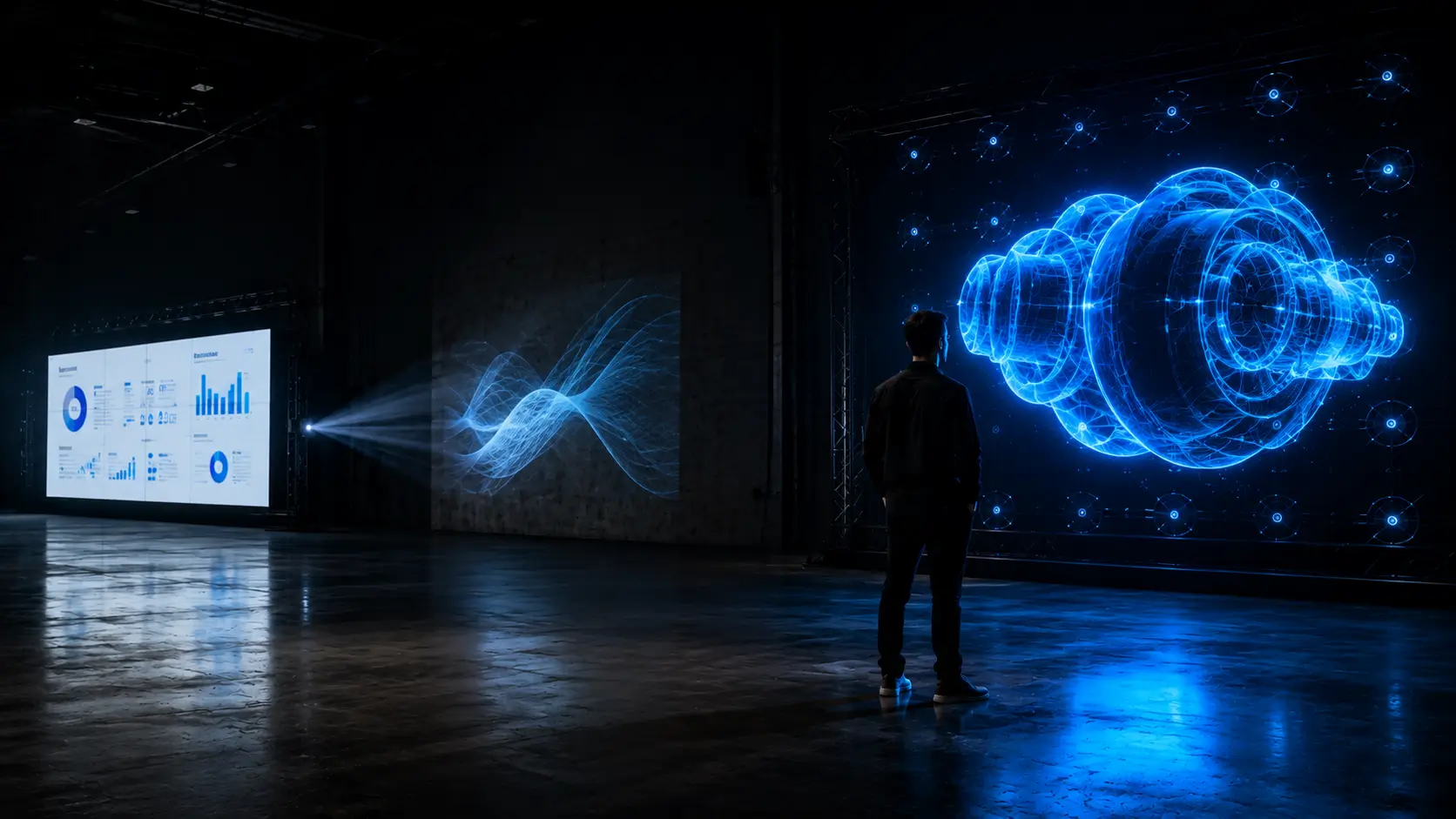
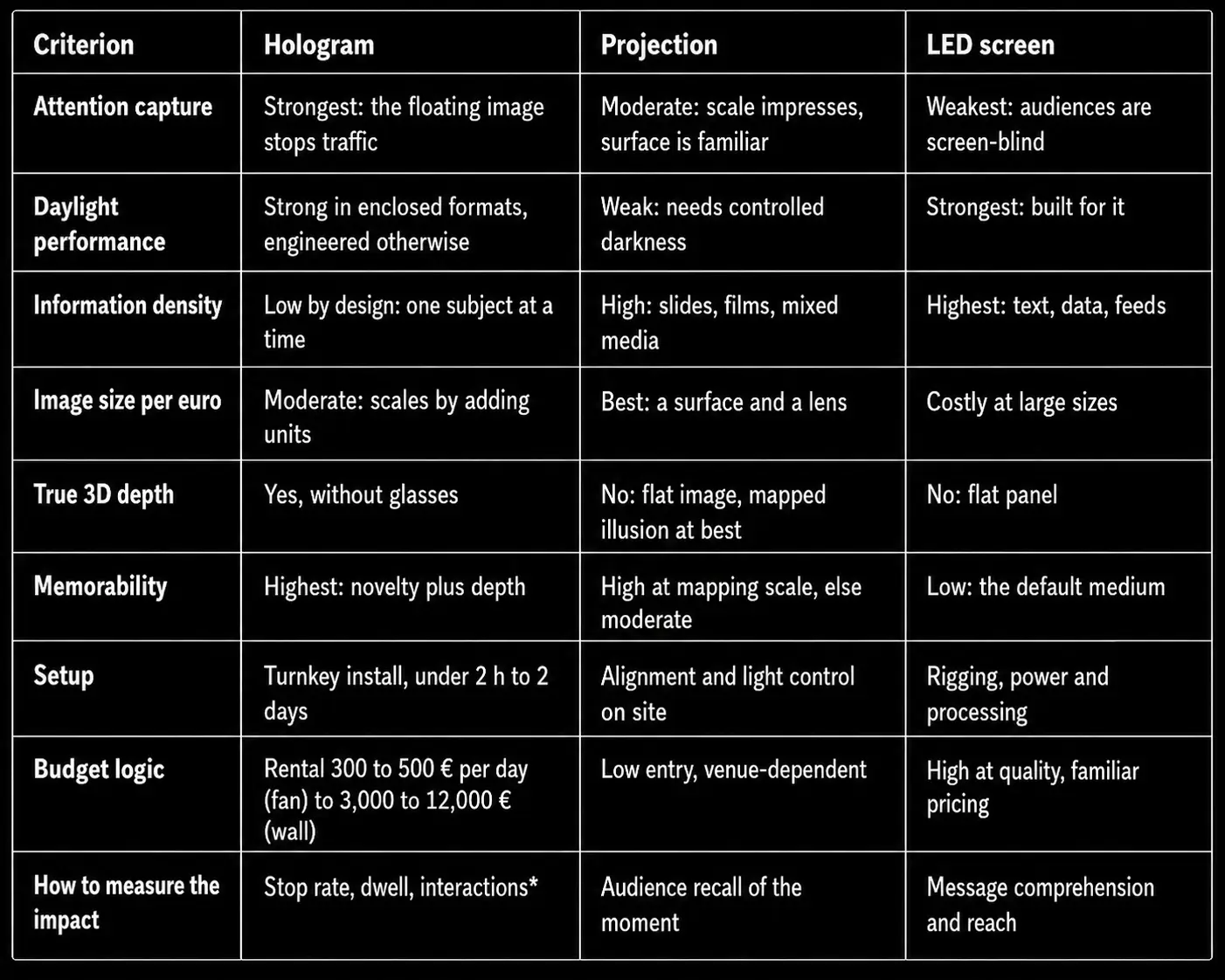
None of the three wins everywhere. LED screens win on brightness and information density, video projection wins on image size per euro, and holograms win on attention, depth and memorability. The right choice follows the job: data on LED, scale on projection, the moment itself on the hologram. The decision matrix below settles it criterion by criterion.
For the Black Box Experience, Mercedes-Benz had every display technology on earth available. The choice was holographic staging, because the brief was not to show information: it was to create presence.
That is the honest frame for this comparison. Holovisio, the company behind hologramme.co, builds holographic devices for a living, and this guide will still tell you plainly where an LED wall or a projector beats us, because a display chosen for the wrong job disappoints everyone, supplier included.
Scope note: this article covers the projection and LED axis only. The augmented reality comparison lives in our holograms vs AR guide, and the two are complements.
The three technologies in ninety seconds
• LED screen or LED wall. Emissive panels behind glass: the brightest of the three, unbeatable in daylight, and the natural home of dense information: agendas, data, live camera feeds, long text. Familiar to every audience, which is both its reliability and its ceiling. Operationally it wants rigging, power and a processor, and its failure mode is one dead panel in an otherwise perfect grid.
• Video projection. Light thrown onto a surface: the largest image per euro of the three, and the only one that turns existing architecture into a canvas. It needs controlled darkness to look its best, and the surface always remains visibly a surface. It travels light but re-aligns at every venue, which makes it the most site-dependent of the three.
• Hologram. Content rendered as light floating free in space, with real depth and no glasses: the strongest attention capture and the most memorable of the three. It trades information density for presence: one product, one figure, one moment, held in the air. It ships in flight cases and installs turnkey, the same configuration venue after venue.
The decision matrix
Nine criteria, three columns, no diplomacy. The 3D holographic display page by Holovisio carries the hologram column's formats in detail.
When the LED screen wins
Choose LED when the job is information under bright light: session agendas, sponsor loops, live camera relays, dashboards, anything with sentences. On an open-air stage or a sunlit atrium, LED is not just better, it is the only serious answer. It is also the medium procurement already knows how to buy, which counts on a deadline. The mistake is asking it to also be the moment: audiences have spent two decades learning to walk past screens.
When projection wins
Choose projection when the brief says big and the venue can go dark: immersive rooms, mapped facades, gala reveals across a whole wall. Nothing else delivers those square metres at that budget. Its condition is discipline: ambient light is its enemy, and the surface, however well mapped, stays a surface the eye eventually files as decor. One nuance keeps the columns fair: holographic projection, the scenography-scale variant Holovisio operates, borrows this column's size economics while keeping the floating-image effect, the format that blurs the line on purpose.
When the hologram wins
Choose the hologram when the event turns on a moment: a product reveal, a launch, a figure appearing, the single focal point everything else serves. Depth without glasses is the mechanism: the content occupies space the way an object does, and people respond to it the way they respond to objects, by stopping. The trade is honest: if the audience must read three paragraphs, this is the wrong column.
That is what the Mercedes-Benz Black Box Experience engineered: not more pixels, but presence, a staged holographic narrative where the technology disappears and the attention remains. Third-party benchmarks put the gains at up to 4 times the visibility and 50 percent more interaction time (figures vary by content and context), but the sharper statistic comes from the event industry itself: attendees who experience a genuine peak moment are 85 percent more likely to return, and only 40 percent report having had one, according to the Freeman Trends Report. Peak moments are precisely what holographic staging manufactures.
Six questions that decide it in one pass
When the matrix feels like too many rows, six questions collapse it:
• Is the venue bright and uncontrollable? LED, or an enclosed holographic format built for daylight.
• Is the content sentences and data, or a subject? Sentences go to LED; a subject earns the hologram.
• Is there one moment that must be remembered? That moment is the hologram's job description.
• Is the budget mostly square metres? Projection delivers the most surface per euro, venue permitting.
• Will the same setup travel across a season? Holograms and LED travel as configured; projection re-aligns at every stop.
• Does it need to live in a window or storefront? Enclosed holographic formats are built for glass; projection dies there; LED works but joins the wallpaper.
.webp)
Mixing them: the real-world answer
The best events rarely choose one. The working combination gives each technology its job: LED carries the information layer, projection dresses the volume, and the hologram takes the moment. One planning rule keeps the mix honest: give the elements separation, since any bright source aimed across a floating image costs it contrast.
• On a trade show stand: LED back wall for the message, hologram at the aisle edge as the stopping point, the pattern our exhibitor guide builds the timeline around.
• At a congress or gala: slides and relays on LED, projection washing the room, holographic staging at the entrance and on stage for the beats that must be remembered.
• In a showroom or flagship: LED for wayfinding and catalogue depth, a holographic wall or case where the signature product deserves an audience.
Budget the mix by role, not by square metre: in practice the hologram is usually the smallest display line on the budget sheet and the largest one in the post-event photo roll. The full holographic brackets are in our hologram cost guide.
For the other axis of this decision, read holograms vs augmented reality; for the device families behind the hologram column, the complete guide to holograms maps them all. Both comparisons end at the same place: match the medium to the job.
Holovisio, the company behind hologramme.co, designs, produces and operates holographic displays (fans, HoloBox, pyramids, walls, projections) for companies, from Mercedes-Benz to Stryker. Rental or purchase, 3D content included. Request a quote.
By the Holovisio team · hologramme.co
Boost your ROI with holograms
Your goals, our solution, your results.


