
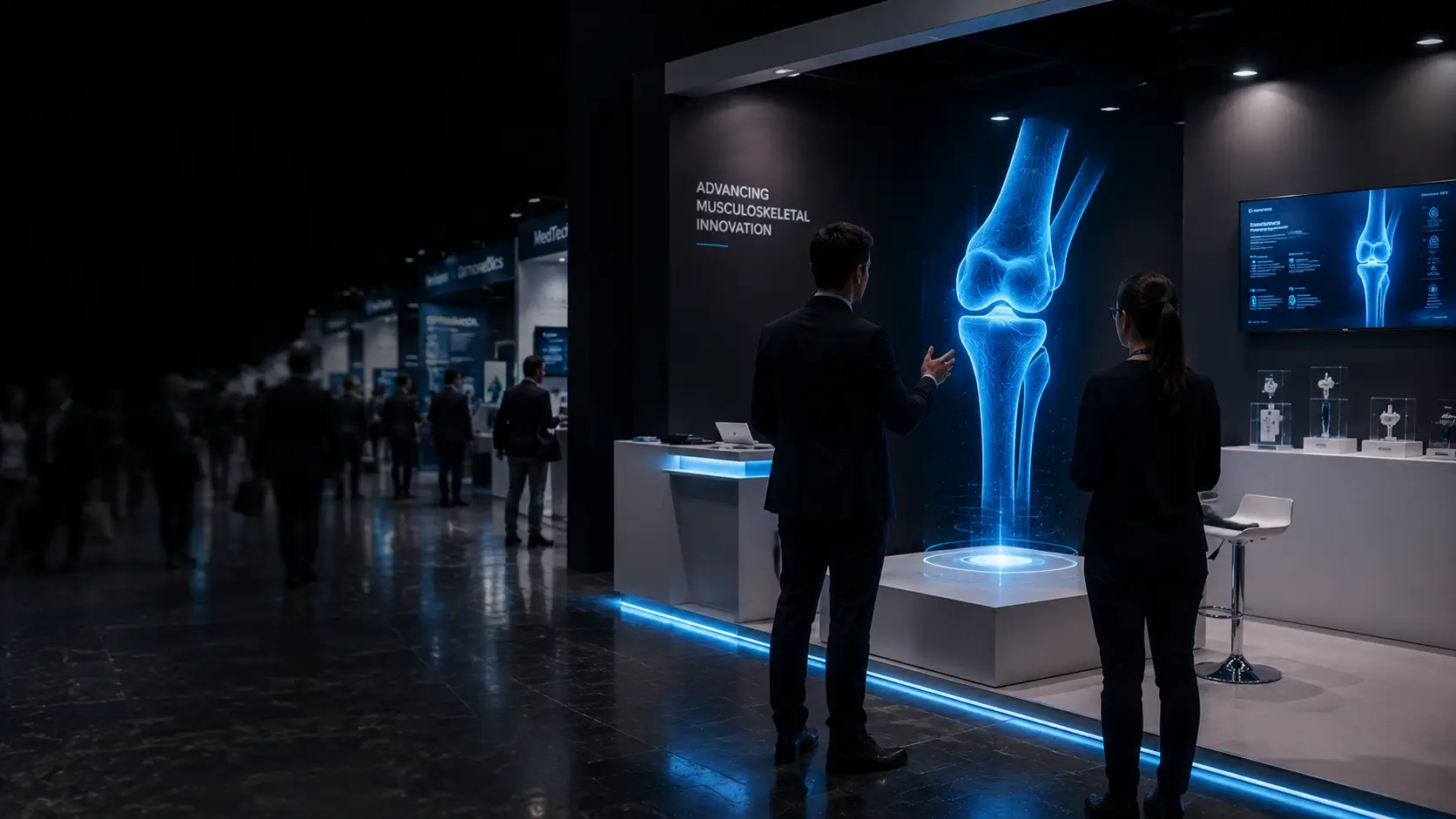
Stryker runs the hologram as the storytelling centerpiece of its booths across more than four international medical congresses; Lilly used a holographic totem and stage devices to reframe its own scientific congress in Brussels. Both solved the same problem: making complex medical innovation understood in seconds, inside strict compliance boundaries.
A hip system and a molecule share the same trade show problem. One cannot be handled by every passerby, the other cannot be seen at all, and the congress aisle gives you seconds either way.
Two of the industry's biggest names solved it holographically with Holovisio, the company behind hologramme.co, and their playbooks cover both halves of congress season: the exhibitor booth and the owned scientific event.
This article is the proof file. The commercial side, formats, booking and congress logistics, lives on our holographic displays for medical device trade shows page.
The problem a medical booth has to solve
Health care professionals walk congress aisles between sessions, badge-scanned and time-poor, past stands that all promise innovation, and the average conversation window is shorter than an elevator pitch. Three constraints make the medical version of this game harder than any other sector's.
• The invisible product. Implants sit in sterile packaging, mechanisms of action happen at cellular scale, and software lives behind a login. The thing being sold is rarely the thing on the table.
• The compliance ceiling. What can be claimed, shown and handed over is regulated, reviewed and audited. Booth creativity operates inside a fence other industries never see.
• The consistency problem. The same story has to survive different countries, languages and team rosters across a season of congresses, without drifting off its approved version.
Stryker: one storytelling device across a season of congresses
At high-traffic meetings like the EHS in Lille, and at major events in Italy and Finland, Stryker faced the standard equation: visitors' attention time is extremely limited, and every neighbouring stand competes with its own visual innovation.
The response was structural rather than decorative. Stryker integrated the hologram as the central product storytelling tool at more than four international shows, designed to do three things: materialize solutions without physical constraints, stage the key benefits immediately, and support the sales conversation without ever replacing it. For a portfolio brand, that first point is the quiet win: the hologram made the range legible, not just one hero product.
The results read like a sales director's wish list: visitors understand the offer faster, exchanges are more qualitative, and the global portfolio becomes readable at a glance. Just as valuable is what the format did across borders: the same device delivered the same story in every country, to every audience, show after show. The full narrative is in the Stryker case study.
Lilly: a holographic thread through its own scientific congress
Lilly's play was the mirror image: not a booth at someone else's show, but its own scientific congress for health specialists at the Quartier Papier in Brussels. The risk was familiar to every pharma events team: important science diluted into a format its audience sees dozens of times a year, in an industrial loft whose imposing volumes demanded presence without noise.
Holovisio deployed two complementary devices. At reception, a transparent plexiglas totem housing a protected holographic propeller played a custom sequence: the Lilly logo, the congress theme and stylized scientific visuals in levitation. In the plenary room, holographic propellers flanked the stage with branded animations synchronized to the room's blue lighting, adding depth to every talk without ever competing with it. The protected totem format was itself a venue answer: moving devices, safely enclosed, in a space where guests circulate with glasses in hand.
Guests stopped at the totem before entering, which smoothed the welcome and started the first conversations about innovation. Onstage, the premium setting reinforced the credibility of the scientific interventions, and the event separated itself in a market where every congress courts the same professionals. The detail is in the Lilly case study.
Two playbooks, one grammar
The grammar both share: the hologram earns the first three seconds, the humans take it from there, and the content never says more than the approved materials do. That grammar travels to any US congress calendar, from MD&M West to RSNA, without renegotiation.
Compliance without the beige booth
The instinct in regulated marketing is to treat compliance as a ceiling on creativity. The two cases treat it as the design brief, which is why neither project reads as compliant in the pejorative sense, and four habits make that work.
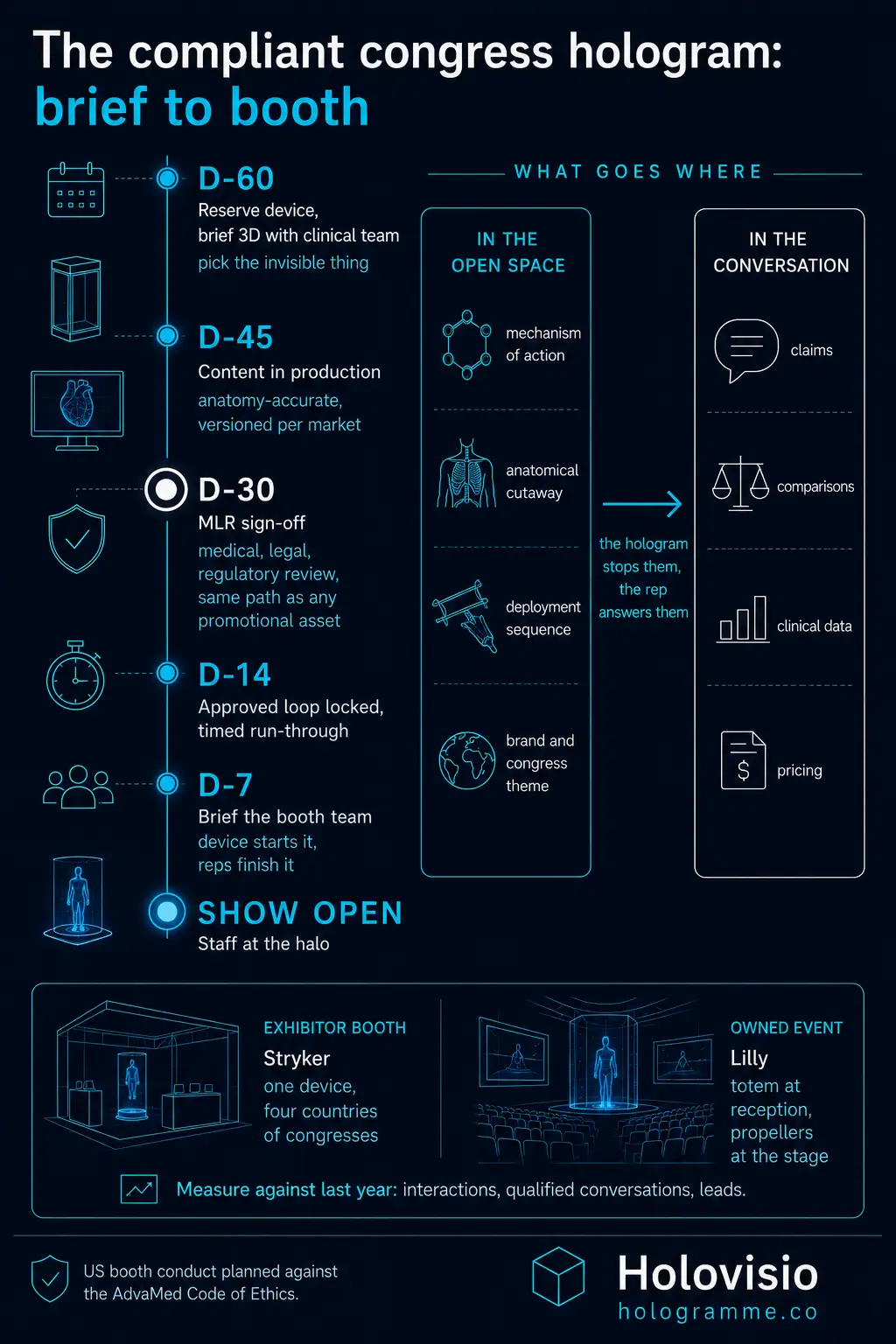
• On-label discipline. Holographic content goes through the same medical, legal and regulatory review as any promotional asset. In the exhibitor timeline, that sign-off sits at the D-30 mark, not the week of the show.
• Educational framing. Mechanisms of action, anatomy, deployment sequences and procedure steps, built with clinical teams through the Studio by Holovisio so accuracy is a feature rather than a caveat.
• The Lilly move. In open spaces, show brand, theme and stylized science; keep the claims where they belong, in the reviewed materials and the qualified conversation.
• The reference frame. For US congress conduct, the AdvaMed Code of Ethics is the industry's baseline for interactions with health care professionals, and booth behaviour and content are planned against it from the first brief.
The replicable checklist
• Pick the invisible thing. The mechanism, the cutaway, the deployment sequence no table demo can show: that is the hologram's job description.
• Build the 3D with clinical input. Anatomy-accurate, on-label, versioned per market, and reusable across the whole congress season.
• Choose loop or show-called. A 20 to 30 second loop works the aisle; an operated sequence carries scheduled HCP demos.
• Put the team at the halo. The device starts the conversation; the representatives finish it. Staff stand where the stopped visitors are.
• Measure against last year. Same congress, same metric: interactions, qualified conversations, leads. Benchmarks put engagement gains at up to 70 percent (figures vary by content and context); your own delta is the number that matters.
Frequently asked questions
Are holograms allowed at medical congresses?
Yes. The hardware is treated like any stand AV, subject to the organiser's height and power rules, and the content follows the same medical, legal and regulatory review as every other promotional or educational asset on the booth. Live or recorded human holograms of speakers follow the same review path.
What can a medical device hologram actually show?
Mechanisms of action, implant deployment, anatomical cutaways, procedure steps and software interfaces at readable scale: educational, on-label content co-produced with clinical teams, which is exactly the material a physical demo struggles to deliver in an aisle.
What does it cost to add a hologram to a congress booth?
Turnkey packages, hardware, adapted 3D content and installation included, start at 2,000 euros with a quote returned within 48 hours. The full 2026 brackets, rental and purchase, are in our hologram cost guide.
For execution mechanics, the trade show hologram guide carries the D-60 timeline; the complete guide to holograms maps every format. The proof sits above, one click deep whenever the internal deck needs it.
Holovisio, the company behind hologramme.co, designs, produces and operates holographic displays (fans, HoloBox, pyramids, walls, projections) for companies, from Mercedes-Benz to Stryker. Rental or purchase, 3D content included. Request a quote.
By the Holovisio team · hologramme.co
Boost your ROI with holograms
Your goals, our solution, your results.


