
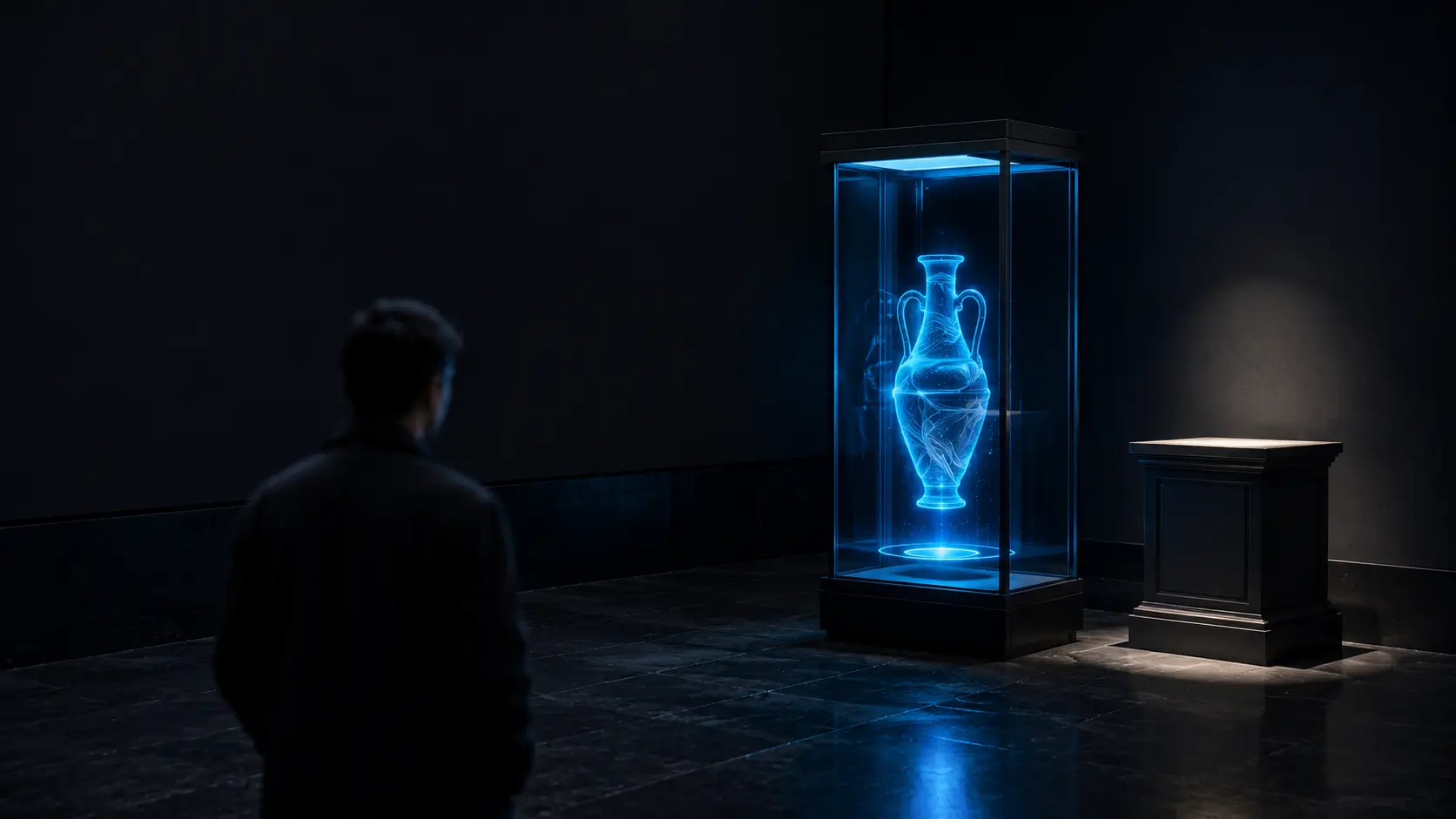
Holograms let museums exhibit what a vitrine cannot: fragile originals kept in reserve, lost works, invisible layers, living context. Enclosed formats like the HoloBox integrate into gallery scenography with no structural work, run for months, and have now carried two national pavilions at the Venice Biennale, in 2024 and 2025.
For the 2024 Art Biennale in Venice, the Swiss Pavilion trusted a holographic installation with one of the most scrutinized artistic briefs in theworld. One year later, the Moroccan Pavilion did the same at the Architecture Biennale.
Two consecutive editions, two national pavilions, onesupplier. Holovisio, the company behind hologramme.co, operated both,and this guide condenses what those runs taught us into the questions curatorsand exhibition designers actually ask.
A scope note first: our article on holograms in art looks at the medium from the artists' side. This one takes the institution'sside: formats, constraints, and what a months-long public run really requires.
What ahologram lets you exhibit that a vitrine cannot?
The strongest curatorial case is not spectacle. It isaccess: a hologram puts in front of visitors what the collection cannotphysically show, without moving a single accession number.
• Fragile originals. The object stays in climate-controlled reserve while ananimated, life-scale double meets the public, rotating, opening, or dissolvinginto its own restoration layers.
• Lost and displacedworks. Destroyed pieces, repatriated objectsand items on loan elsewhere can hold their place in the narrative at fullpresence rather than as a wall label.
• The invisible. Underdrawings, construction techniques, interiormechanisms and archaeological strata become visible in sequence, in the gallery,next to the real thing.
• Living context. Craft, ritual and performance can inhabit the exhibition:the Moroccan Pavilion in Venice projected artisans at work across a facade ofluminous propellers, memory and modernity on the same wall.
• The next audience. Museums courting younger visitors meet them on familiarground: at the 2024 Biennale, 30 percent of the 700,000 visitors were under 26,and immersive rooms are consistently where they linger.
Whichholographic format fits which exhibition space?
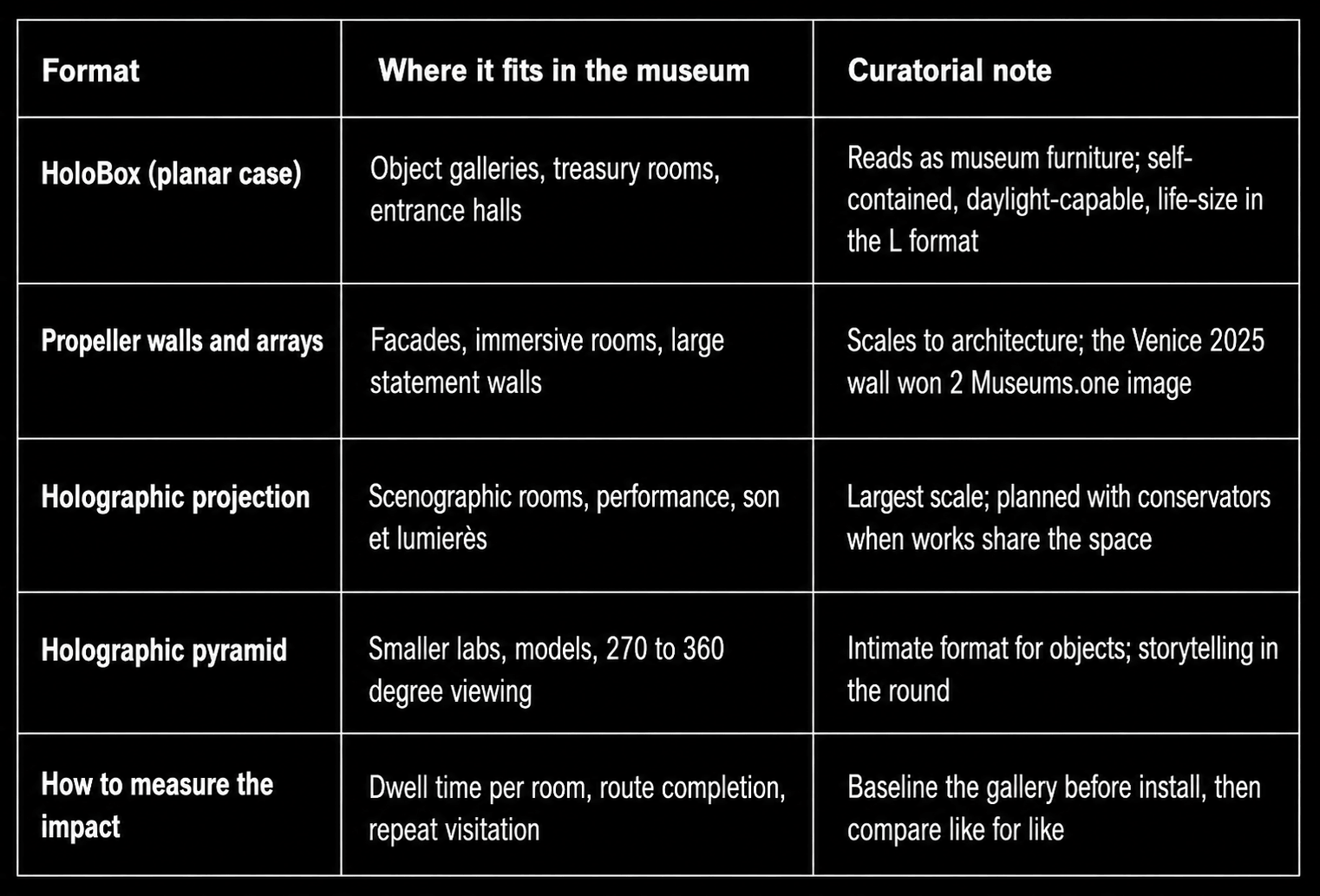
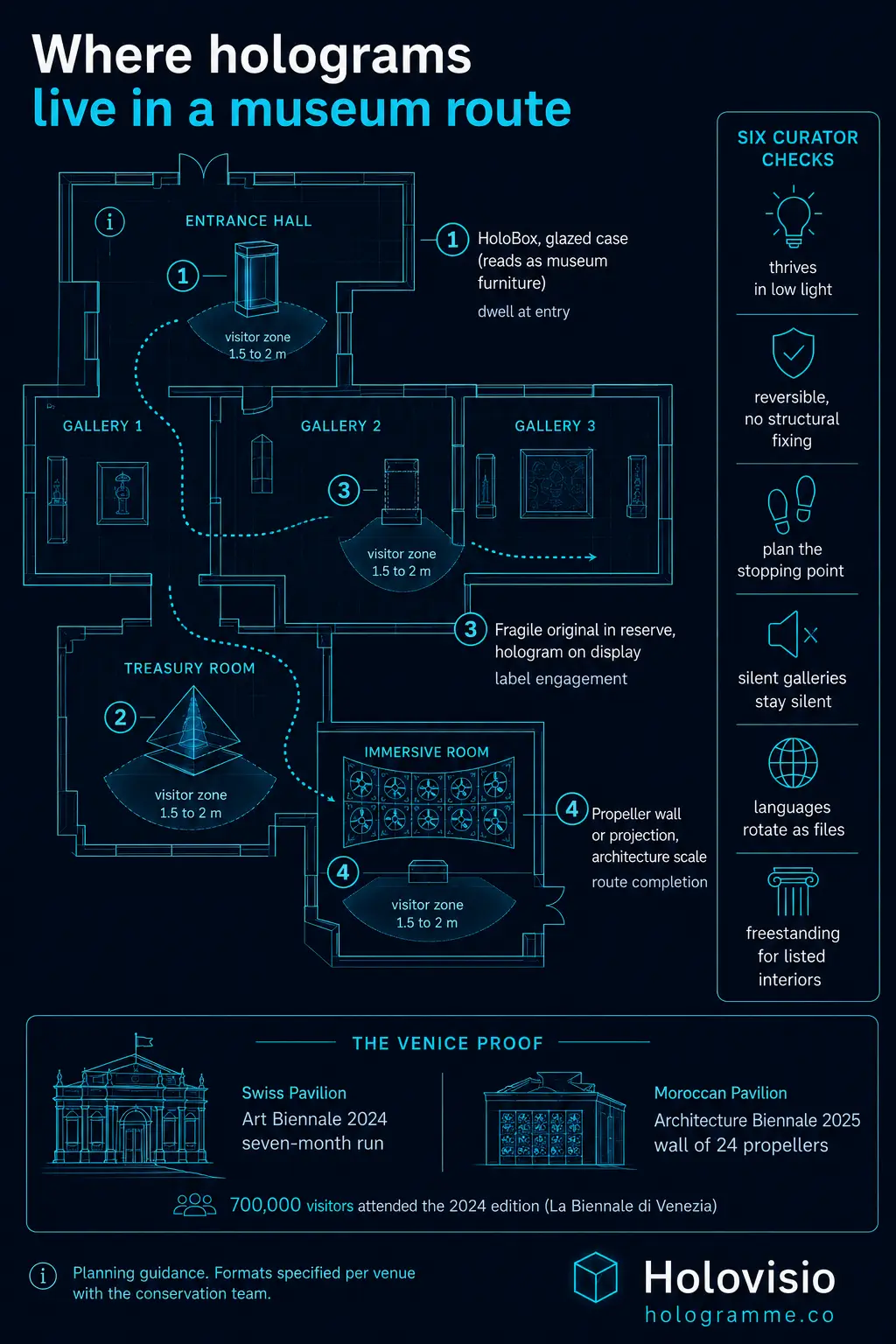
Format choice is a scenography decision before it is atechnical one. Four families cover most museum briefs, and each readsdifferently in a gallery; the HoloBox by Holovisio,whose glazed case reads as museum furniture, is the most requested for objectgalleries. Formats also combine along a single route: a pyramid in thetreasury, a wall in the immersive room, a glazed case at the entrance, eachholding its own register.
The sixconstraints curators raise first
Every institutional conversation lands on the same sixsubjects. All of them have clean answers when they are planned at the designstage rather than at delivery.
• Light discipline. Holographic displays thrive in the dim conditionsconservation already imposes: the darker the room, the stronger the image.Enclosed formats also hold up in daylight for atriums and street-facing spaces.
• Conservation andreversibility. Enclosed, screen-basedunits are self-contained, run on a standard outlet and require no structuralfixing: the installation leaves no trace when the exhibition closes. Projectionformats that share space with works are specified together with theconservation team.
• Visitor flow. A hologram creates a stopping point, so it is placed likeone: 1.5 to 2 metres of standing zone, sightlines that do not blockcirculation, and a position in the route where a cluster of visitors helps theroom rather than jams it.
• Sound. Silent galleries stay silent: content runs muted orenclosed formats are chosen where mechanical noise would intrude, and audio,when wanted, is directional.
• Access and languages. Content is a file, so language versions, subtitles andaudio-described loops rotate on schedule, and the display itself needs nointeraction to be understood.
• Historic buildings. Freestanding, self-powered units suit listed interiors:nothing is fixed into protected fabric, no rigging touches the ceiling, and thefloor load stays within ordinary furniture range for standard configurations.
Venice,twice: what two national pavilions proved
In 2024, the Swiss Pavilion, under the aegis of ProHelvetia, presented Super Superior Civilizations by the artist Guerreiro doDivino Amor: a dense, critical work on national mythologies, stagedholographically inside one of the most rigorous institutional frameworks in theart world. The published brief was explicit: the technology serves the work,never the other way around.
The installation ran the full seven-month season of anedition that drew 700,000 visitors, 59 percent of them from abroad, according to La Biennale di Venezia.That is a museum-grade endurance test: daily public operation, internationalpress, and an artwork whose credibility could not be dented by a technicalincident.
In 2025, the Kingdom of Morocco answered the ArchitectureBiennale's theme on natural, artificial and collective intelligence with adouble-sided wall: raw earthen materials, adobe, local stone and mud brick onone face, and on the other a luminous facade of 24 holographic propellersprojecting Moroccan artisans at work. Public and critics received it as exactlythe dialogue it staged: heritage and transmission, carried by a contemporarymedium.
For a curator, the two projects answer the reliabilityquestion and the credibility question at once. The medium held a nationalpavilion's discourse for months, twice, in the most photographed exhibitioncontext on earth.
What transfers to any institution is the method rather thanthe glamour: brief the device like a work, integrate it into the scenographyfrom the first sketch, and plan the run like an operations schedule, withcontent updates and support scoped for the full season.
How a museum project runs, from loan to permanent gallery?
The process starts where it should: with the curatorialintent, not the hardware. Content is co-produced with the curators, the artistsor the collection team, and the Studio by Holovisio handles the 3D production, so the files remain the institution'sassets for future re-use.
Temporary exhibitions typically run on rental: delivery, installation, training and teardown areincluded, which keeps a three-month show light on the museum's own teams.Permanent galleries and long-term displays shift the logic to purchase, withmaintenance and content updates planned across the life of the display.
Third-party benchmarks point to up to 50 percent moreinteraction time with the featured subject (figures vary by content andcontext), which in a museum translates into the metric every exhibition reportcares about: dwell. Route completion and repeat visitation follow the samelogic: measure the gallery before the install, then compare the season like forlike.
On lead times, standard rentals book two to four weeksahead; co-produced artistic or collection content extends the runway, andpavilion-scale projects are planned months out with the scenographer. Theearlier the conversation starts, the more the technology disappears into thedesign.
For the artists' perspective on the medium, read ourpiece on holograms in art; thetwo articles are complements, not competitors. For practical sizing, the HoloBox space and installation guide gives the planning numbers, and the completeguide to holograms maps every devicefamily. If the project tours, the same planning logic applies venue by venue,with the content travelling as files.
Holovisio, the company behind hologramme.co, designs,produces and operates holographic displays (fans, HoloBox, pyramids, walls,projections) for companies and institutions, from Mercedes-Benz to the VeniceBiennale pavilions. Rental or purchase, 3D content included. Requesta quote.
By the Holovisio team · hologramme.co
Booster votre ROI grâce a l'hologramme
Un échange sur vos objectifs, une solution, du résultat.


