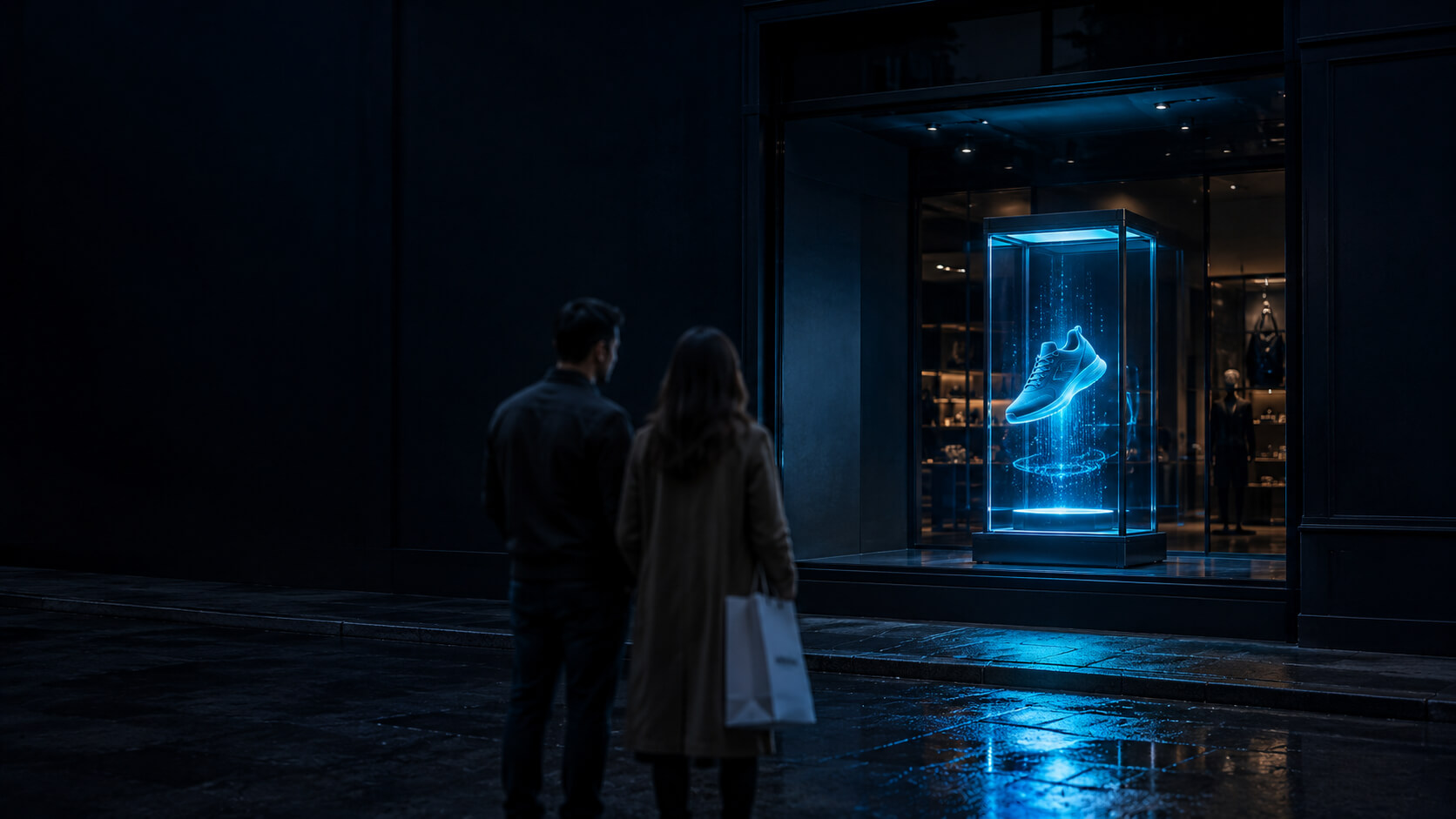
Holograms give educationwhat slides cannot: anatomy, machines, molecules and history rendered life-sizein the room, visible to the whole class at once, with no headsets. Institutionsdeploy the digital HoloBox in classrooms, labs and academies, with 3D contentbuilt with faculty and reused cohort after cohort.
Every teacher meets the same wall: the most importantthings in the syllabus cannot be brought to class. The beating heart, therunning engine, the burning star, the fallen city. Education has always beenthe art of describing what the room cannot hold.
Holographic display removes a piece of that wall, andthis guide covers the institutional version of the answer: where hologramsolutions for education actually land, which device carries them, how thecontent is built, and what the budget paths look like. Holovisio, thecompany behind hologramme.co, already deploys holographic devices fortraining and education across healthcare and industry, and for publicinstitutions such as Le Mans Metropole.
The evidence base for immersive 3D learning is unusuallystrong. PwC's landmark study found immersive learners trained up to four times faster than classroom peers,with far higher confidence and focus. The hologram brings that immersivegrammar into the room with one decisive difference: no headsets, one sharedimage, the whole class watching the same floating object together.
What ahologram changes in a classroom
The mechanism is spatial understanding. Structures thatflatten to mush on a slide, a ventricle behind a ventricle, a gear train insidea housing, a molecule's true geometry, hold their depth as floating 3D,rotating, exploding into layers, reassembling on cue, at the pace of theexplanation rather than the pace of a video.
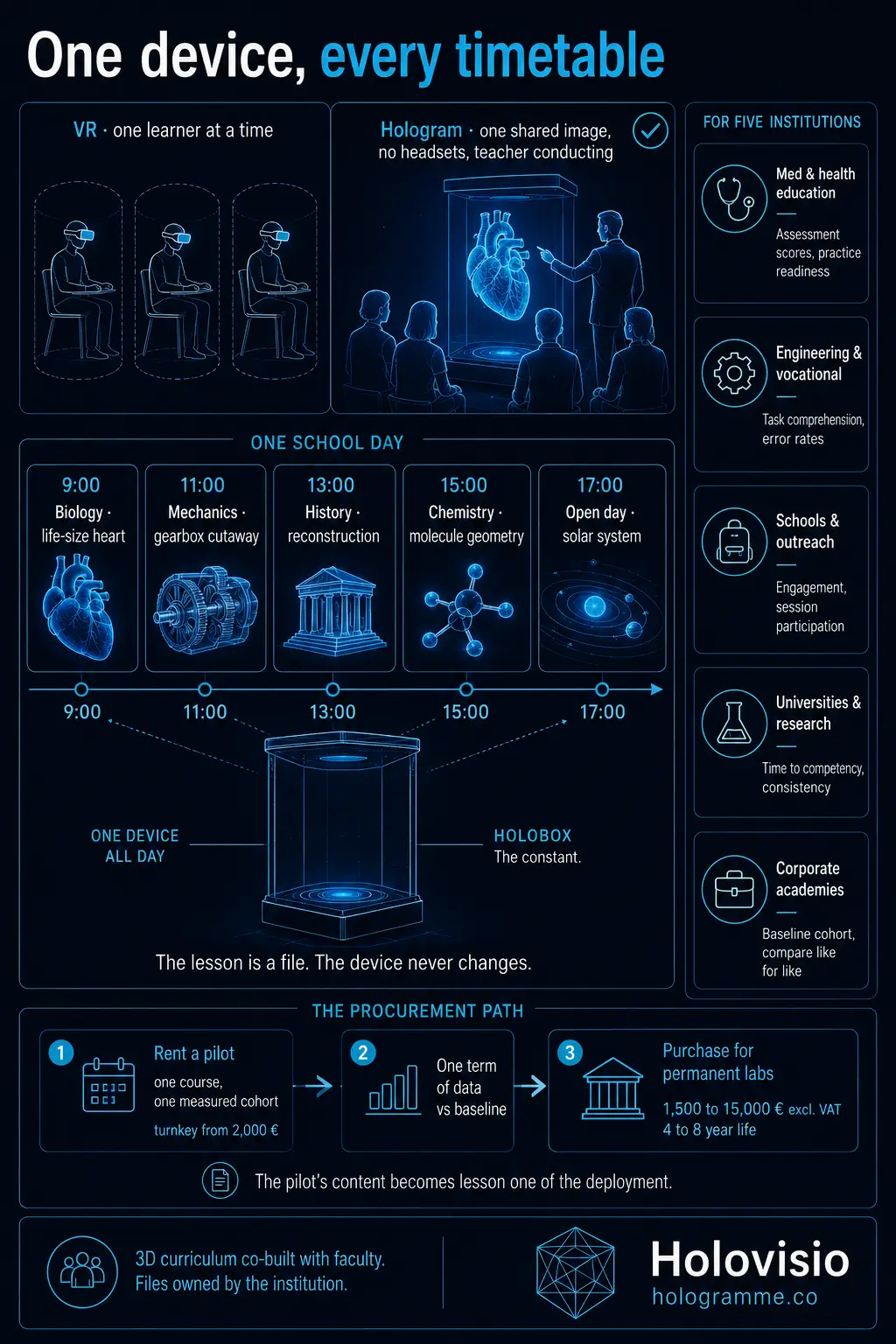
The social mechanism matters just as much. Unlike VR,which teaches one student at a time inside a headset, the hologram is a sharedobject: thirty students and one teacher looking at the same heart, pointing atthe same valve, asking questions out loud. The teacher stays the conductor,pausing, rotating and questioning, with the hologram as the instrument ratherthan the lesson.
And it is repeatable at zero marginal cost: thedissection that used to be an annual event becomes Tuesday's lesson, runidentically for every cohort, every year, from the same file. Thatrepeatability is also the equity argument: the school that cannot fund thefield trip can fund the file.
The format is also quietly inclusive: no headset means nomotion discomfort, no hygiene rotation between students, and full visibilityfor the teacher of where every pair of eyes actually is.
Educationinstitutions: where it lands
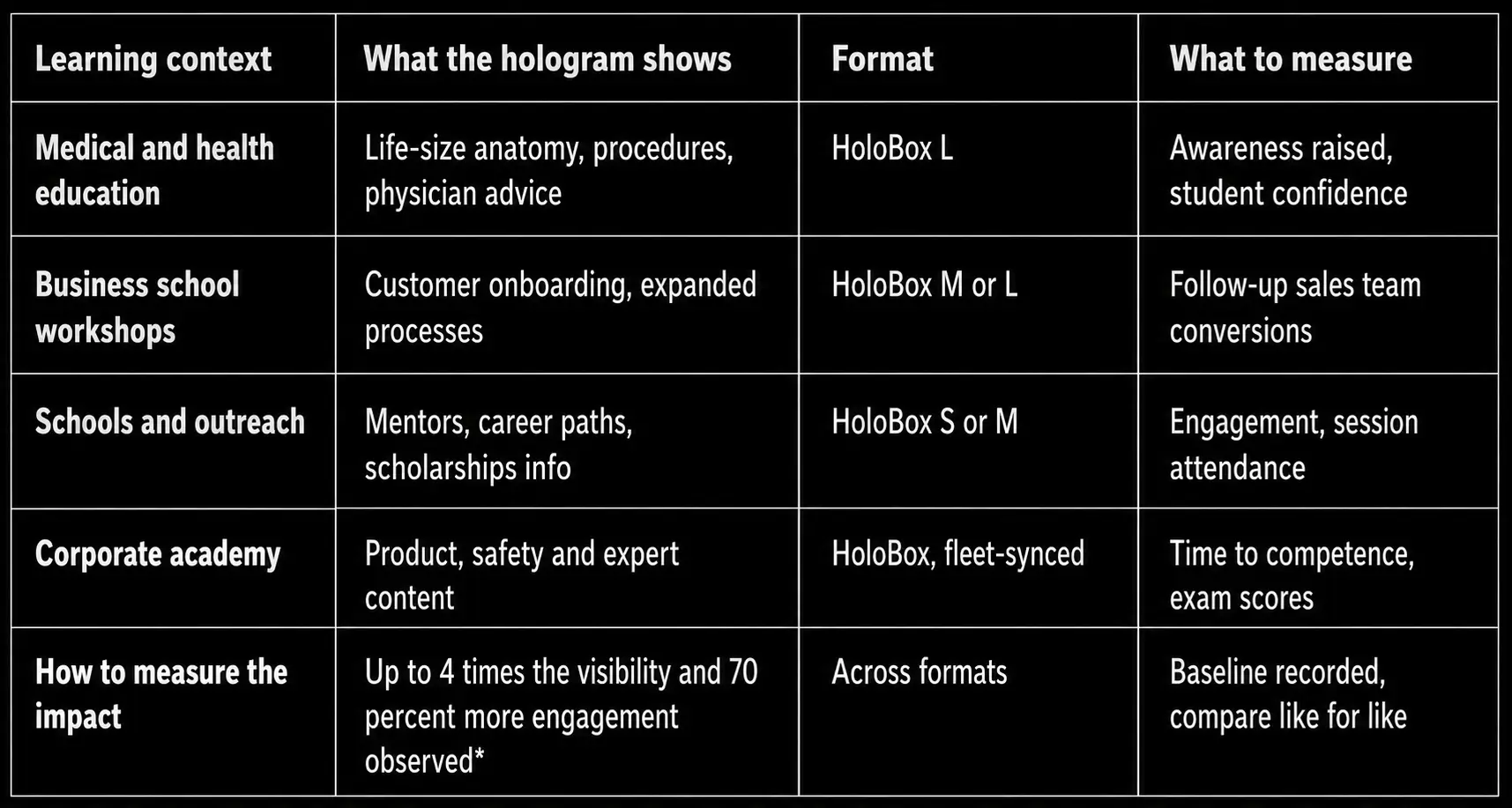
• Medical and healtheducation. Anatomy at life size,physiological processes in motion, procedure steps sequenced in the round: thecontent that made holograms standard at medical congresses translates directlyinto the lecture theatre and the simulation lab, and the model never tires, neverdecays and is never in short supply, which anatomy departments will recognizeas three separate miracles.
• Engineering andvocational schools. Machines in cutaway,assemblies exploding into their parts, processes animated end to end. It is theclassroom edition of the digit al twin logic:the object of study present, manipulable and unbreakable.
• Schools and scienceoutreach. Cells and single-celled lifeat monumental scale, the solar system in the gymnasium, historicalreconstructions that put the class inside the chapter: the themes that makeopen days and science weeks memorable. For open days in particular, it is alsothe photograph parents take home.
• Universities andresearch communication. Beyond teaching,the hologram is a publication format: labs render their findings as floating 3Dfor defenses, open campuses and funders, turning abstracts into objects.
• Corporate academies. Onboarding, safety training, product knowledge: onefilmed or generated expert, one accurate 3D asset, present identically in everysite's training room, which is how scarce expertise becomes infrastructure.Time to competency is the metric, and fleet sync means two sites on two continentsonboard identically.
Thedigital HoloBox in the classroom
The device question resolves quickly for institutions.The HoloBox is aglazed holographic display running interactive 4K content at up to life size,readable in a daylit classroom, plug and play on a standard outlet, in formatsfrom a counter unit for the lab bench to the life-size L for the lecturetheatre: the configuration institutions increasingly search for as the digitalHoloBox for education.
The enclosure earns its place in a school: the hardwaresits protected behind glass, survives corridors and curiosity, and installswithout structural work, so the same unit serves biology at nine and mechanicsat eleven, the lesson swapped as a file. For the optics behind the glass, ourexplainer on how the HoloBox workscovers the reflection system.
Practicalities stay light. Loops run without a network,interactive modes take a standard connection, the timetable logic is one fileper period, and there are no exposed moving parts, which matters in rooms fullof teenagers and bags.
Content:the curriculum is the asset
The hardware is the smaller half of the decision. Thelasting asset is the 3D curriculum: models and animations co-built with facultythrough the Studio by Holovisio, technically and anatomically accurate, versioned per course and perlanguage, owned by the institution, and delivered in formats its own AV teamcan manage.
That ownership changes the economics. A commissionedheart, gearbox or historical reconstruction amortises across every cohort thatstudies it, travels between campuses as a file, and updates when the syllabusdoes, which is why the content line deserves more scrutiny than the device linein any education quote. The practical brief rule: commission the asset at thefidelity the hardest course needs, then simplify downward per level, never thereverse.
Budgetsand paths for institutions
Two paths cover almost every institutional case. Rental suits pilots, open days, science weeks andsingle-semester programmes: turnkey from 2,000 euros excluding VAT, delivery,installation, training and pickup included, with quotes returned within 48hours.
Permanent teaching installations flip quickly to purchase, the education pattern par excellence, since a classroomdevice works every teaching day: professional units run 1,500 to 15,000 eurosexcluding VAT depending on model and services, with maintenance and contentupdates planned across a 4 to 8 year working life.
The procurement-friendly sequence is the one thatsurvives committees: a rented pilot with a measured cohort, a term of dataagainst the baseline, then the deployment case written in the institution's ownnumbers. Committees also like what the file format implies: the pilot's contentis not sunk cost, it becomes lesson one of the deployment.
For the wider device families, the complete guide to holograms maps them all; forthe industrial cousin of the classroom cutaway, read our piece on holograms and digital twins. The wall between the syllabus and the room is thinnerthan it has ever been.
Holovisio, the company behind hologramme.co, designs,produces and operates holographic displays (fans, HoloBox, pyramids, walls,projections) for companies and institutions, from Mercedes-Benz to Stryker.Rental or purchase, 3D content included. Requesta quote.
By the Holovisio team · hologramme.co
Booster votre ROI grâce a l'hologramme
Un échange sur vos objectifs, une solution, du résultat.