By Pierre Chabot, co-founder of Holovisio · Last updated: November 12, 2026 · Reading time: 9 min
Digital signage attracts more attention than static displays: eye-tracking studies measure nearly twice the fixation time on an animated poster, and media owners' neuroscience studies report 2 to 8 times more impact. But a look at a screen lasts one to two seconds on average, often under a second in a mall, and the most spectacular version is not the most effective. This page reviews 15 studies, separating independent research from vendor-funded work.
The rule in one sentence
Motion wins the first look; a simple message wins memory. Every serious study points that way, and it should drive how content is designed for screens and holograms.
Holovisio designs and installs holograms and display systems for brands, at events and in retail, since 2019, from Orsay near Paris. This page is part of our collection of hologram and digital signage statistics.
What independent studies measure
Academic studies confirm the advantage of motion, with smaller gaps than media owners report.
- Animated versus static posters: 870 seconds of total fixation versus 462, and 3,743 fixations versus 2,192, across 60 eye-tracked participants. The authors note that side-by-side presentation may favor the animated poster (Applied Sciences, MDPI, December 27, 2025).
- Public displays observed in the field: most looks last one to two seconds, video draws more attention than text or still images, and at some sites only 4% to 16% of passers-by looked up. 46 displays observed in three cities (Pervasive 2008 conference, RWTH Aachen University, old).
- Interactive shop window: 54.8% of 832 passers-by looked, 20.6% interacted, and mirroring the viewer's silhouette produced about 90% more interactions than a plain attract loop (CHI 2012 conference, old).
- Animated sports sponsorship boards: the more intense the animation, the longer the look, 52 eye-tracked viewers (German Sport University Cologne, EASM conference).
The counterpoint you need to know
In a busy place, a screen is seen very briefly. A University College London study presented at CHI 2015 fitted 22 people with eye-tracking glasses in a London mall. Screens were in their field of view 26% of the time but looked at only 3.3% of the time. The average look lasted 0.318 seconds, and 96% of looks were under 800 milliseconds. Only 9 of 52 brightness changes on screens triggered a look.
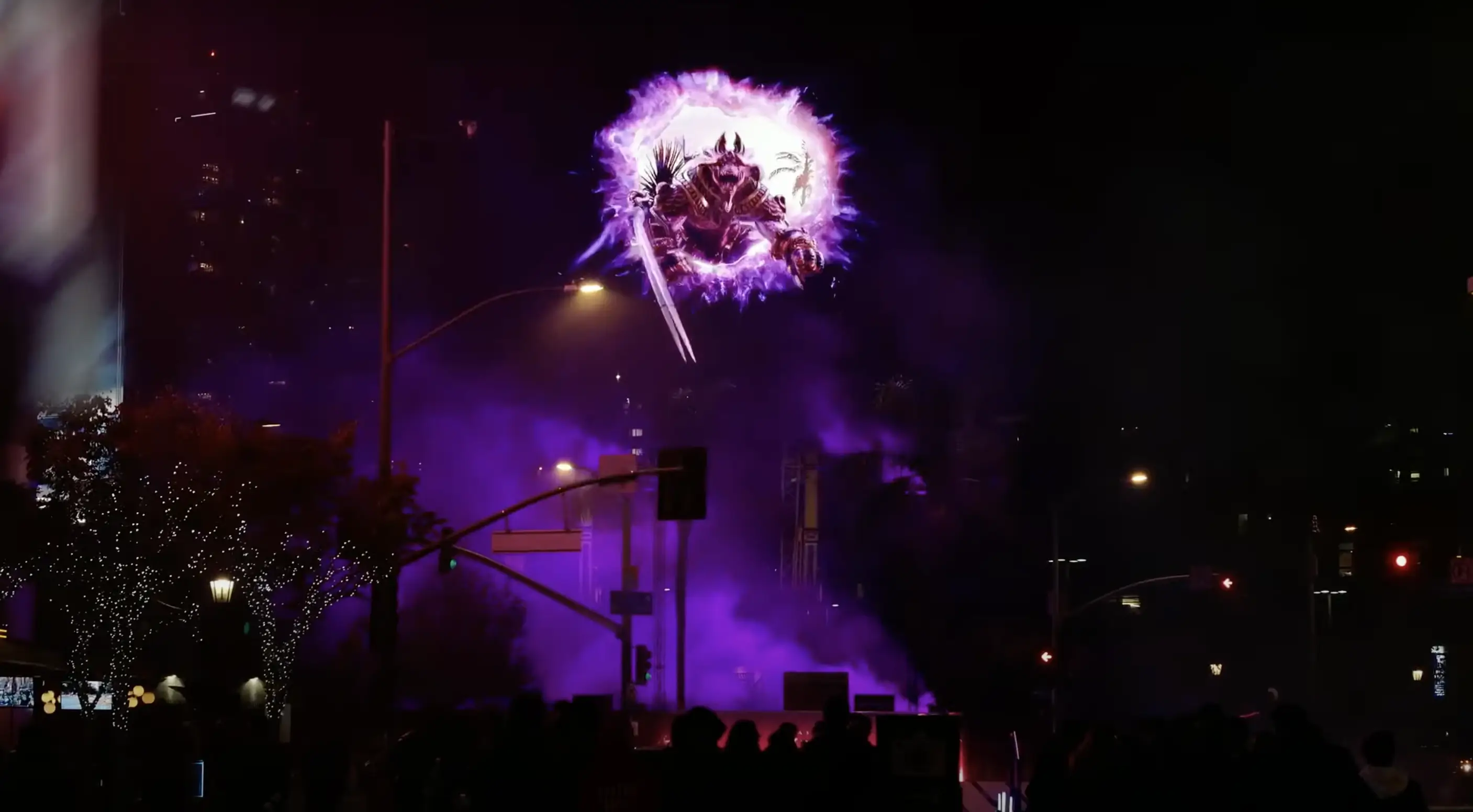
The lesson is direct: content must be understood in under a second. One logo, one product, one promise. That is also why holograms work when the image is simple and floats alone on a black background.
What media owner studies say
Media owners measure high multiples, often with thinly documented samples. These figures are useful, but they are paid for by companies that sell digital space.
- Ocean Outdoor and Lumen Research (June 11, 2025, 2,500 people): large-format digital out-of-home gets 5.1 times more attention per thousand than online formats, video drives 2.5 times more brand choice than static, and 3D formats lift brand desirability by 32%.
- Vistar Media with Omnicom and JCDecaux (May 19, 2026, 7,513 people): motion creative delivers on average 33% more ad recall and 50% more brand awareness than static. 3D motion is said to be "67% more effective" on awareness, with no detail of the calculation.
- Lumen for JCDecaux, Clear Channel, Exterion and APG (2017): video is 25% more likely to be seen than a static poster by drivers, 16% by pedestrians, and equally likely in malls and transit.
- Vertical Impression (January 30, 2025): only 11% more attention for video and 8% for light animation. A more cautious measure, with no published sample.
What neuroscience says
Brain measurements show stronger memory encoding for motion, on small samples.
- Ocean Outdoor and Neuro-Insight: full-motion out-of-home produces 2.5 times more brain impact than static (2017), and 8 times more with interaction; memory encoding is 5 times stronger with social media interaction (2019, 107 lab participants).
- Shopper Media and Neuro-Insight (October 21, 2020, 134 mall journeys): 2 times stronger memory encoding, 88% more eye movement and 2.5 times more return looks for an animated panel.
- QMS and Neuro-Insight (September 14, 2021): creative that evolves over the week shows a 38% difference in encoding by day five, while fixed creative stays flat.
- Clear Channel, JCDecaux and Posterscope (March 3, 2020): content matched to the moment and context lifts brain response by 32%, and sales by 16% versus 9% for a single creative.
The common thread: refreshing content and matching it to context matters as much as the format.
What we know about holograms
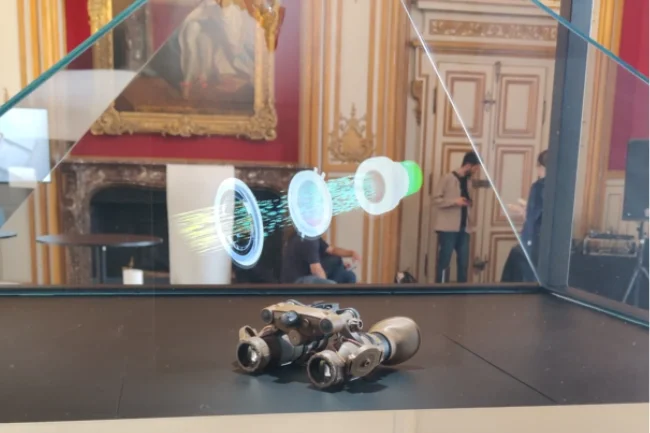
No peer-reviewed study quantifies the effect of holographic LED fans yet. The only academic publication we found, in the Polish journal Marketing i Rynek in 2023, compares holographic LED-fan ads with a 2D poster: stronger positive emotions, higher purchase intent and lower price sensitivity, with no figures in the abstract.
Manufacturers publish their own measures: 13.9 seconds of average viewing for HYPERVSN, 24 seconds for Proto units in US malls. Neither comes with a method or a control group. We cite them for what they are: manufacturer indications.
"A hologram wins the first look almost every time. The real work starts after that: getting the message across in two seconds." Pierre Chabot, co-founder of Holovisio
Two mistakes these studies help you avoid
Believing that more spectacular means more effective. The Journal of Retailing study presented by the University of Bath on October 12, 2022 shows it: the most vivid projection was noticed by 31% of shoppers against 26% for the simple one, yet sold no more. The effect follows an inverted U.
Believing the effect lasts. Novelty attracts, then wears off. Evolving creative keeps its impact; the same loop for months loses it. Our article on digital versus traditional point-of-sale displays explains how to organize that refresh.
Attention figures to stop quoting
- "400% more views": attributed to Intel and Arbitron, absent from the 2009 Arbitron study, which does not compare digital and static.
- "60,000 times faster than text": traced to a 3M brochure with no source.
- "8 seconds, shorter than a goldfish": no underlying research, according to the BBC's investigation.
- "5,000 ads seen per day": a 2005 illustration, not a measurement, according to its own author interviewed by MediaPost in January 2024.
Our position
Motion and 3D give a real advantage on the first look, which is exactly what a hologram sells. But that advantage plays out in one to two seconds, and it fades if the content never changes. Design for the second, refresh monthly, count footfall. Our 3D Studio produces content built for that constraint, and our holographic fan updates remotely. See also our definition of digital signage and our article on sensory marketing and holograms. Let's talk about your project: a quote within 48 hours.
Digital signage and attention FAQ
How long do people look at a screen in a store?
Under a second on average in a busy mall, according to University College London (2015), and one to two seconds for out-of-home ads according to dentsu and JCDecaux (2026). The message must read at a glance.
Does video attract more attention than static images?
Yes. Independent studies measure up to twice the fixation time on an animated poster. Media owners report 11% to 2.5 times more impact depending on method.
Is 3D more effective than 2D?
Available data is favorable but funded by media owners: 32% more desirability according to Ocean Outdoor (2025), 10% more top-of-mind awareness according to Vistar Media (2026).
Should screen content be changed often?
Yes. Evolving creative keeps its memory effect, and the sales effect of promotional screens in hypermarkets fell from 17% to 3% in five months, according to the Journal of Retailing (2016).
Are there studies on advertising holograms?
One academic publication found, Polish (2023), qualitative. Available figures come from manufacturers, with no published method.
Pierre Chabot is co-founder of Holovisio, the company behind hologramme.co. Since 2019 he has worked with brands such as Mercedes-Benz, Stryker and ASUS on holographic displays in more than 20 countries. LinkedIn profile · About Holovisio
Boost your ROI with holograms
Your goals, our solution, your results.