By Pierre Chabot, co-founder of Holovisio · Last updated: October 29, 2026 · Reading time: 10 min
Holographic advertising is the use of displays that make an animated 3D image appear to float in mid-air, in order to stop a passer-by or visitor and deliver a short brand message. In almost every case it is not a hologram in the scientific sense, but an optical effect created by a spinning LED fan, a lit display case or a projection on transparent film. This guide settles three questions: which format to pick, what to budget, and when holographic advertising is not worth the money.
Contents
- The rule in one sentence
- What the industry calls a "hologram"
- The four formats and where each one works
- How much does holographic advertising cost?
- What attention studies actually show
- Which rules apply to a hologram in a shop window?
- When holographic advertising is a waste of money
- At Holovisio, in practice
- The four mistakes we see most
- Our position
- Holographic advertising FAQ
The rule in one sentence
Holographic advertising pays off when your problem is being seen, not being read. It wins where attention is scarce and the message is short: a shop window on a busy street, a booth in a trade show aisle, a product launch. It loses as soon as the message needs paragraphs, a long demo, or reading from more than ten meters in direct sunlight.
Holovisio designs and installs holograms and display systems for brands, at events and in retail, since 2019, from Orsay near Paris. We sell and rent these displays, which is exactly why we also write about the cases where you should not use them.
Have a location in mind? Send us a photo and the dimensions: hologram rental or a quote within 48 hours.
What the industry calls a "hologram"
A true hologram records light diffracted by an object and plays it back in relief, without a screen. What you see in shop windows and at trade shows works differently, and the trade press keeps saying so. Gizmodo wrote on April 17, 2012 that the Tupac performance at Coachella "wasn't a hologram": it was a projected image on a reflective film, the Pepper's ghost technique. On July 22, 2024, invidis Sixteen:Nine described the LED rotors in Nike's Paris flagship as visuals that are "neither holographic or 3D".
So the word is industry shorthand that everyone uses, us included, because it is what buyers search for. What matters to you is not the physics but the effect: an image that floats, can be seen from a distance and makes people look twice.
"Nobody buys a technology. Our clients buy three seconds of attention in an aisle where everyone is shouting." Pierre Chabot, co-founder of Holovisio
The four formats and where each one works
Each format answers a constraint of place, viewing distance and budget.
- Holographic fan (LED fan): 42 cm to 1 m in diameter, floating image visible up to about ten meters, ideal in a window, on a booth or hanging. The format we install most. See our holographic fan.
- Fan wall: several synchronized fans form one giant image, for a facade, a lobby or a large booth. See our guide to the holographic wall for business.
- HoloBox: a closed, lit display case, from countertop size to life size (86 inches), showing a product or a person. See the HoloBox.
- Pyramid and film projection: 270 or 360 degree viewing for a product, or a stage appearance of a person. See the holographic pyramid and holographic projection.

If you are deciding between screens, our comparison of hologram vs projection vs LED screen goes through the trade-offs criterion by criterion.
How much does holographic advertising cost?
A turnkey project starts at around 2,000 euros excluding VAT at Holovisio, hardware, 3D content and installation included. Beyond that, the budget depends on format, content and duration. Our 2026 ranges, excluding VAT:
- Window fan, rental: 300 to 500 euros per day.
- HoloBox, rental: 1,500 to 5,000 euros per event depending on model and duration.
- Holographic wall: 3,000 to 12,000 euros depending on the number of fans and the structure.
- Studio capture of a person for a human hologram: 3,000 to 10,000 euros of production.
- Full stage appearance (keynote, concert): 15,000 to 80,000 euros and more.
For market context, Looking Glass announced on September 16, 2025 a 16 inch Hololuminescent Display aimed at retailers and advertisers from 2,000 dollars, and the French maker Holusion publicly lists its Iris 22 display at 2,000 euros to buy. Our hologram cost guide breaks down every line, including the ones first quotes tend to forget.
The math that matters. Example: a fan rented at 400 euros for a sale Saturday, in a street where 8,000 people walk past, costs 5 cents per person exposed. That says nothing about sales, but it lets you compare with a poster or a standard screen on the same basis. Rent first, measure, then decide to buy: that is the order we recommend, through hologram rental or a purchase once the use becomes permanent.
What attention studies actually show
Motion beats static, but attention does not guarantee sales. Three sources are worth knowing, with their limits.
- The strongest is academic. A study published in the Journal of Retailing and presented by the University of Bath on October 12, 2022 tested product projections on supermarket endcaps for three weeks in three stores. Sales rose by up to 62% compared with a standard endcap. The twist: the flashiest version was noticed by 31% of shoppers against 26% for the simple one, yet sold no more. Simple, legible content wins.
- Media owner studies, funded by screen networks, point the same way. Ocean Outdoor and Neuro-Insight measured 2.5 times the impact for full-motion screens compared with static sites (wave 3, 2017, recalled by Media4Growth on July 12, 2019).
- Hologram vendor figures need caution. HYPERVSN reports 13.9 seconds of average viewing time on its rotors (Packaging Digest, February 24, 2026), and Proto's mall network reports 24 seconds (GlobeNewswire, February 4, 2025), with no published method.
None of this measures our format specifically, and we know of no independent study dedicated to LED fans. What we know from our own projects is set out below, with its limits.
Which rules apply to a hologram in a shop window?
Assume your display must switch off at night and check the local signage rules before any rollout. Rules are local, and they are tightening in Europe. France is a good example of what to expect:
- A December 27, 2018 order on light pollution requires shop window lighting to be off by 1 am at the latest, or one hour after closing, and back on no earlier than 7 am.
- Decree 2022-1294 of October 5, 2022 requires illuminated advertising to be off between 1 am and 6 am nationwide.
- Article L581-14-4 of the French Environment Code, created by the Climate and Resilience Act of August 22, 2021, lets each city's local advertising regulation restrict screens placed inside shop windows and visible from the street: hours, surface, energy use.
In the UK, illuminated advertisements generally fall under advertisement consent, as the government's Planning Portal explains. In every market, schedule automatic switch-off and keep a record of the settings. Our fans are managed remotely, schedule included.
When holographic advertising is a waste of money
If your message needs more than seven words, a hologram is the wrong medium. These are the situations where we advise against it ourselves:
- Direct sunlight on a south-facing window with no shading: the image loses its contrast.
- A detailed pricing message: a standard screen or digital signage does it better and cheaper.
- Reading distance beyond 15 meters: you then need a fan wall, and the budget changes scale.
- A 16:9 video recycled as is: on a black, round canvas a cropped TV spot does not float, it looks broken.
- No measurement plan: without counting footfall or contacts, you will never know whether it paid off.
At Holovisio, in practice
For Or en Cash, a French gold buying and selling network, we designed a custom plinth in the brand's colors topped by a 65 cm Full HD fan under a protective dome, then rolled it out to nearly 100 stores across France. Every unit is connected: content changes remotely from one central point, with no local intervention. The details are in the Or en Cash case study.
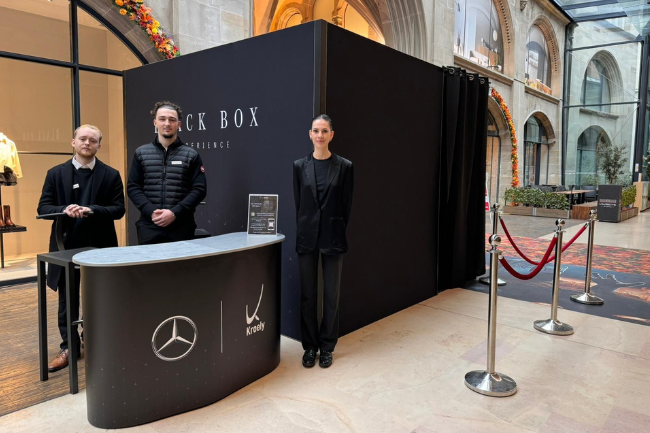
For Mercedes-Benz, a HoloBox combined with a swipe-based tablet quiz recommended each visitor's ideal model. The dealership reported 70% more engagement than a standard vehicle presentation and an average interaction time of 10 minutes. See the Mercedes-Benz Black Box Experience.
Content makes half the result. Our 3D Studio produces animations built for a black background and circular viewing, which avoids the mistake we see most often.
The four mistakes we see most
Buying hardware before writing the message. The format follows the viewing distance and the location, not the other way round.
Too much text. One logo, one product, one promise. Beyond that, the eye drops off.
Ignoring safety. A fan spins fast: it must sit under a dome or out of public reach, especially in stores.
Measuring nothing. A footfall counter, a dedicated promo code or a QR code is enough to turn an impression into data.
Our position
Holographic advertising is not a mass medium and will not replace billboards or screens. It is a pattern-breaking tool that pays when it owns one precise point of passage with a very short message. The market is growing fast: Fortune Business Insights, in a study updated on October 12, 2026, sizes the global holographic display market at 5.42 billion dollars in 2026. That growth will bring a wave of low-end offers. The difference will be made by content, operations and measurement, not by hardware.
If you are weighing formats, our complete guide to holograms covers the basics, and our client projects show every format in real conditions. Let's talk about your project: a detailed quote within 48 hours.
Holographic advertising FAQ
Is holographic advertising a real hologram?
No, in almost every case. It is an optical effect produced by an LED fan, a lit display case or a film projection. The result is an image that seems to float, which is enough for the advertising goal: stopping the eye.
What size works best for a shop window?
A 65 cm fan suits most store windows and reads well up to about ten meters. Beyond 15 meters of viewing distance, or for a facade, move to a wall of several synchronized fans.
Can a holographic display stay on all night?
Usually not. In France it must be off by 1 am at the latest, and many cities in Europe set their own hours. Check local signage rules and schedule automatic switch-off.
How long does it take to launch a holographic campaign?
Two to four weeks with existing 3D content. Allow about eight weeks when the animation is created from scratch, including storyboard approval, production and tests on the actual hardware.
Should I rent or buy?
Rent for one event or a test. Buy as soon as the display runs permanently in a window or showroom, or beyond three to four events a year, since the 3D content is reusable.
Does a holographic fan work outdoors?
Rarely well. Daylight crushes the contrast of most displays. Behind glass, in shade or indoors, the result is far better.
Can the content be changed remotely?
Yes, on connected models. That is what lets a retail network switch campaigns on the same day in every window, without sending a technician.
Pierre Chabot is co-founder of Holovisio, the company behind hologramme.co. Since 2019 he has worked with brands such as Mercedes-Benz, Stryker and ASUS on holographic displays in more than 20 countries. LinkedIn profile · About Holovisio
Boost your ROI with holograms
Your goals, our solution, your results.