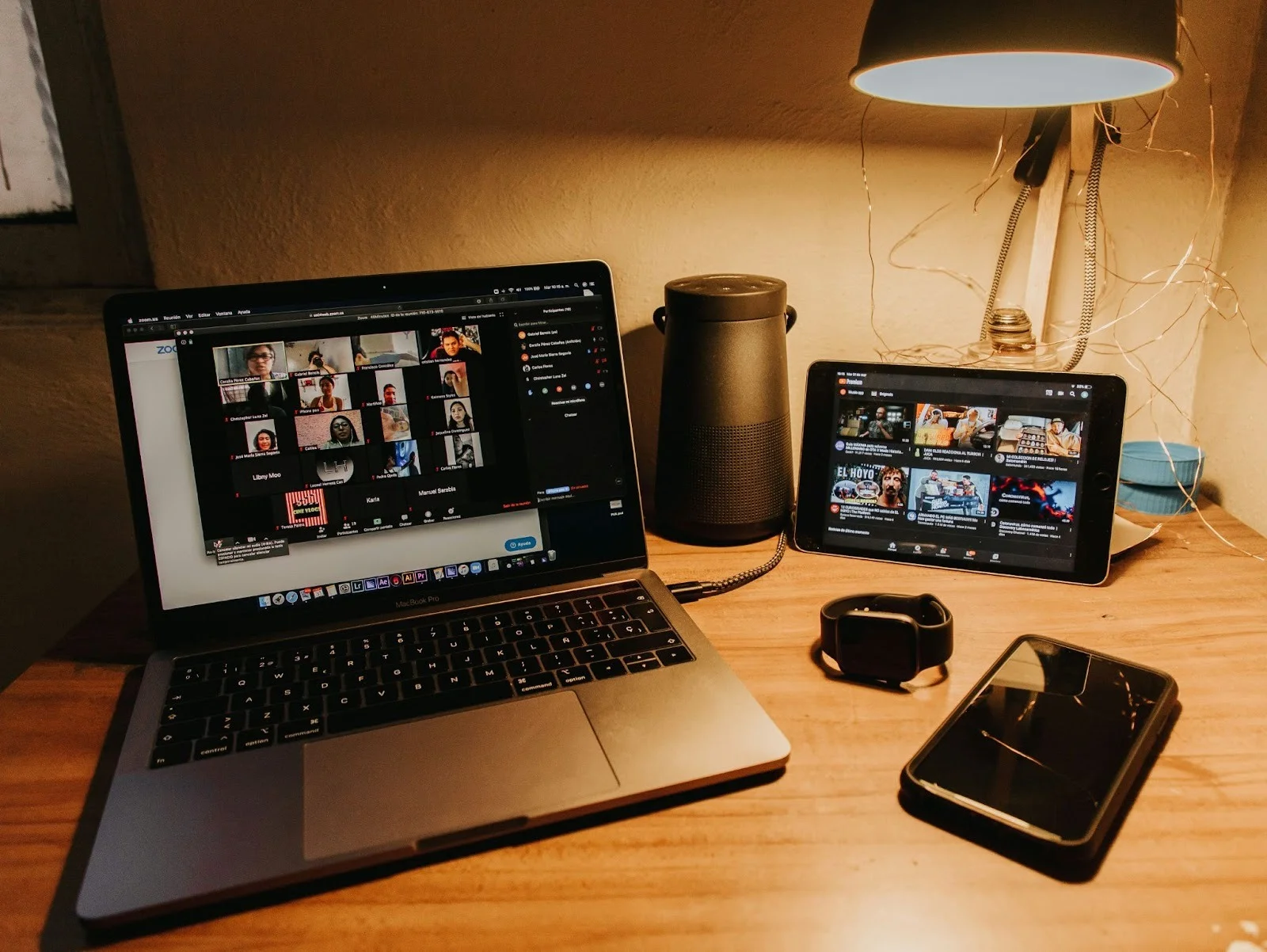
Since 2020, videoconferencing has become the norm for collaborative work.
Zoom, Teams, Google Meet... these tools have changed our habits and changed traditional communication methods. We are no longer attached to a place or to fixed hours: work has become connected, flexible and dematerialized. But while videoconferencing is reaching its limits, a new era of professional communication is already beginning: that of holographic telepresence. Between digital efficiency and physical realism, this technology promises to transform our interactions at a distance. We explain to you.
Video conferencing: a revolution that has become routine
In a few years, videoconferencing has gone from being an exceptional solution to an indispensable tool during our professional exchanges. With the rise of remote working, video has made it possible to maintain the link between teams, customers and partners around the world.
The undeniable benefits of videoconferencing
This method of communication allows:
- saving time and productivity: no need to travel;
- a reduction in costs: fewer transport and accommodation costs;
- increased flexibility: teleworking is becoming a permanent reality.
The limits of video
But as video conferences accumulate, their structural weaknesses are emerging:
- digital fatigue linked to overexposure to screens;
- a lack of spontaneity in exchanges (microphones cut off, annoying silences, loss of fluidity);
- a difficulty in maintaining the public's attention over time
One study conducted by Nanyang Technological University (Singapore) interviewed 1,145 employees who frequently use videoconferencing tools: 46.2% of respondents indicated feeling tired, being “exhausted, overwhelmed or emptied” as a result of using these platforms
Even if it remains essential, videoconferencing does not succeed in recreating the emotions that could be perceived during a real interaction.
→ Discover how the interactive hologram works.
Holographic telepresence: when technology makes communication more alive
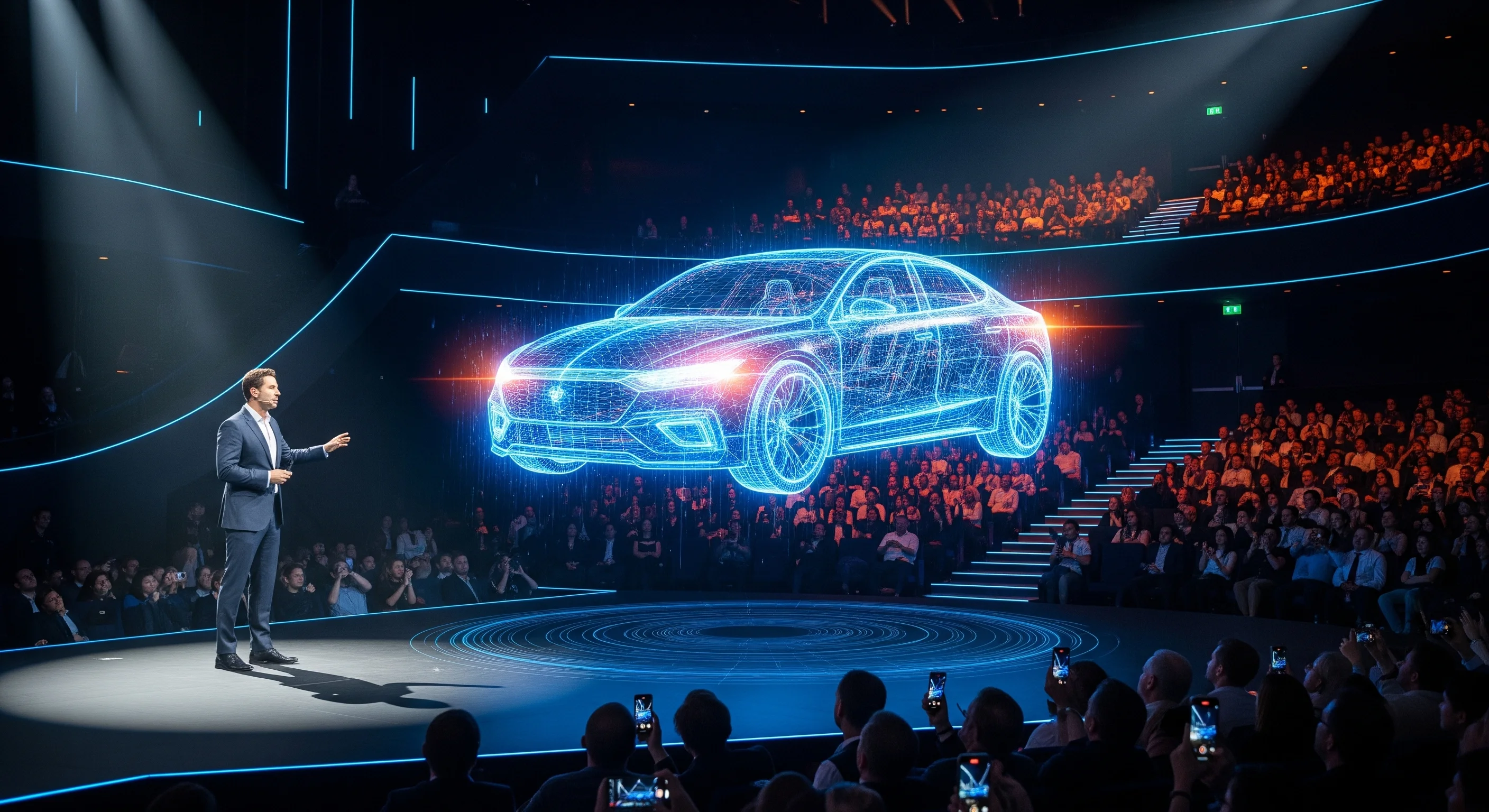
Holographic telepresence allows a person to appear in real size, in 3D and in real time, thanks to a volumetric projection.
This technological feat combines:
- a live 3D capture (multiple cameras or volumetric sensors);
- very high speed transmission (fiber, 5G, even future quantum networks);
- a holographic projection on the reception site.
The experience is impressive: the interlocutors exchange as if they were sharing the same room.
A New York-based executive or even Jean-Luc Mélenchon can appear in a hologram in Paris for a conference, interact with the public and respond live without having taken a plane.
Holograms: strategic benefits for businesses
More human communication
Holograms reproduce the gestures, postures and expressions of the human body.
This sensory dimension reinforces the emotional impact of exchanges, which is crucial in:
- commercial negotiations;
- managerial training;
- or public interventions.
According to an Accenture survey (2024), 67% of professionals consider non-verbal communication to be decisive in mutual understanding. An aspect that videoconferencing is struggling to reproduce.
An innovative and differentiating image
Adopting holographic telepresence means asserting yourself as a pioneer company.
The uses are multiple:
- product launches spectacular;
- international conferences without travel;
- premium customer presentations with a guaranteed “wow” effect.
This approach fosters the image of a tech-savvy, forward-thinking and sustainable brand.
An ecological and economic lever
Reducing business travel means reducing CO₂ emissions. According to ADEME, a Paris—New York flight represents on average 1.7 tons of CO₂ per passenger. By substituting these trips with holographic interventions, a large company can save up to 40% of its annual carbon footprint related to travel.
On the financial side, the savings in tickets, accommodation and logistics are considerable: telepresence is becoming a profitable investment in the medium term.
→ Holograms for events: a must in 2025.
And AI in all this?
Holographic telepresence makes distance invisible. Artificial intelligence (AI), on the other hand, makes communication smoother and smarter. By combining AI and holography, the meetings of the future will be interactive, adaptive and multilingual.
More intuitive interactions
With voice recognition, emotional analysis, and instant translation, AI can:
- generate multilingual subtitles in real time;
- adapt the intonations and the holographic posture;
- synchronize expressions for a natural look.
Imagine an international meeting where everyone speaks their language, while their hologram translates and adapts the gestures and tone of speech in real time.
Data-driven meetings
The AI will be able to analyze:
- the level of attentiveness of the participants;
- the key moments of an exchange;
- or generate automatic reports.
She can even adjust the lighting, the sound or the holographic staging directly according to the dynamics of the group.
Unprecedented personalization
Tomorrow, everyone could have their own smart holographic avatar : a faithful replica capable of providing repetitive presentations or training sessions in its place.
An autonomous “digital double”, powered by AI, freeing up time while maintaining an authentic presence.
To summarize, AI does not replace humans, it reinforces their presence and amplifies their impact at a distance.
Videoconferencing vs holographic telepresence: the comparison
Towards total hybridization: the future of immersive work
Thanks to 5G, fiber optics and 3D compression algorithms, telepresence is becoming more and more accessible.
We can imagine, in 5 to 10 years:
- hybrid meeting rooms combining physical and holographic collaborators;
- trade shows hosted by remote speakers;
- or even virtual campuses where students and trainers interact in real-time 3D.
The future of communication will not be completely virtual or completely face-to-face: it will be hybrid, immersive and deeply human.
→ Holograms as an educational tool: a strong impact.
Clearly, videoconferencing is and will remain the daily tool, but holographic telepresence will be essential for communications with high added value. It provides a concrete response to the challenge of maintaining the link between people in a highly connected world. Enriched by AI, distance is then nothing more than a simple detail.
FAQ — Video conferencing vs holographic telepresence
Is holographic telepresence suitable for all businesses?
It is especially suitable for companies that organize conferences, product launches, training courses or strategic meetings where the visual and emotional impact is important. Small daily meetings remain more convenient in traditional video conferencing.
What equipment is required for a holographic meeting?
A typical installation includes 3D cameras or volumetric sensors, space for holographic projection, a very high speed connection (fiber or 5G), and real-time holographic rendering software.
Can video conferencing and holograms be combined in the same meeting?
Yes. We can imagine hybrid rooms where some participants are in person, others in videoconferencing and still others appear in a hologram, creating a fluid and immersive experience for all.
Does the hologram completely replace business trips?
No, it reduces travel for high value-added meetings but does not replace all physical interactions. It is a complement to limit costs and the carbon footprint while maintaining the efficiency of exchanges.
Can holograms incorporate AI features?
Yes. AI can improve telepresence by translating in real time, analyzing participants' attention, generating automatic reports, and adapting the gestures or intonation of the hologram for a more natural look.
What types of content can be broadcast via hologram?
Presentations, product demonstrations, interactive training, conferences, and even avatars for repetitive interventions or to illustrate complex concepts.
What is the environmental impact of holographic telepresence?
By substituting long-distance travel (planes, trains) with holographic interventions, businesses can significantly reduce their CO₂ emissions, while limiting logistics costs.
What are the main benefits for brand image?
Pioneering companies reinforce their image of innovation, modernity and technophilia, while offering a memorable experience to participants, customers or partners.
Is the hologram easy for participants to use?
Yes, users only need to interact as in a typical meeting: talk, ask questions, and react. Technical complexity remains in terms of projection and management of holographic flows.
What are the prospects for the future?
Holographic telepresence could become the standard for high-value communications, combined with AI and hybrid environments, creating interactions that are more immersive, intuitive, and remotely accessible.
Sources:
https://www.jll.com/en-us/insights/why-holograms-are-coming-to-the-corporate-meeting
https://www.sketchbubble.com/blog/5-reasons-why-hologram-presentations-are-the-new-conference-norm/