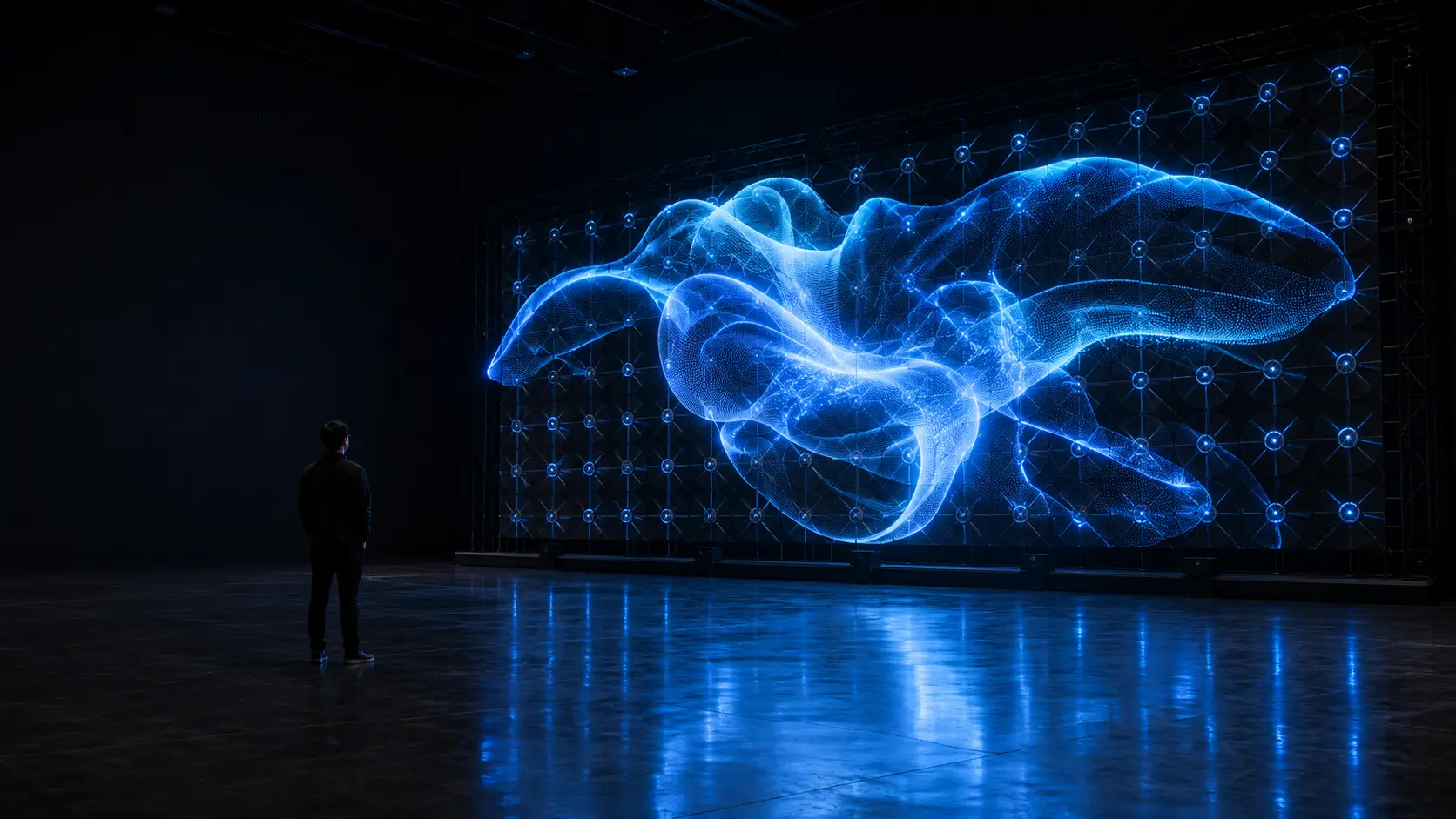
A holographic wall is a large-format display built from synchronized holographic propellers or projection surfaces, producing a single floating image at architecture scale. Businesses deploy it in showrooms, on large stands, at congresses and in flagship spaces, for budgets of 3,000 to 12,000 euros depending on span, units and content.
When Dastri needed to present its collection systems, the answer was not a bigger screen. It was aholographic wall: the systems rendered at scale, in motion, floating where aslide deck would have sat.
This guide covers what the format is, the six waysbusinesses use it, how it scales, and what it costs in 2026. It draws on thewall projects Holovisio, the company behind hologramme.co, hasdelivered, from an eco-organisation's showroom to a national pavilion inVenice.
The direction of travel is set, too: the holographicdisplay market is growing at 17.82 percent a year through 2031 according to Mordor Intelligence,and large-format signage is the segment pulling the hardest.
What isa holographic wall?
A holographic wall is a large-format holographic display:multiple holographic propellers mounted and synchronized so their individual images fuse into one continuous animation, or a projection surface producingthe same floating effect at scenography scale. There is no bezel and no visibleframe, only content suspended in space.
Two properties define the format. It scales by addition,one more unit extends the image rather than replacing the hardware, and itrenders light rather than pixels on glass, which is why it thrives against darkbackgrounds and dim environments and why bright, street-facing positions callfor the high-brightness and enclosed variants.
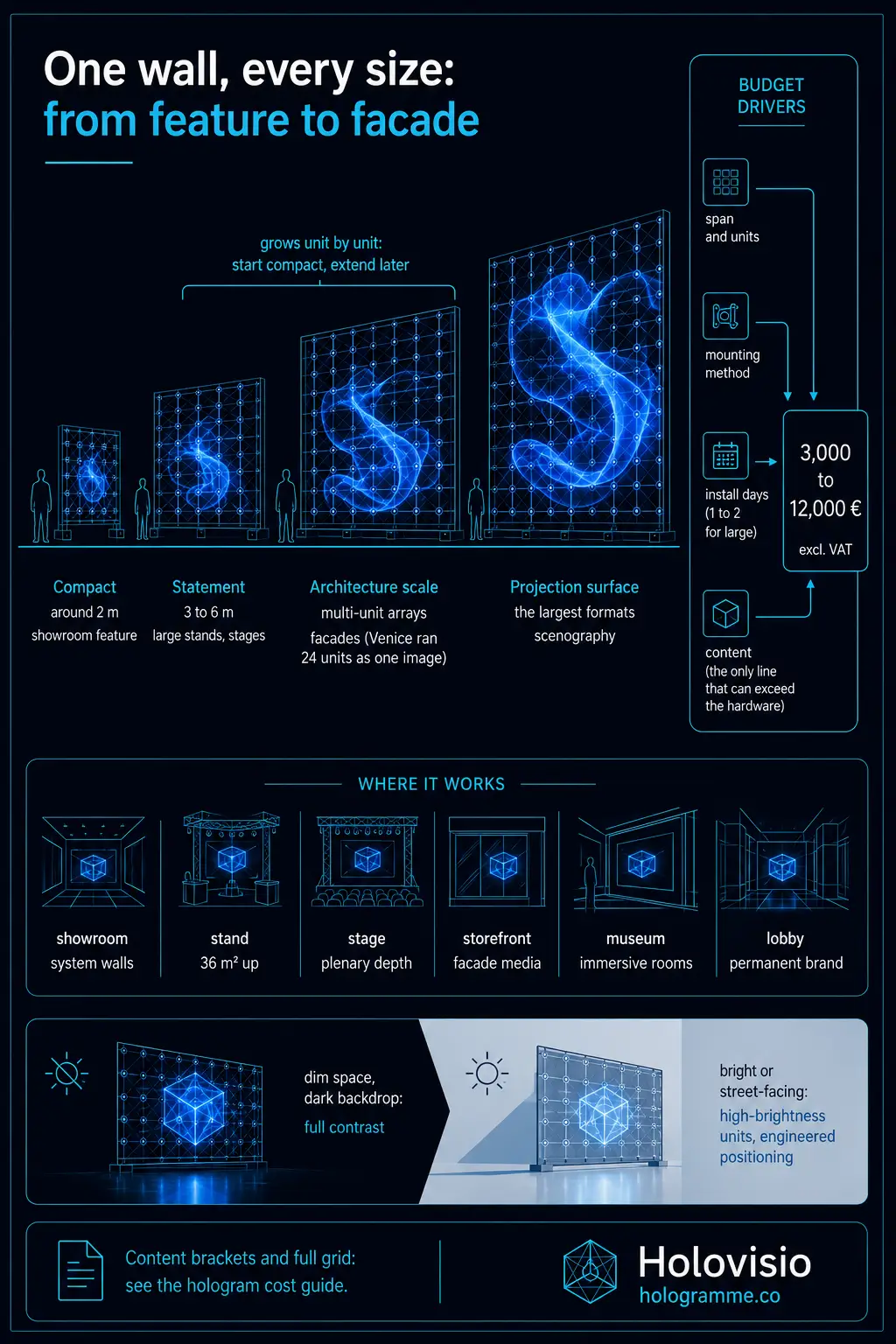
The proof that the fusion holds at scale is public: atthe 2025 Venice Architecture Biennale, the Moroccan Pavilion ran a facade of 24 holographic propellers as a single luminous imagefor the length of the exhibition.
Two comparisons place the format. Against a video wall,the difference is the medium itself: a video wall shows pixels on panels behindglass, with bezels and a frame the eye registers, while a holographic wallrenders light in open space, so the content appears to float free of anyhardware. Against a single holographic fan, the difference is simply reach: oneunit animates a product, an array animates a facade, and the step between thetwo is addition rather than replacement.
The sixbusiness use cases
• 1 · The showroom systemwall. When the product is a process, amachine or a network, the wall shows it working at scale. That is the Dastri configuration:collection systems presented in animated 3D, permanently, to every visitor whowalks in.
• 2 · The large trade showstand. From around 36 m2 of stand, awall becomes the immersive backdrop that defines the space and reads across thehall. It anchors the stand's identity while smaller devices work the aisle.
• 3 · Congress and stagescenography. Flanking a stage ordressing a plenary, wall-format devices add depth and premium presence withoutcompeting with the speakers, the configuration Lilly used for its scientificcongress in Brussels.
• 4 · Flagship retail andimmersive brand spaces. At street scale,the wall turns architecture into media: a storefront or interior feature wallanimated with brand and product content that a static facade cannot match. Thesame grammar carries fully staged brand experiences like the Mercedes-Benz Black Box Experience, where large-format holographic scenography holds theentire narrative.
• 5 · Museums and exhibitions. Immersive rooms andstatement walls carry narrative content at the scale institutions need, withthe Venice pavilion as the standing reference for months-long public operation.For curators, the wall is the room-defining format, planned into the routerather than added to it.
• 6 · Lobbies and headquarters. As permanent brandsurfaces, walls give receptions and campuses a living identity: content rotatesby season, campaign or visitor, while the hardware stays. It is theconfiguration where purchase logic arrives fastest, since the wall works everyworking day.
Sizesand configurations
The format's real advantage is modularity. The sametechnology covers a two-metre feature and a full facade, because capacity growsunit by unit, which also means a project can start compact and extend later:the first units are never wasted, they become the left edge of the bigger wall.
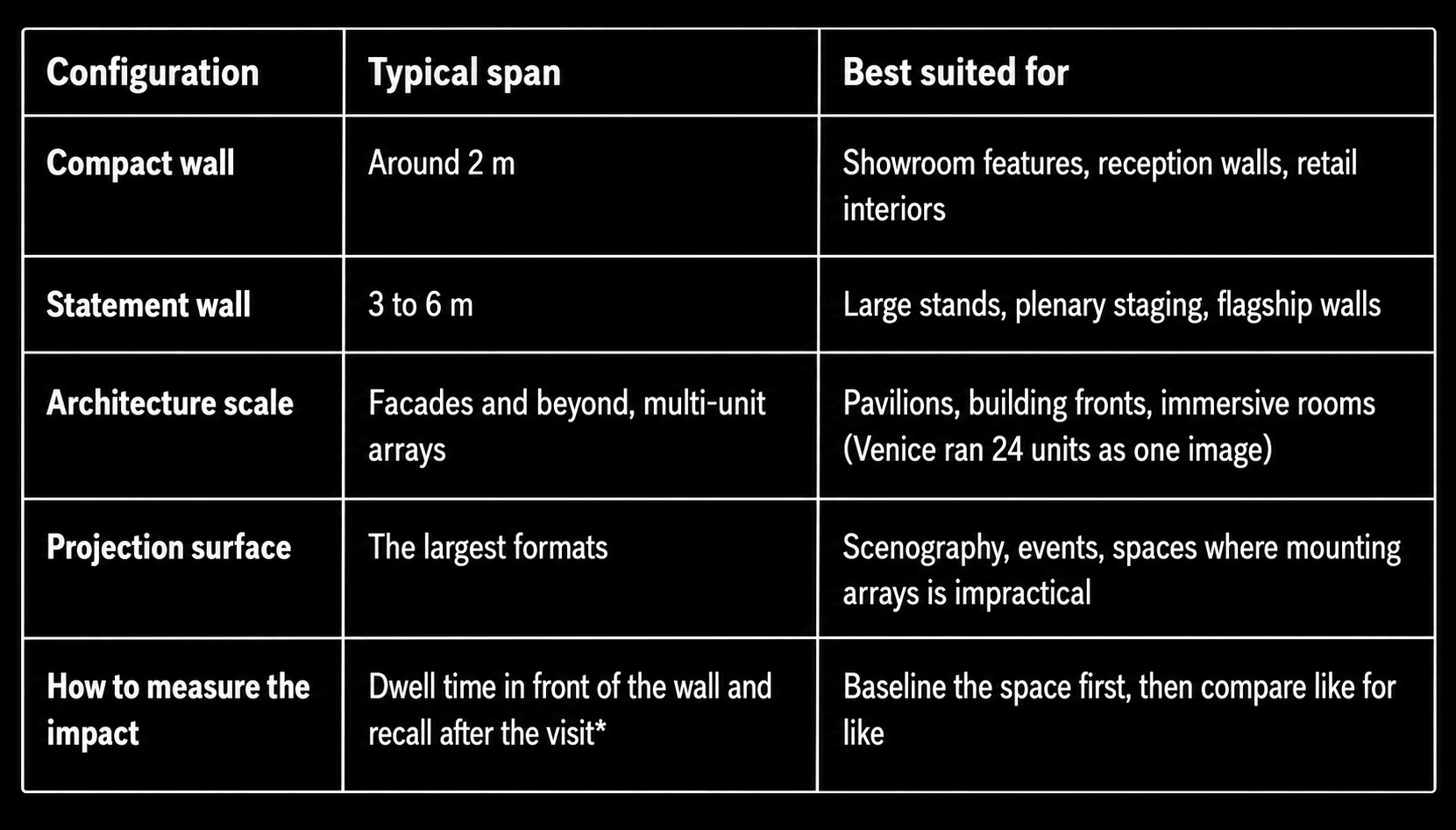
Wall and large-scale projection formats live on the holographic projection page by Holovisio, alongside the technical options for each span.
What aholographic wall costs in 2026
The bracket runs from 3,000 to 12,000 euros, and fourdrivers place a project inside it: the span and number of units, the mountingmethod (a freestanding truss and a facade rig are different days of work), thenumber of install days on site, and above all the content, which is the onlyline that can exceed the hardware.
Content follows the canonical grid: adapting existing 3Dassets costs little, a bespoke product animation typically runs 1,500 to 5,000euros, and a complex photorealistic scene 5,000 to 20,000 euros, with the filesremaining yours for every future use of the wall. The full grid, every deviceincluded, is in our hologram cost guide.
The rent-or-own logic mirrors the rest of the catalogue:rental for an event season, purchase for a permanent showroom or lobby wall,with the crossover around three to four uses a year. The rental guidede tails what turnkey includes at this scale.
Planningthe installation
One planning truth first: the wall is a low-lightathlete. It performs best in dim, controlled environments against darkbackdrops, and bright or street-facing positions are engineered rather thanimprovised, with high-brightness units, enclosed variants and positioning thatkeeps direct sun off the image. Naming the light conditions in the first briefis what keeps the quote accurate.
Three decisions shape install day. Mounting: arrays fixto a structure or stand freestanding on a truss, and the choice drives riggingpaperwork in venues. Power: standard supply for compact and statement spans,planned per unit as arrays grow. Background: the old scenography rule holds, adark, matte backdrop behind the wall maximizes contrast and makes the colorscarry.
Content production runs through the Studio by Holovisio, and the exhibitor timeline applies unchanged: brief at D-60 when animation is created from scratch, withinstallation landing at one to two days for large configurations.
For the wall's role among the other formats, the complete guide to holograms maps the family; the retail and museum guides showwhere the wall meets the HoloBox and the pyramid on real floor plans.
Holovisio, the company behind hologramme.co, designs,produces and operates holographic displays (fans, HoloBox, pyramids, walls,projections) for companies and institutions, from Mercedes-Benz to the VeniceBiennale pavilions. Rental or purchase, 3D content included. Requesta quote.
By the Holovisio team · hologramme.co
Boost your ROI with holograms
Your goals, our solution, your results.