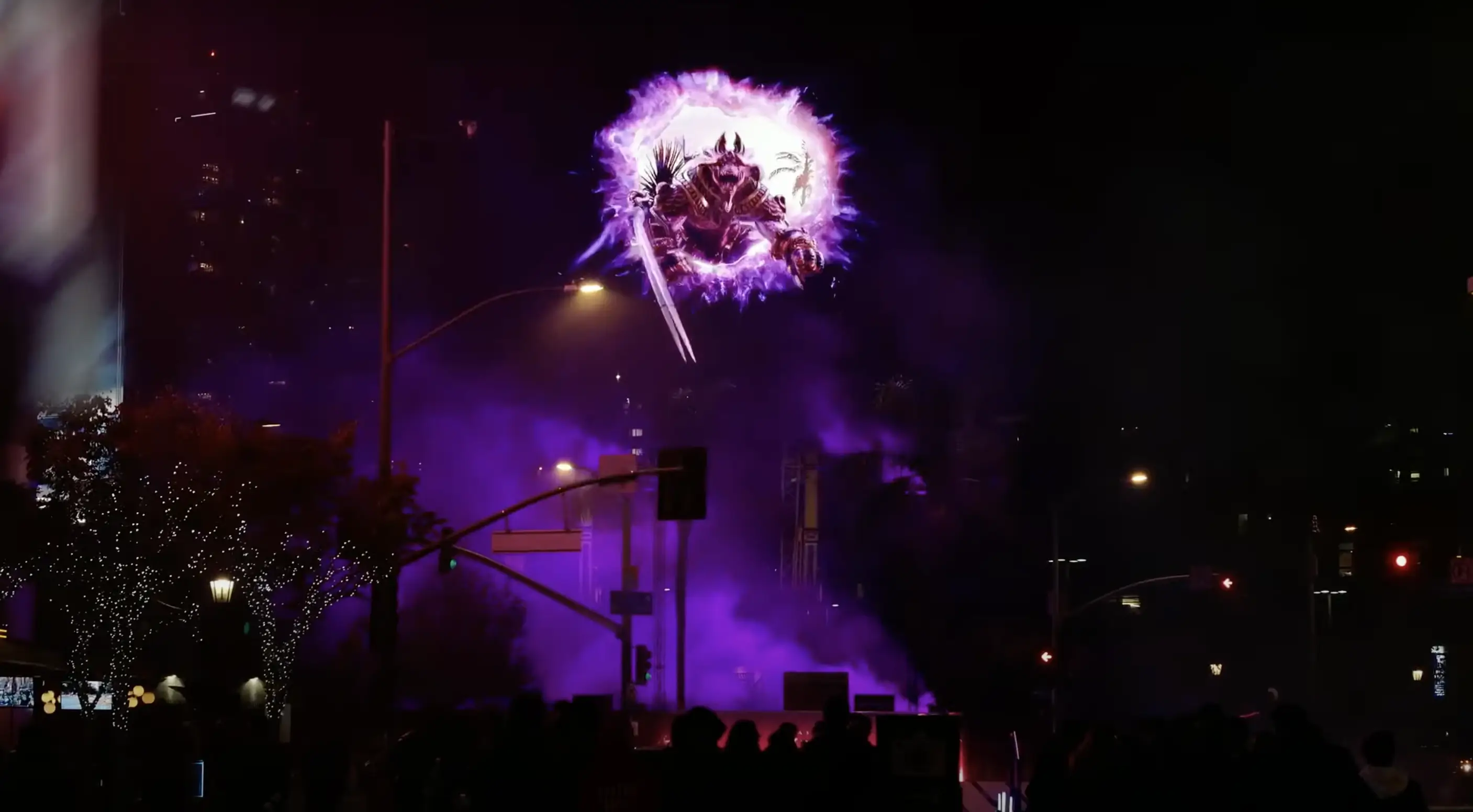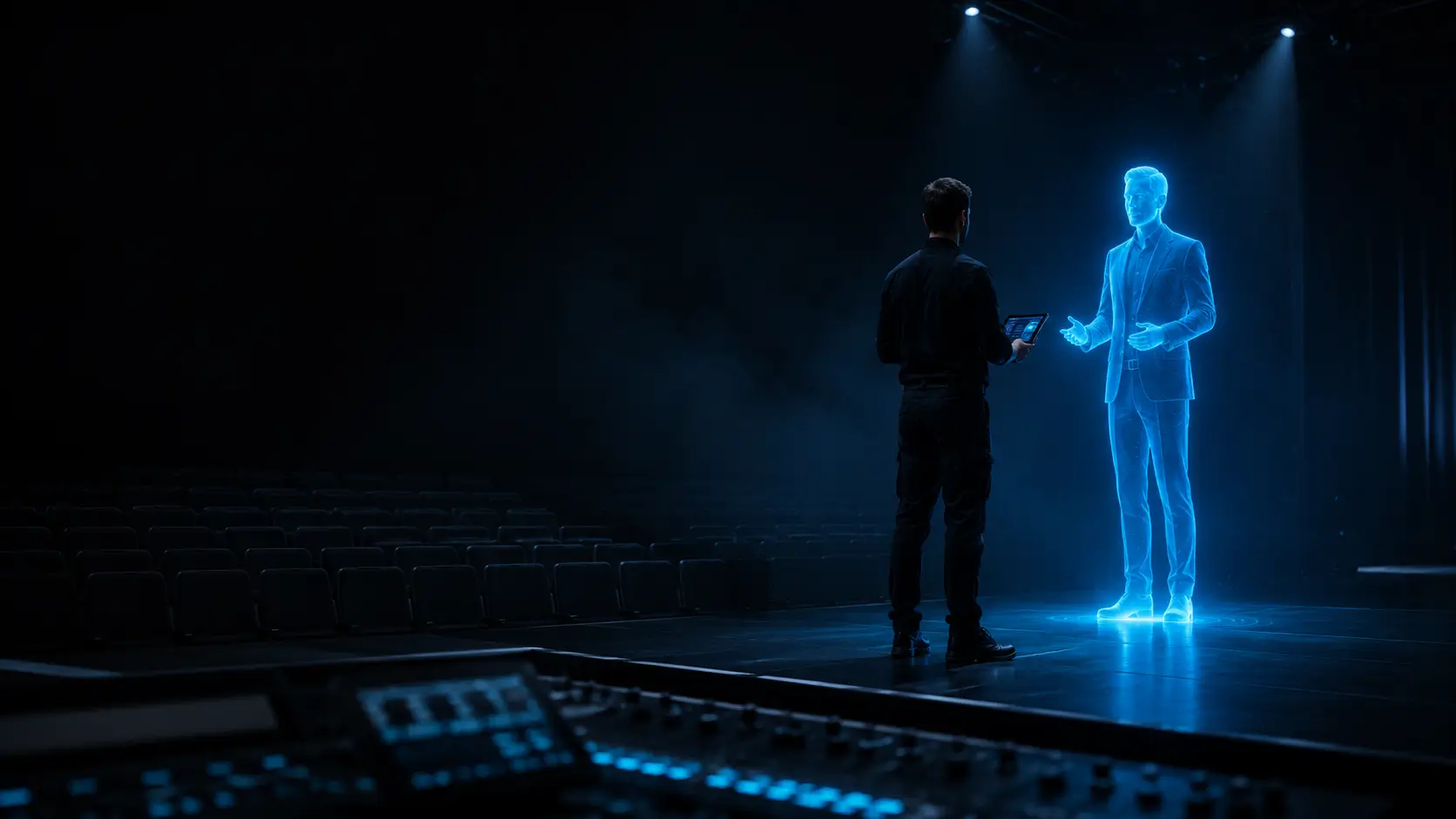
A life-size human hologram is a filmed, live-streamed or AI-generated person rendered at real scale on holographic hardware: a glazed HoloBox for lobbies and retail, staged configurations for events and concerts. Production follows three routes, pricing is on quote because staging drives everything, and quotes return within 48 hours.
When Holovisio produced the life-size hologram of M. Pokora, the point was never the technology. The point was presence: an artist standing in a room he was not in, at his own height, holding the attention a poster never could.
This is the evergreen guide behind that moment: what a life-size human hologram actually is, the three ways one gets made, the hardware that carries a person, and why the price is quoted rather than listed. Holovisio, the company behind hologramme.co, produces all three routes, and the human hologram page carries the formats and booking.
The demand proof now has a landmark. The London residency built around life-size digital performers has drawn more than three million visitors and contributed over two billion pounds to the UK economy since 2022, according to its official impact analysis reported by NME. That residency is not our project; it is the market's proof of appetite. Audiences do not just accept holographic human presence; they queue for it.
What counts as a life-size human hologram
Strip the science fiction and what remains is stronger: a person rendered at true scale, in real space, without glasses, using optical staging and high-brightness display rather than free-floating magic. The honesty matters, because the effect works precisely when the staging is engineered well: correct height, correct light, correct distance to the audience. The audience knows it is staged, the way theatre audiences know, and it subtracts nothing.
Three properties define the format. Scale: the figure stands at human height, which is what triggers the presence response a screen never does. Space: the person occupies the room, behind glass or on a stage, rather than a rectangle. And repetition: once produced, the presence runs identically every time, in every venue, from the same files.
Scale deserves one more sentence, because it is the counterintuitive rule of the format: larger than life reads as advertising, life-size reads as presence. Eye height is where the human attention system files another person, and holding the figure exactly there is why visitors instinctively address it, photograph it and wait their turn in front of it.
The three ways to make one
• 1 · The filmed route. The person is captured in studio against black, lit for the medium, directed for the loop, then finished in post and delivered as holographic content. It is the route behind most artist and founder holograms, and the craft is specific: framing, wardrobe and movement all behave differently when the output floats. Our guide on how to film a hologram covers the capture rules.
• 2 · The live-streamed route. The person appears in real time from anywhere: a keynote speaker beamed to a second stage, an expert present in a showroom on another continent, a founder greeting three openings in one evening. The production shifts from post to transmission: capture setup on one end, calibrated display on the other, and latency and framing become the craft, since the remote person must appear to inhabit the room's light rather than a video call's.
• 3 · The AI-generated route. A generated likeness with a voice, driven by conversational AI: the avatar greets, answers and hands off to humans. It is the route growing fastest, and the one with the most paperwork, since likeness, consent and usage rights are contracted before production. The AI hologram page carries this branch.
The hardware that carries a person
A human-scale figure needs a human-scale carrier, and the venue decides which. The glazed HoloBox in its life-size format is the default for lobbies, retail and exhibitions: daylight-readable, protected, plug and play. Staged configurations built on holographic projection carry the concert and keynote scale, where the figure shares a stage with light, sound and a live audience.
The production process, step by step
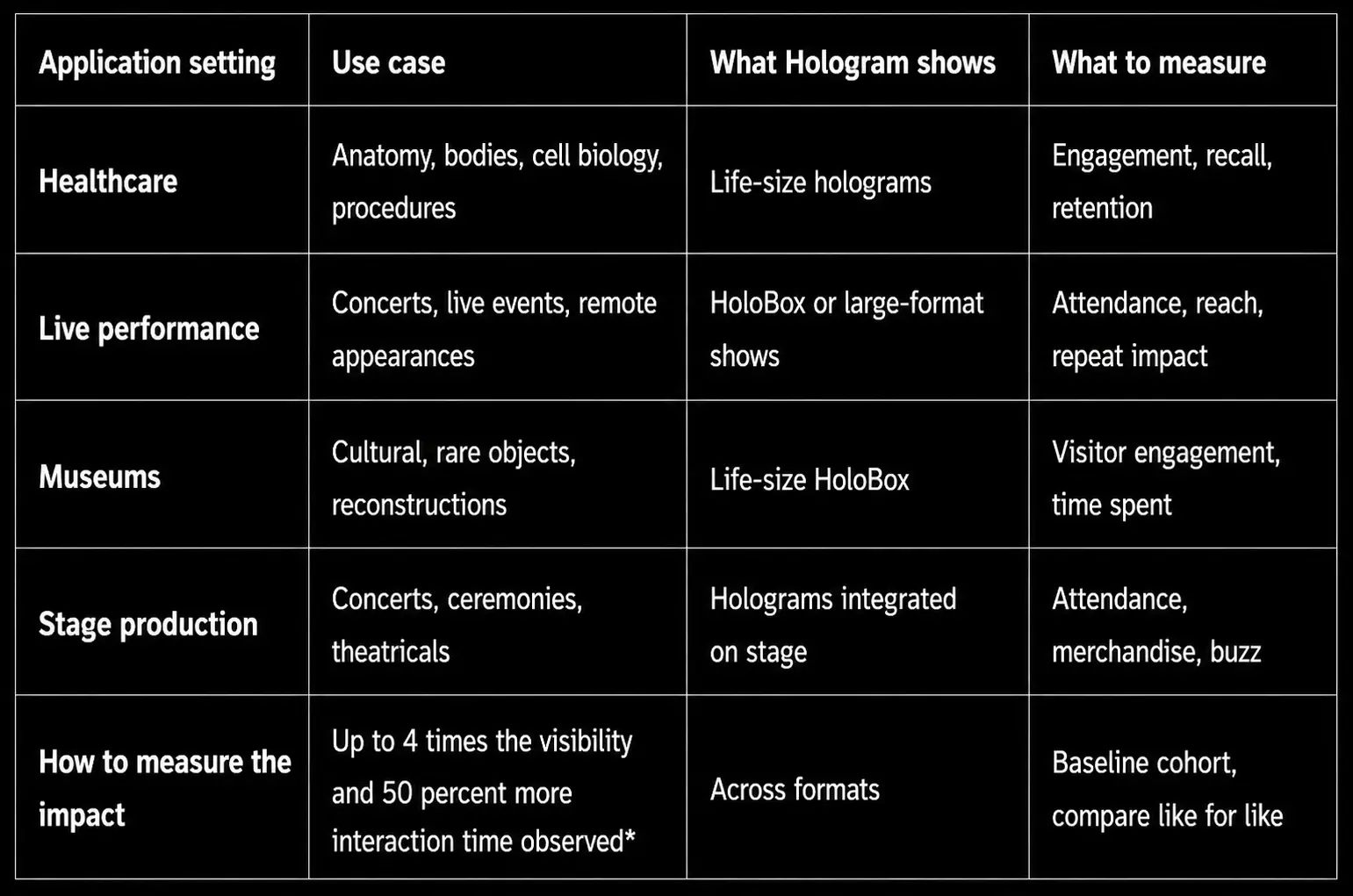
Five steps take a name on a brief to a presence in a room, and the order is what protects the result: the staging plan exists before the capture, never after.
• Brief and script. What the figure does, says and never says: thirty seconds of presence is written like sixty seconds of film.
• Capture or generation. Studio filming, live-feed setup or avatar production, run through the Studio by Holovisio, with likeness and rights settled before the first frame.
• Staging plan. Venue, sightlines, audience distance, light control: the plan that makes the height read true and the illusion hold.
• Rehearsal. The figure, the operator and the humans around it walk the sequence before an audience does.
• The run. Loop, live session or interactive service, with support through the operation and the files retained for every future use.
The format is not reserved for stars. Holovisio delivered a human hologram for Le Mans Metropole, a public institution, which says something useful about maturity: when a technology serves both an arena and a city administration, it has stopped being a stunt.
What a life-size human hologram costs
The honest answer is on quote, and the reason is structural: no two human-hologram projects share a bill of materials. Five drivers set the number, and naming them is more useful than pretending a pricelist exists; it is also why comparing quotes line by line beats comparing totals.
• The production route. A filmed loop, a live transmission and an AI avatar are three different productions with three different crews.
• Likeness and rights. A public figure's image, a founder's voice, an invented persona: each carries its own contractual weight and duration.
• Staging scale. A glazed case in a lobby and a staged figure before two thousand people are different engineering problems.
• Run length. One evening, one season or a permanent installation changes hardware, support and content economics; a permanent lobby figure shifts the quote from event logic to equipment logic, service contract included.
• Operation. An autonomous loop runs itself; a show-called live moment adds direction and technicians.
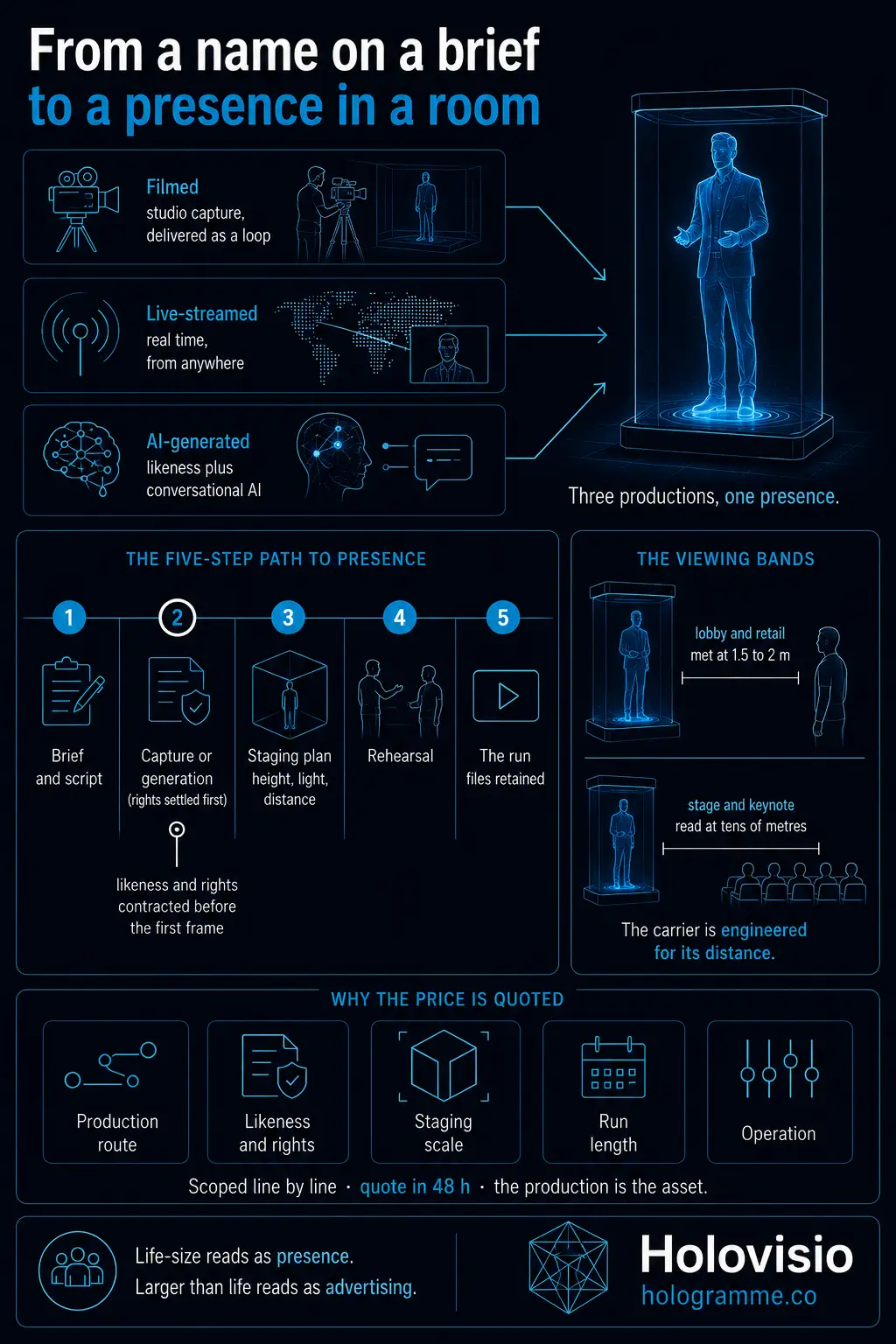
Every project is scoped against those five lines and quoted within 48 hours. One economic constant survives every route: the production is the asset, and it replays at marginal cost for as long as the rights run. For where human holograms sit inside the wider budget landscape, our hologram cost guide maps the full grid, and rental covers event formats turnkey when the presence is needed for a moment rather than forever.
For the news story that started many of these conversations, read the M. Pokora hologram post: it covered the moment, this page covers the method. And for the full family of devices around the human figure, the complete guide to holograms maps them all.
Holovisio, the company behind hologramme.co, designs, produces and operates holographic displays (fans, HoloBox, pyramids, walls, projections) for companies, from Mercedes-Benz to Stryker. Rental or purchase, 3D content included. Request a quote.
By the Holovisio team · hologramme.co
Boost your ROI with holograms
Your goals, our solution, your results.